Knowing what is happening on and under the seas – and being able to respond accordingly – is critical to national, economic and human security in the Asia-Pacific. However, the region’s unique geographic features can make that a daunting mission.
First, consider the staggering size of the Asia-Pacific. More than 8,000 kilometers (5,000 miles) separate Tokyo and Sydney, and Indonesia alone spans more than 4,800 kilometers (3,000 miles) from its eastern to western boundaries. Second, the volume of the Asia-Pacific maritime domain greatly exceeds that of its land domain. With thousands of miles of coastline and expansive ocean territories to survey and traverse, countries in the Asia-Pacific need their maritime surveillance systems to have four core features.
Sean Liedman, director of Mobility and Surveillance Business Development for Boeing, explained from the Singapore Airshow that those four keys are range, speed, persistence and multimission capabilities.
Range and Speed
In light of the vast distances in the Asia-Pacific, time is of the essence, particularly for patrol, reconnaissance and early warning aircraft.
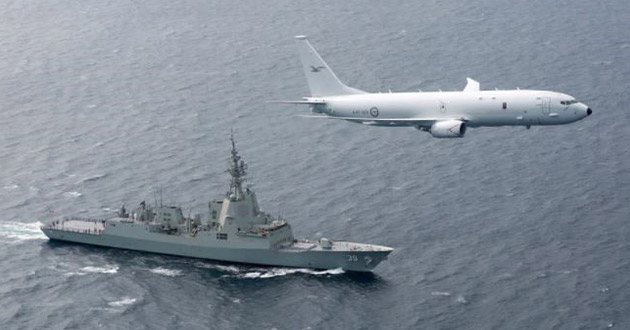
“The combination of long range and high speed leads to earlier and more distant detections of maritime and undersea contacts of interest,” said Liedman, a retired U.S. Navy captain who piloted the P-8A Poseidon and its predecessor, the P-3C Orion. “Ultimately that gives decision makers more time to select a course of action, whether addressing an approaching threat or responding to a humanitarian crisis.”
A platform such as the P-8, a maritime surveillance and anti-submarine warfare (ASW) aircraft, brings tremendous advantages in covering large geographic areas. With a mission radius of more than 2,225 kilometers (1,200 nautical miles) and speeds up to 490 knots (907 kph / 564 mph), the P-8 excels not only at surveying large areas but also responding quickly and with pinpoint accuracy. It provides a 30% faster transit speed than any other aircraft in its class, which leads to a reduced area of probability when searching for contacts of interest.
Those features make the difference when every moment matters. Just last year a Royal Australian Air Force (RAAF) P-8 came to the rescue of a fishing crew stranded on a capsized boat. The P-8’s ability to fly at low altitudes allowed the crew to drop life rafts, saving 20 sailors and allowing time for another vessel to retrieve them.
“The attributes of speed and range are imperative here in this region,” said Liedman, noting that aerial refueling can further extend the mission radius of the P-8 and other aircraft. “That’s why we see so many countries interested in investing in platforms that are capable of in-flight refueling, along with aerial refueling platforms that deliver that refueling in flight.”
Take, for instance, a P-8. The aircraft is designed to fly, with its maximum payload, 2,200 kilometers (1,200 nautical miles) from base; stay on station for four hours; and return home. A sortie like that could last more than 10 hours from start to finish. With aerial refueling, a P-8 sortie length can be extended up to 24 hours, widening the territory the P-8 can cover and reducing the number of aircraft needed for the mission.