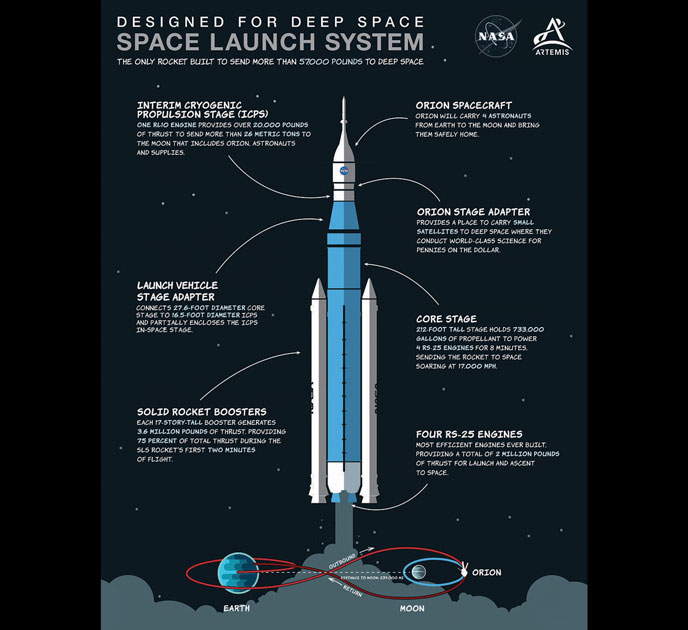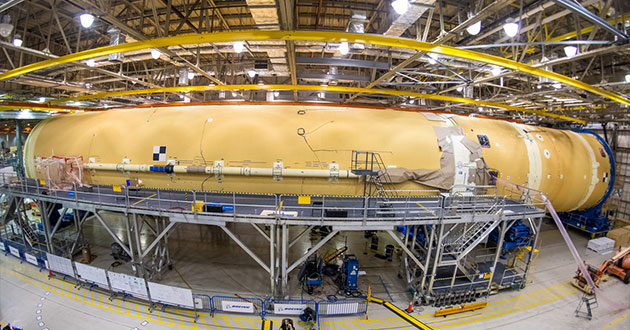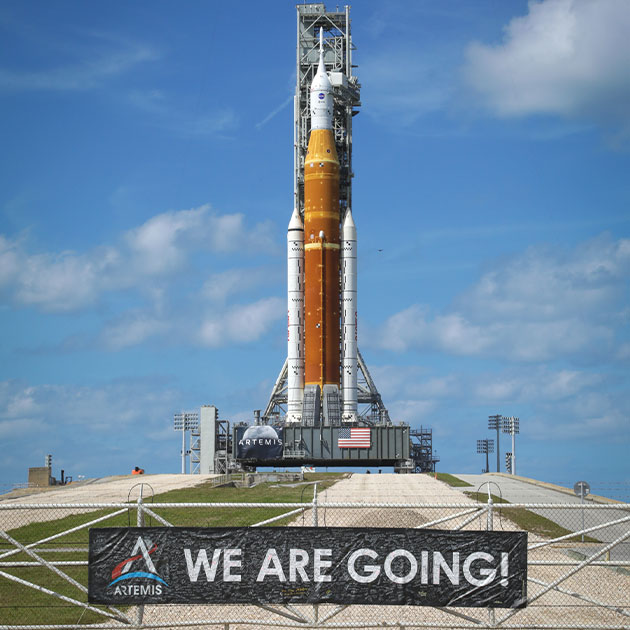
It will take about eight and a half minutes for the core stage of the Space Launch System (SLS) to catapult NASA’s Orion spacecraft to the Moon, but it has taken years of careful thought, new manufacturing techniques and innovative mission planning to get the rocket from the drawing board to the launch pad.
SLS is America’s first super-heavy-lift booster since the Saturn V rocket that lofted Apollo and its crews to the moon from 1968 to 1972. Following Skylab and 30 years of space shuttle operations, NASA pointed its development efforts at the Moon and Mars in the early 2010s. The focus became building the infrastructure needed to safely send astronauts beyond Earth’s orbit.
For this first flight test of the Artemis program, the Orion capsule will not carry astronauts. Instead, it will orbit the moon for several weeks to prove its own systems. NASA is scheduling the Artemis I launch for no earlier than August 29 from Kennedy Space Center. Future Artemis missions will carry astronauts to lunar orbit and then to landings on the surface of the Moon.
“We are going to the moon to learn how to live on other planets. When the first woman and the first person of color arrive on the moon, the Artemis generation will be even more inspired,” said Natasha Wiest, Boeing’s launch engineering manager for SLS.