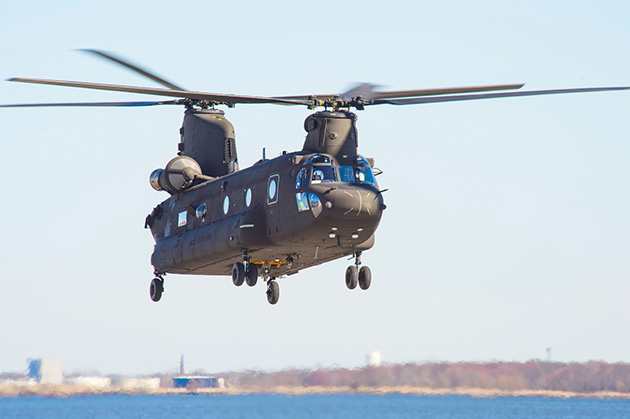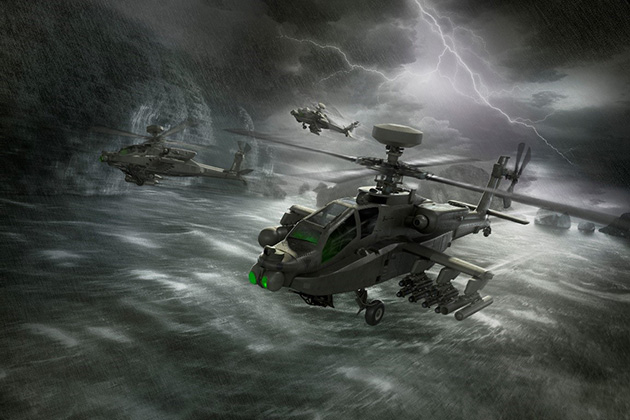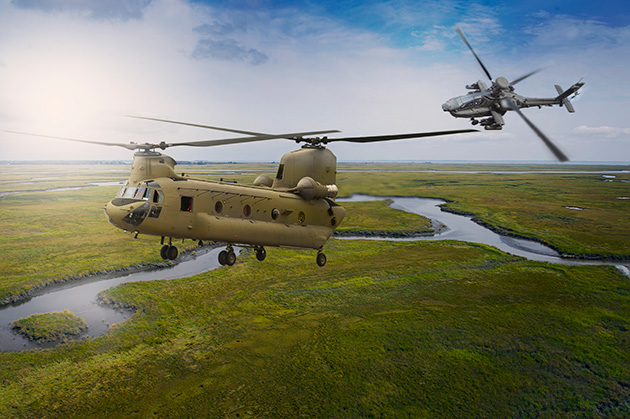
The Chinook and Apache have been mainstays in the U.S. Army Aviation fleet for decades. The most advanced and capable aircrafts in their respective fields, the Chinook serves as a heavy-lift icon and the Apache as the world’s preeminent attack helicopter.
Widely known as members of the Army’s enduring fleet, these products have undergone major technological transformational efforts to become the helicopters that they are today.
Boeing continues to innovate the fleet by adding state-of-the-art capabilities. The technology behind the platforms allows the U.S. Army and international allies to dominate the battlefield with these aircraft for decades to come.
Chinook
For over 60 years, the Chinook has been the most capable, affordable and interoperable heavy-lift aircraft in the world. The Chinook is battle-tested and, thanks to continuous modernization efforts, will continue to serve as the backbone of combat, logistics and humanitarian missions for the U.S. Army, Special Operations Forces and 19 international operators (including 8 NATO nations) for decades to come.
The CH-47F Chinook Block II is the latest iteration of the world-class heavy-lift aircraft. It provides increased lift and range, allowing soldiers to get what they need, when they need it. Backed by 800 flight test hours and 3,200 data points, the CH-47F Block II is proven to operate well beyond that of the Block I aircraft. Its improved drivetrain, stronger airframe and redesigned fuel tanks produce an eight percent increase in lift capabilities and increase the mission radius across nearly all payloads. A Block II Chinook carrying a full allotment of 32 soldiers has an 8 percent greater mission radius relative to the CH-47F.