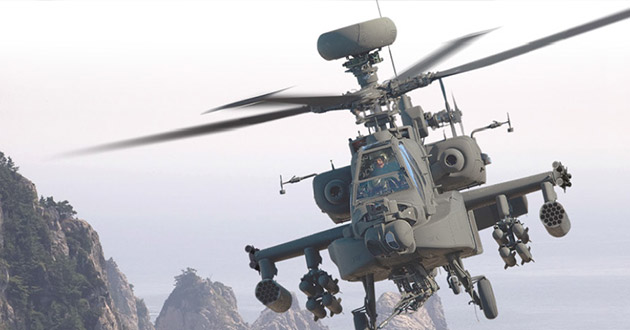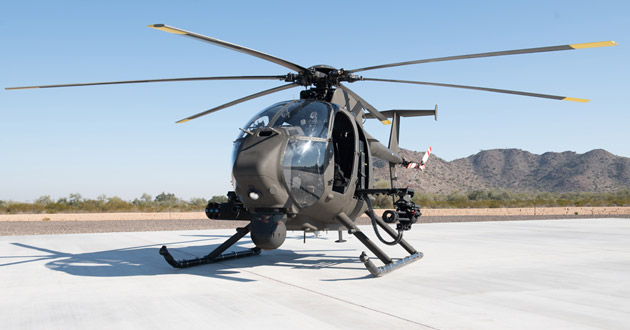
The Asia-Pacific region is a collection of diverse nations with unique terrain that present challenges for humanitarian assistance and disaster relief missions. Vast distances over land and water in an area with a growing population mean defense assets must be agile, responsive and versatile. For a region with wide-ranging needs, Boeing’s Vertical Lift capabilities, such as the AH-6 Little Bird, AH-64 Apache and H-47 Chinook, provide versatile tools for any scenario.
“The Asia-Pacific footprint includes more water than land, plus tens of thousands of islands, the vast majority of which do not have airfields with long runways,” said Randy Rotte, a former U.S. Army colonel and Boeing’s senior director for International Business Development for the Asia-Pacific region. “The ability to reliably reach remote areas quickly and engage in versatile defense and humanitarian missions are the hallmark of the Apache and Chinook.”
H-47 Chinook: The World’s Most Advanced Heavy-Lift Helicopter
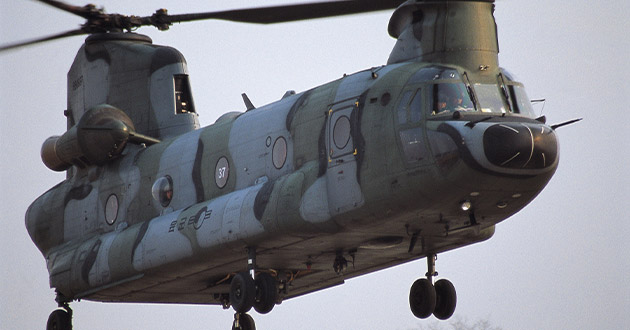
With more than 60 years of combat and humanitarian experience, the Chinook is the most battle-tested, reliable and advanced heavy-lift helicopter in the world. As part of Boeing’s longest-running production program, 950 Chinooks are flying for 20 nations around the world, including more than 100 in the Asia-Pacific region. In fact, Japan and Korea operate two of the largest global fleets of H-47 Chinook helicopters in the world.
The Chinook is a proven multimission platform, performing all missions that include troop transport, search-and-rescue humanitarian and disaster relief, and special operations. India operates 15 H-47 Chinooks for their heavy lift requirements and has enlisted them to help in the fight against COVID-19—just one example of the Chinook’s capabilities. With more than 6 million flight-hours, the Chinook brings unmatched survivability and the ability to perform the world’s most demanding missions.
With so many Chinooks flying around the world, the program has a distinct advantage over any competitor aircraft because of its large installed base supporting mission interoperability and the worldwide supply chain network. And this advantage will be built in for decades to come, as the U.S. Army intends to fly its 500 Chinooks through 2060 and beyond.
Mark Ballew is a former Chinook pilot and the current senior director of International Business Development, International Government and Defense at Boeing. He sees an aircraft that was advanced when it first started flying in the 1960s and has only gotten stronger.
“The Chinook has been the preeminent heavy-lift helicopter in the world for decades. And while its exterior may look the same as the legacy aircraft, today’s Chinook is significantly more powerful, versatile and agile than any other aircraft in its class,” said Ballew. “The enduring legacy of the Chinook is a true testament to the brilliance of the engineering and manufacturing teams that have kept it at the forefront of technology and performance for so long. There is an undeniable reason why 20 countries around the world operate the Chinook.”
That evolution is apparent in its versatility and customization. The Chinook can be customized to fit the user’s unique requirements, with capabilities such as air-to-air refueling, which has been in use on the Chinook for decades. Boeing has incorporated the latest technologies to deliver the world’s most modern digital avionics, flight controls and mission-centric capabilities. The CH-47F Block II, the next generation of Chinook aircraft, incorporates upgrades to increase lift and reach, improve commonality between U.S. Army and allied fleets, and reduce maintenance costs. The first CH-47F reached final assembly in March of 2023, and will be delivered to the U.S. Army in early 2024.
Even with its advanced capabilities and versatility, the Chinook is still the world’s most affordable heavy-lift helicopter. According to the U.S. Department of Defense, the Chinook has the lowest flight costs per hour in its class and significantly lower procurement and maintenance costs than any other aircraft that could carry similar loads, making it a very affordable life-cycle solution.