
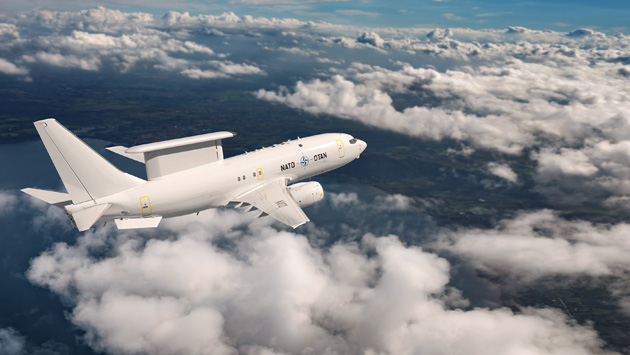
For years, global operators Australia, South Korea and Türkiye have been demonstrating the unparalleled “first to detect, first to engage” surveillance and command-and-control capabilities of the E-7A. Now in production for the United Kingdom and the United States, and recently selected by NATO, the E-7A strengthens national security and enhances sovereignty to allied nations around the world, providing operationally focused capabilities, allied and coalition interoperability, and life cycle mission benefits.
As the global community faces the urgent and growing need for Battle Management Command and Control (BMC2) capability, Boeing’s active E-7A production delivers mission-ready next-generation capabilities, mission systems interoperability, increased readiness, life cycle cost savings and shared evolutionary growth.
Next-generation capability
A critical node for air superiority, the E-7A offers air forces unparalleled advanced airborne moving target indication, battle management, and command and control capabilities for long-range “first to detect, first to engage” advantages against potential adversaries.
The E-7A’s multirole electronically scanned array (MESA) sensor provides situational awareness and long-range surveillance for global operators. Developed using secure, Open Mission Systems architectures, the E-7A equipped with MESA serves a crucial role within the Combined Joint All-Domain Command and Control (CJADC2) structure to support and enhance the allied and coalition missions.
The E-7A’s command-and-control abilities also make it perfectly suited for integrating future Collaborative Combat Aircraft and other manned-unmanned teaming in fleet operations.
Interoperability
A built-for-purpose weapons system, the E-7A’s standardized mission system configuration enables global operators with a fleet of interoperable E-7A aircraft for integrated allied and coalition operations, aiding mission planning and increasing mission execution effectiveness. This game-changing aircraft can work with and talk to joint assets across multiple domains — thereby increasing the situational awareness of the battlespace to coalition participants such as fourth- and fifth-generation fighters, naval assets, and ground agencies in the most challenging of operational environments.
The trilateral agreement between the U.S., UK and Australia exemplifies the opportunity to share in the gains from collaborative development with minimized design differences while meeting operator-specific requirements. The E-7A contributes to the integrated overall surveillance and control system of systems capability that is crucial for the security of NATO, allies and partners.
Mission readiness
Based on the Next-Generation 737-700 airframe, platform commonality has always been a hallmark of the E-7A. With more than 9,000 737s in service, and more than 280 service centers and repair facilities worldwide, 24/7/365 support ensures greater mission generation. And the size and power of the 737-based platform makes the combat-proven E-7A ready for complex, all-weather operations requiring long mission duration.
Fleet life cycle cost savings
Allied collaboration on the sustainment of the aircraft drives synergies and life cycle cost savings in training, maintenance, spares and other facets of operation. As the global community of E-7A operators continues to grow, these cost savings will continue to grow as well.
Likewise, leveraging the commercial-grade platform makes the E-7A the lowest-cost option to own and operate for air forces around the globe. The E-7A is less expensive to operate compared with platforms based on small business jets, which require extensive alterations and face more costly, disruptive maintenance regimes.
Evolutionary growth
With the E-7A, Boeing successfully married a compliant Open Systems Architecture BMC2 system to an advanced, active electronically scanned array. Adaptable by design, the E-7A’s open systems architecture and agile software development foundation enables rapid, flexible and affordable upgrades to field new capabilities. The E-7A’s size, weight and power/cooling (SWaP-C) margin advantage also facilitates more opportunities for capability growth to remain relevant as threats evolve.