Small team, big job innovating future moon rockets
Behind the scenes on how Boeing team is using 3D modeling to visualize the launch process for Artemis missions.
The spirit of NASA's Artemis program is an undeniable one – relentless human curiosity and ambition. One of the groups working behind the scenes to bring this spirit to life is the Exploration Upper Stage (EUS) Launch team at NASA’s Kennedy Space Center (KSC) in Florida.
Orchestrating success: The EUS Launch team is responsible for the operational, maintenance and logistical support for the arrival, integration, and launch of the evolved upper stage for future configurations of NASA’s Space Launch System (SLS) rocket at KSC. Together, they orchestrate the seamless integration of the EUS to ensure a successful launch.

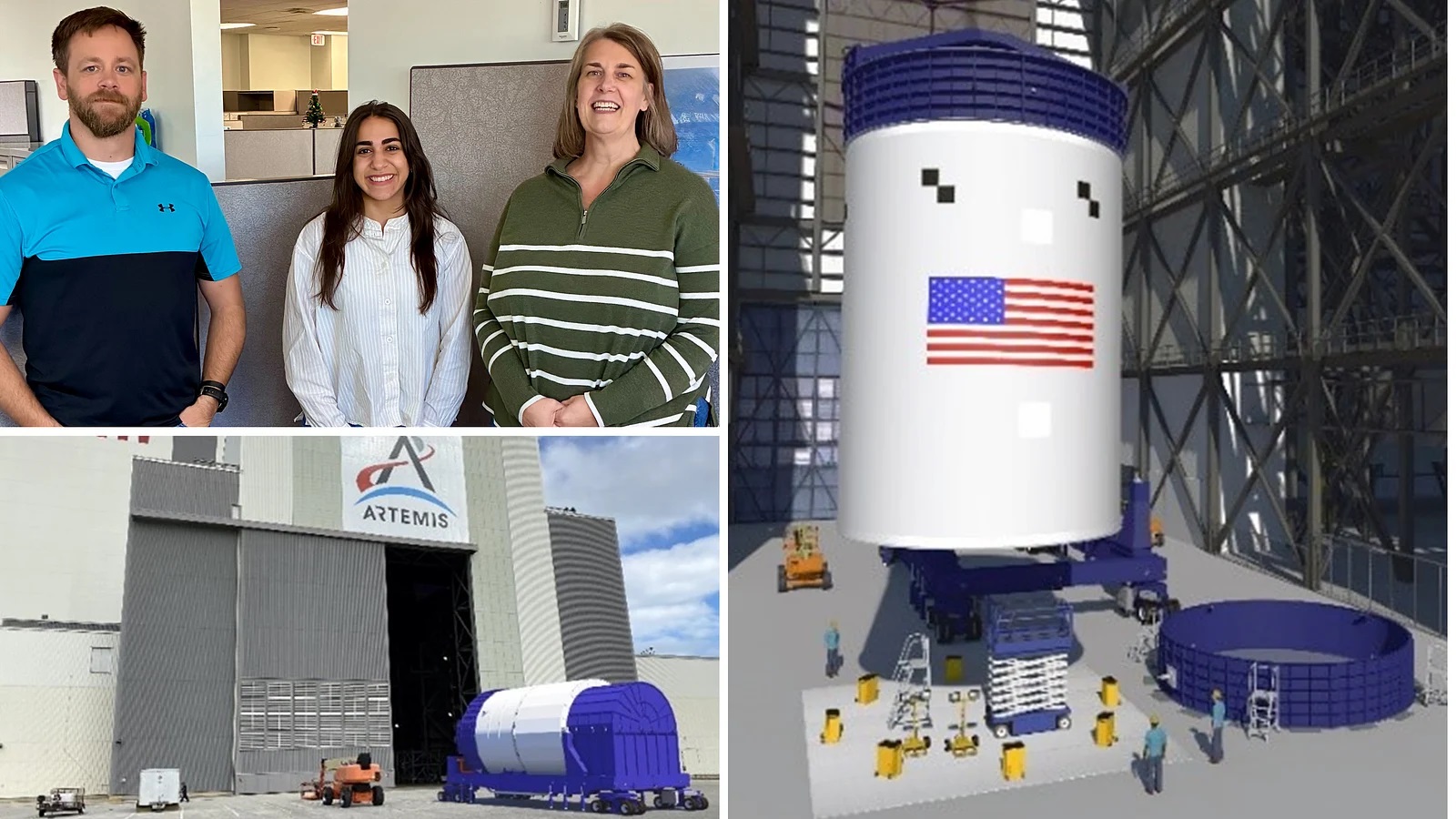
Teammates Matthew Sandford, Darina Khater and Bev Schieferdecker are part of Boeing's Exploration Upper Stage (EUS) team at Kennedy Space Center in Florida. (© Boeing)
“Our expertise is in engineering integration support – ensuring the operations are sound for the buildup of EUS from a transportation to flight configuration as well as the follow-on vehicle testing,” says Matthew Sandford.
In essence, the team lays the groundwork for EUS integration to run smoothly – confirming processes meet contractual requirements and accurately align with what teams can expect on the ground when the hardware arrives at KSC.
A crucial aspect of the EUS launch team's role is coordinating with various teams across the EUS sub-systems, including propulsion, avionics, and design, to ensure seamless collaboration among all groups. This teamwork enables them to verify that the plans they are formulating for the future will integrate effectively and achieve first-time success.
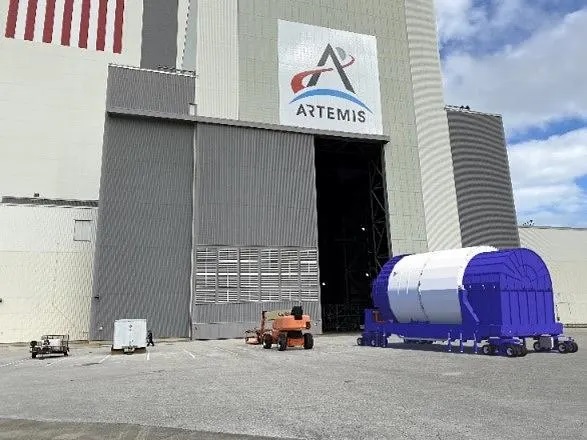
This 3D model visualizes EUS arriving in the Vehicle Assembly Building at KSC after it is unloaded from barge. 3D modeling allows the team to see what the integration process could look like while the EUS hardware is still in the early design and production phase. (NASA 3D Modeling Image)
"We share learnings across our external SLS program partner groups as feedback to empower the Boeing design team, so the vehicle is built with quality and process assurance in mind from the start," adds Bev Schieferdecker, EUS Launch lead.
Leveraging innovative approaches: To tackle the intricate challenges of integrating the EUS into the SLS rocket, the team harnesses cutting-edge technology such as 3D modeling.
- This technology allows the team to visualize the integration process while applying lessons learned from the Artemis I processing.
- They’ll use this data to inform decisions on their processes for the new upper stage of the Block 1B configuration of the SLS rocket.
"3D modeling is really helpful for us to visualize the EUS before it's built. It gives us an idea of what we are working on and how design changes can be applied to the integration work we perform," says Darina Khater.
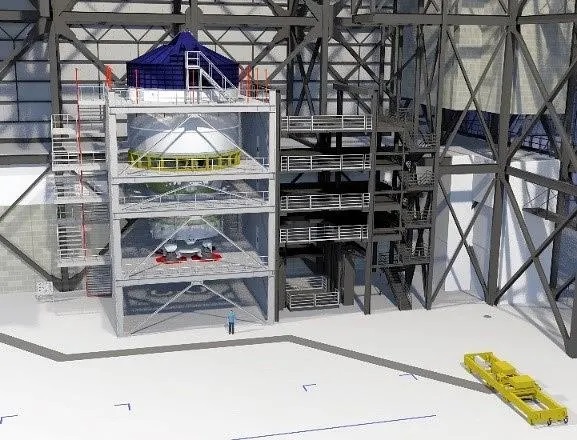
This 3D model represents the EUS in the Vehicle Assembly Building (VAB) while undergoing final preparations before stacking operations on the SLS rocket. (NASA 3D Modeling Image)
Beyond visualization in general, these realistic models also provide critical insights into the ergonomics of working on the stacked vehicle.
- For example, the team can map out the vehicle's position in the VAB to confirm whether technicians can reach certain access points.
- This provides a significant advantage, as it allows them to visualize the stack in its vertical configuration and validate that their design meets operational requirements.
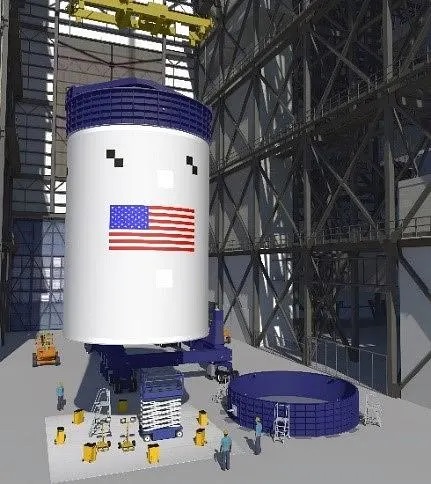
This 3D model illustrates the EUS interstage preparing to be stacked onto the SLS rocket. The model shows the blue protective tooling ring on the bottom of the interstage being removed for inspection before stacking. (NASA 3D Modeling Image)
Paving the way for the future: The EUS Launch team's efforts play a crucial role in advancing human space exploration and paving the way for future missions. The team’s diverse skillsets, experience, and knowledge aids in how they solve problems – critical in making sure the rocket and its hardware is launch-ready for future missions.
“The team’s diversity of thought, meticulous attention to detail and commitment to first-time success will enable the seamless execution of future launch operations, propelling humanity's quest for knowledge and exploration to greater success,” reflects Natasha Wiest, the acting SLS Core Stage program manager for Boeing.
The big picture: November is World Quality Month. Boeing joins quality organizations across the globe during this annual opportunity to share progress and best practices.
NASA’s Space Launch System (SLS) rocket – the nation’s next-generation, super heavy-lift rocket – will enable NASA’s Artemis program and will carry people and cargo to the moon, Mars and beyond. Boeing was selected by NASA to design, develop, test and produce the core stages, upper stages, and avionics suite for the SLS fleet of rockets. The first SLS rocket – featuring the Boeing-built Core Stage – successfully launched at 1:47 AM ET on November 16, 2022, as part of the Artemis I Mission. Production is currently underway for the Boeing-built core stages, upper stages (including Exploration Upper Stage) and avionics for future Artemis missions.