
Above: A rendering of the Evolved Strategic SATCOM satellite Boeing is building for the U.S. Space Force.
(© Boeing)
Boeing’s Space Mission Systems (SMS) organization made 2025 its most active delivery year since 2000.
The Millennium Space Systems team, a non-integrated subsidiary that is part of Space Mission Systems, recently delivered several satellites for an undisclosed national security customer. The delivery pushed Boeing’s 2025 satellite deliveries to the company’s highest annual satellite deliveries since Boeing acquired Hughes Space & Communications a quarter century ago.
Deliveries for the year included satellites for undisclosed defense customers as well as civil and commercial customers around the globe, including: SES in Luxemburg, the U.S. government’s independent space agency NASA, PSN in Indonesia, and Viasat in the United States.
Why it matters: Every day satellites provide the awareness, connectivity and security people rely on, including airline Wi‑Fi, ships far from shore staying linked, emergency communications in disasters, and secure military links.
- More resilient satellites in orbit mean stronger networks and fewer dead zones when it counts.
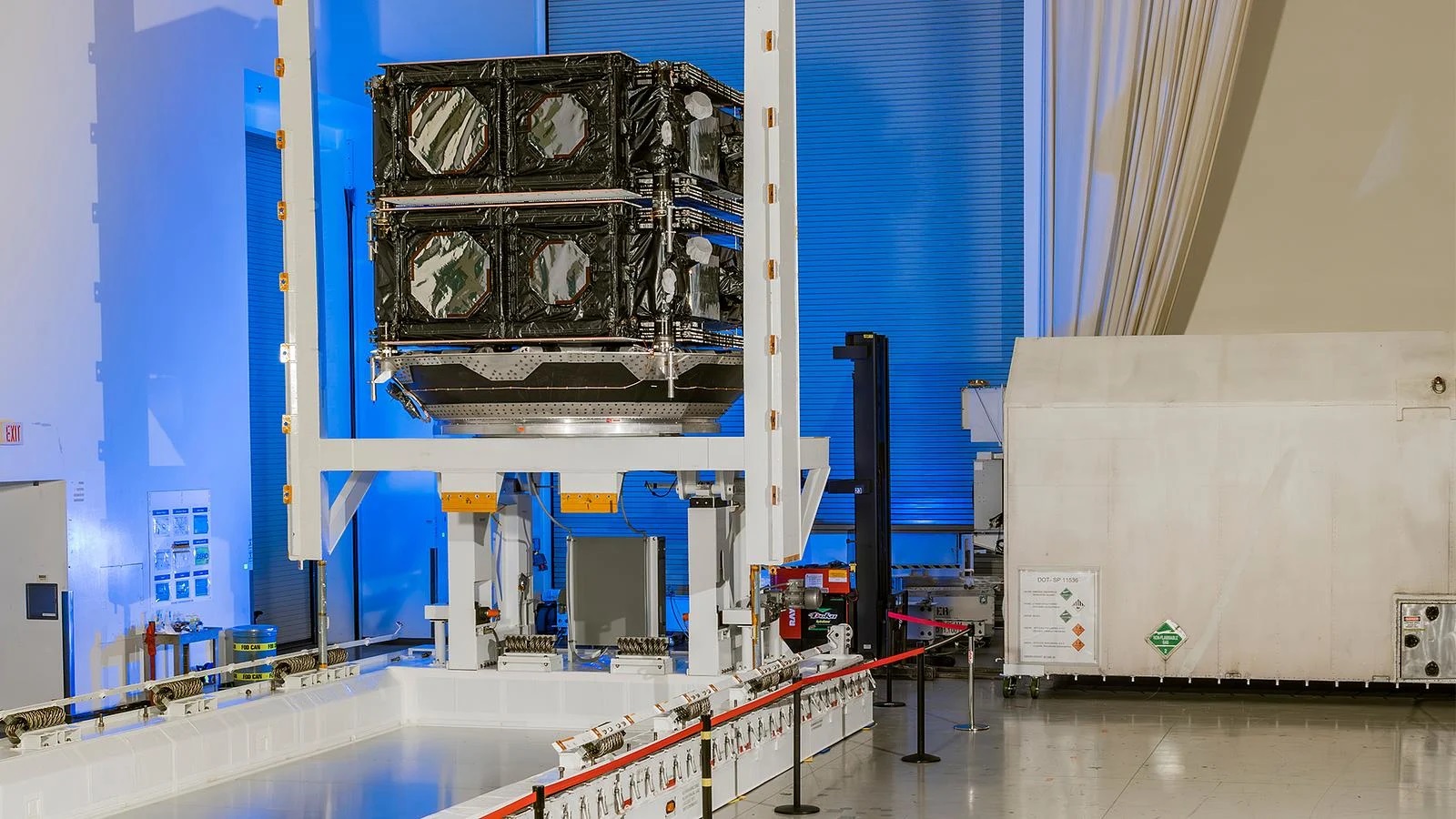
Boeing-built satellites O3b mPOWER F9 and F10 are pictured before delivery to SES and launch to medium Earth orbit. (© Boeing)
The big picture: SMS pairs spacecraft with modern ground systems and operations so users don’t think about platforms (i.e. what satellite they’re connecting to) — they just get service.
- Boeing-designed ground systems, such as Ground Support Control and Configuration Element (GSCCE) and the Protected Tactical Enterprise Service (PTES) are advancing to make the Boeing-built satellites, in this case the Wideband Global SATCOM (WGS) constellation, easier to configure and protect.
- The X‑37B spaceplane continues its heritage, now on its 8th mission, testing technologies like laser communications and quantum navigation that can keep signals moving even when GPS or traditional links are contested.
What’s next: Boeing is scaling production capacity to meet market demand and investing in quantum, artificial intelligence, photonics and 3D‑printed solar substrates to build more flexible, resilient space architectures for customers, competing to grow the company’s order book.
- “2025 was a strong year for us. The team rallied with pace and persistence,” said Michelle Parker, vice president of Boeing Space Mission Systems. “2026 will be formative. We will flex our power and speed to field resilience in the fight, and deliver on our customer commitments.”