
Boeing expands satellite production to meet rising demand

A new payload production line enables delivery of space-based, electro-optical/infrared (EO/IR) missions at rate.

February 20, 2026 in Space, Defense

Photo of the new Boeing EO/IR payload production space This modular, high-cleanliness (ISO Class 6) space will house Boeing’s new EO/IR payload production line, expanding satellite production capacity to support mission delivery at scale. (Zeyad Maasarani photo © Boeing)

Boeing has opened a new production line at its satellite facility in El Segundo, California.

  • The electro-optical infrared (EO/IR) sensor line delivers the payload capacity necessary to support Millennium Space Systems’ delivery of 12 U.S. Space Force’s Resilient Missile Warning and Tracking (MWT) MEO program vehicles in 2027, and positions the combined Boeing team to compete for more work as the United States and allies adapt to meet emerging threats.

Why it matters: This expansion enables Boeing to meet current payload demands and rapidly scale production, strengthening its ability to transition proven technology into rate manufacturing. Millennium’s contribution within Boeing Space Mission Systems has been instrumental in driving this scale, playing a central role in advancing production capability and accelerating growth.

By the numbers:

  • 9,000 square feet (nearly 840 square meters): Approximately the size of two professional basketball courts, the EO/IR production area enables the team to stand up additional lines to accommodate new customers and programs, improve workflow efficiency, and accelerate the transition of proven technology into scalable, repeatable production.
  • 26 in ’26: Since acquiring Hughes in 2000, Boeing delivered its highest satellite output last year, with Millennium providing a significant contribution as it continues to ramp production. Boeing’s Space Mission Systems aims to more than double that output this year with 26 satellites in 2026.
  • 12 space vehicles: Millennium is building a dozen MWT MEO program satellites for the Space Force. The space vehicles will host the Boeing EO/IR mission payload.
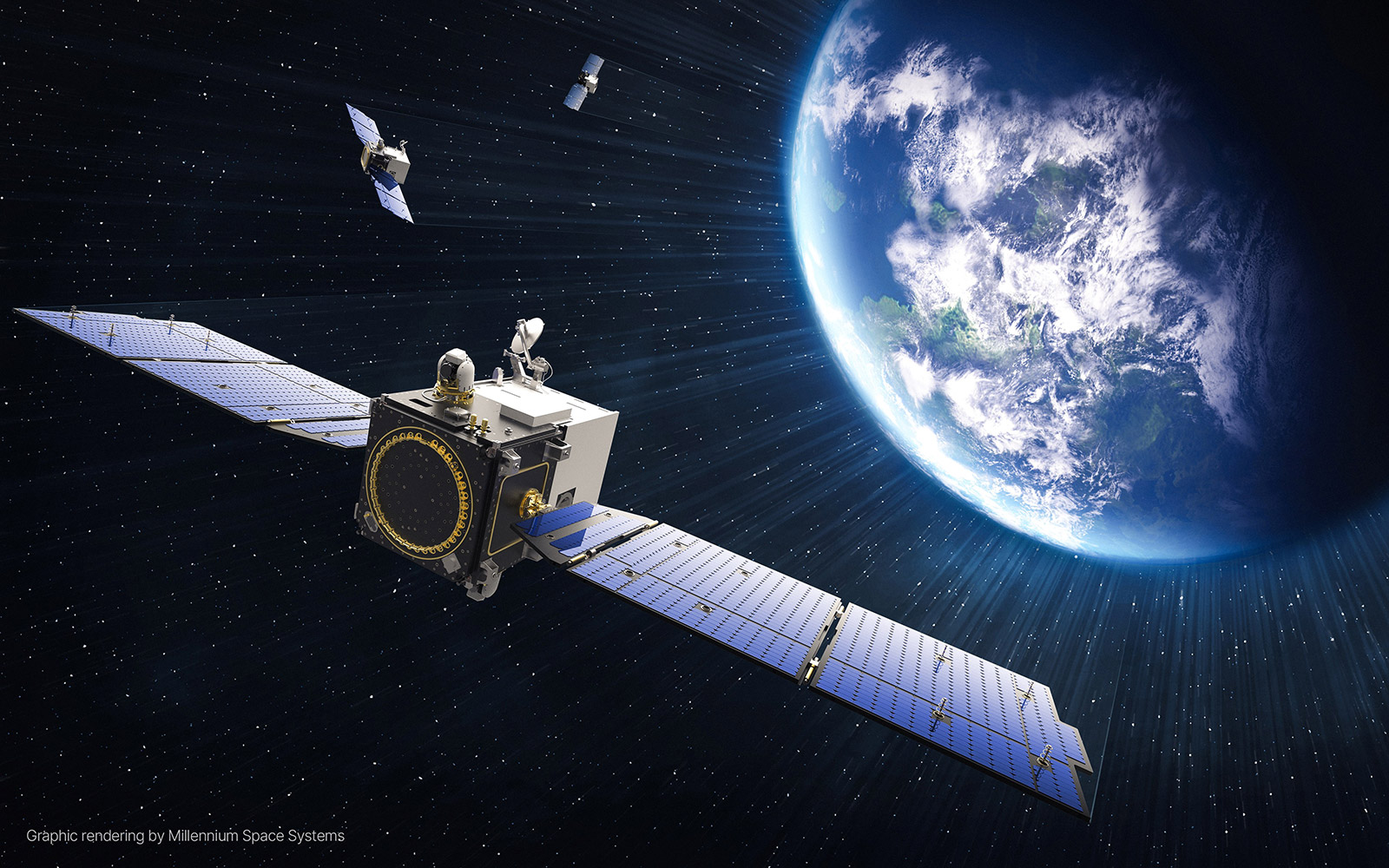
On-orbit render of the Resilient MWT MEO satellite constellation On-orbit render of the Resilient Missile Warning and Tracking (MWT) MEO satellite constellation that Boeing subsidiary Millennium Space Systems is building for the U.S. Space Force. (Millennium Space Systems image)

What they’re saying:

  • “Last year, we proved we can deliver at pace, and we’re not taking our foot off the gas,” said Sam Greaves, interim vice president of Space Mission Systems and vice president of SMS Growth & Engagement. “We’re moving to more than double our satellite output this year, and investments like this, along with other factory upgrades and continued investment in our team, are how we do it with schedule credibility.”
  • “This demonstrates the combined company scaling required to meet customer demands, and we are leading the way,” said Tony Gingiss, CEO of Millennium Space Systems. “By combining Millennium’s agility with Boeing’s EO/IR payload capability, we can deliver superior mission performance for the MWT MEO program. We will continue investing in and expanding our production footprint to advance our capability and drive future mission success.”

The big picture: The EO/IR line builds on technology matured by Boeing Research & Technology and transitions it into higher-rate production.

  • For teams on the floor, that translates into more stable production flow, repeatable work packages, and the capacity to support today’s commitments and future mission needs as demand grows.

By Zeyad Maasarani