
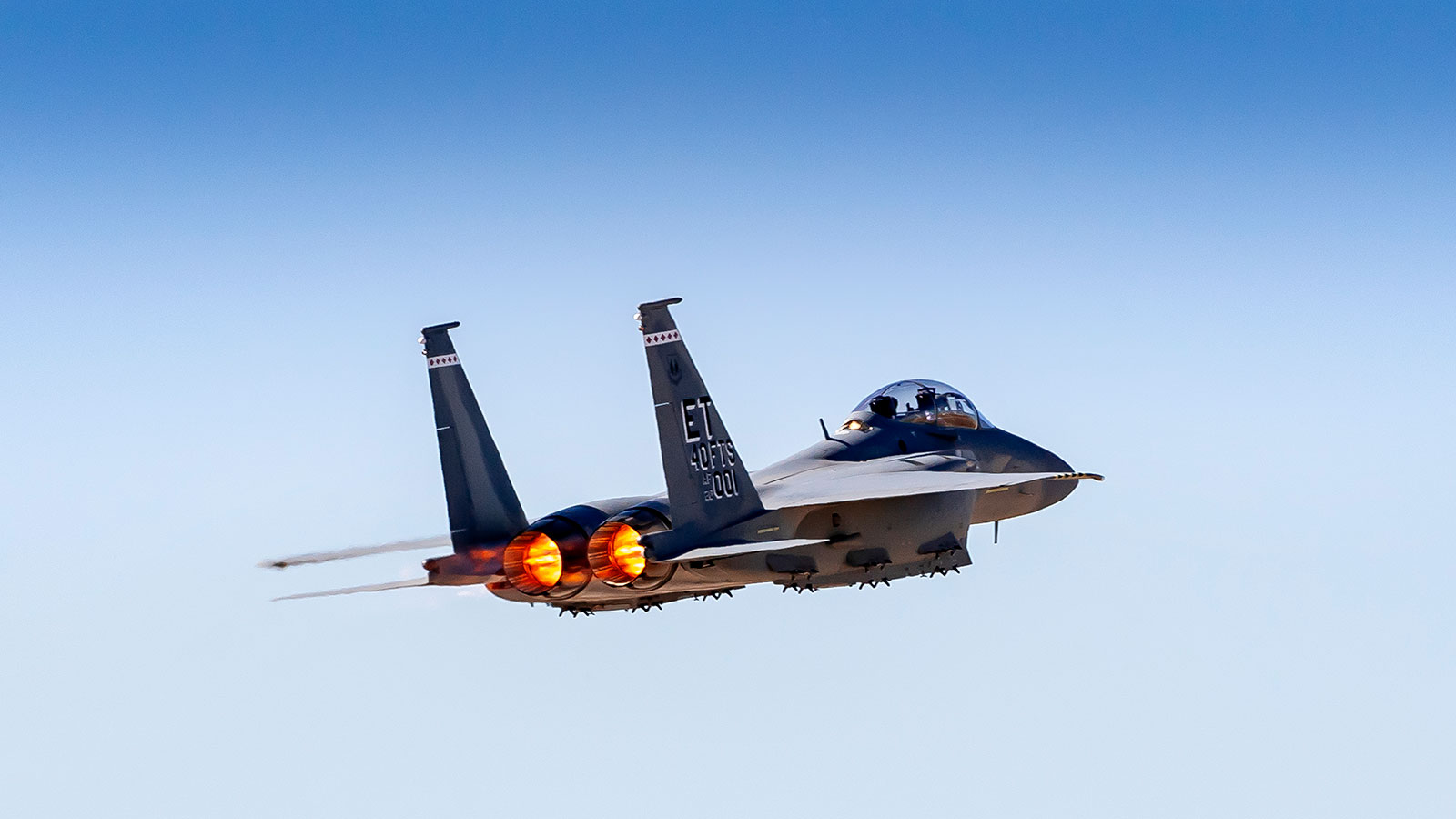
When the McDonnell Douglas F-15 Eagle first entered U.S. Air Force service in 1974, it was designed with a single mission: to ensure air superiority against any adversary. Nearly five decades later, the F-15’s legacy is measured not only in speed and payload but also in adaptability, mission success and its role in shaping the capabilities of defense forces around the world.
Evolving Over Generations
The world has seen many evolutions of the F-15 fighter.
- F-15A/B/C/D Eagle: The original air superiority design that laid the foundation for the aircraft’s success. The first F-15A and B models were delivered in 1974 and F-15C and D models entered the Air Force in 1979.
- F-15E Strike Eagle: First delivered to the U.S. Air Force in 1988, the F-15E was introduced as a long-range interdiction fighter with a focused ground-attack capability while retaining air-to-air prowess.
- Tailored builds for allies: Including Israel, Japan, Qatar, Saudi Arabia, South Korea and Singapore — strengthening partnership interoperability and regional deterrence.
- F-15EX Eagle II: This latest F-15 model extends the effective range of air-to-air weapons and incorporates advanced avionics, digital flight controls, Open Mission Systems architecture and enhanced payload to deliver unique and complementary capabilities alongside 5th- and 6th-generation fighters.
The F‑15 sits at an interesting intersection: a pinnacle of air superiority that has evolved across decades into variants that blur the lines between generations. Now with extended payload capacity and incremental advances through avionics, radar and mission system upgrades, some of the F-15EX’s capabilities outpace all other fighters currently on the battlefield.
Unmatched Reputation
The F-15 has long been regarded as one of the most successful and durable fighters – earning the moniker “the workhorse.” The combination of robust airframe life, high thrust to weight, advanced radar and avionics, and generous fuel and payload capacity make it a platform that can attain and maintain air superiority across a wide range of theaters over decades of useful life.
- Combat record: Publicly reported data credits the F-15 family with more than 100 air-to-air victories, a testament to its design and capabilities.
- Key fighter across diverse arenas: The F‑15 is a key asset in the Pacific due to its long range, large fuel and payload capacity, and powerful sensors that allow it to carry heavy standoff munitions and loiter with tanker support across vast maritime distances. Additionally, with its high speed, advanced radar and flexible loadout, the F-15 is seen as a critical player in and contributor to the evolving next-generation homeland defense shield.
- International adoption: The F-15 is operated by multiple allied air forces, performing a variety of roles from air superiority to long-range strike missions — evidence of broad operational confidence.
- Continued procurement: The U.S. Air Force and partner nations have continued to order upgraded F-15 variants, showing the unique value the platform brings and the institutional trust in extending the platform’s service life.
