FAA clears higher takeoff weight for 787-9 and 787-10

Increased maximum takeoff weight provides more payload or more range, opening new opportunities and greater flexibility for airlines.

March 23, 2026 in Commercial

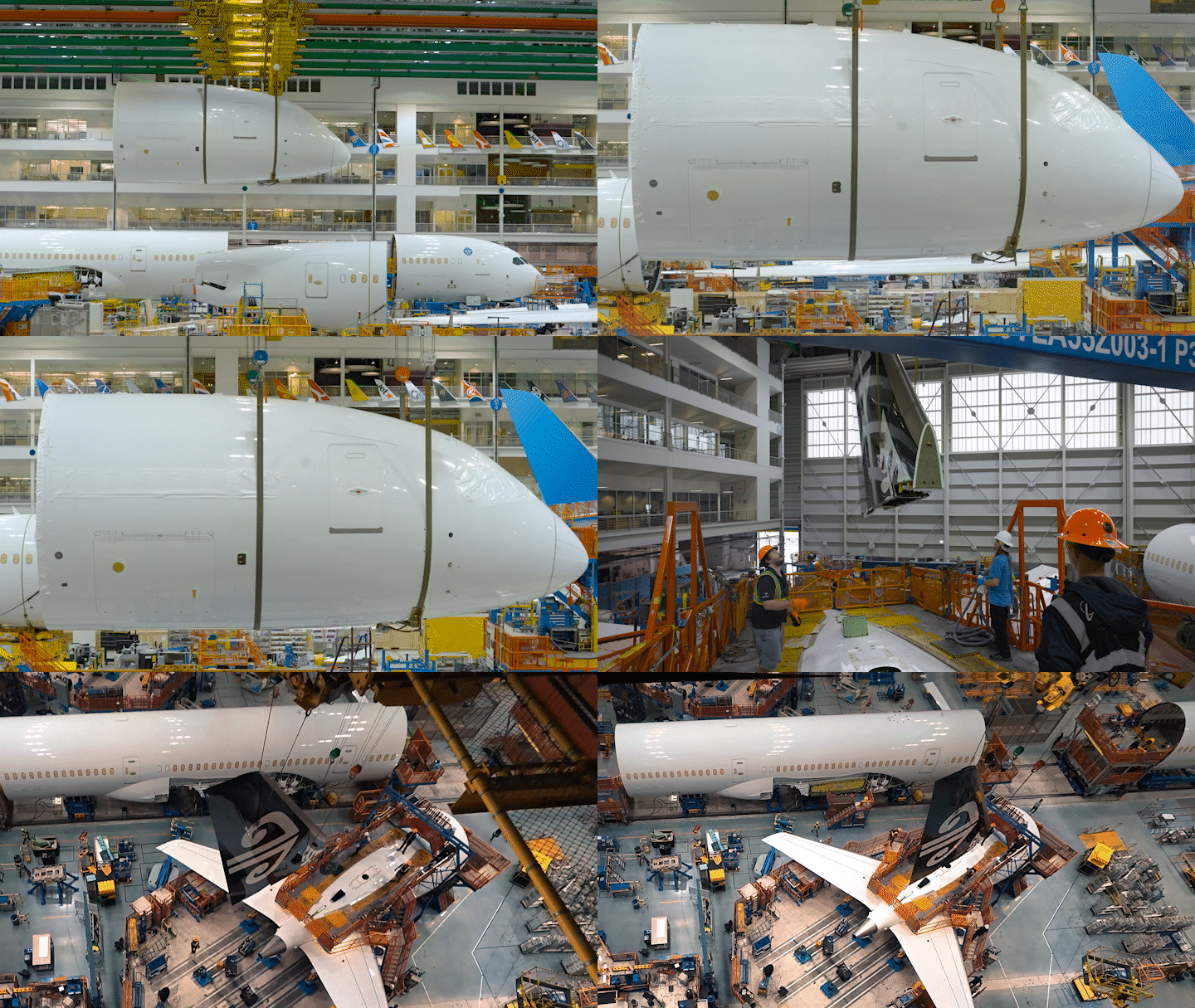
Sections of the enhanced 787-9 are loaded into Final Assembly. Sections of the enhanced 787-9 are loaded into Final Assembly. (© Boeing)

The U.S. Federal Aviation Administration (FAA) has certified an increased maximum takeoff weight (iMTOW) for the 787-9 and 787-10. The change gives Boeing airline customers the option to carry more payload or fly longer routes.

The first jets built with the capability are now progressing through ticketing and delivery activities.

Shaped by customer needs: Program leaders say iMTOW upgrades reflect airline feedback and ongoing product development.

We started this effort after airlines sent Boeing a clear message: they wanted greater flexibility,” said John Murphy, 787 chief project engineer. “Some wanted the 787-10 to fly longer missions; others wanted the 787-9 to carry additional payload with range trade-offs. Boeing designed a solution that delivers both.”

Air New Zealand, the 787-9 launch customer, will be among the first operators to use the iMTOW capability.

“It’s incredibly exciting to see our first 787-9 with the increased maximum takeoff weight completing assembly and preparing for its final inspections and flight tests,” said Baden Smith, Air New Zealand general manager of Strategy, Networks and Fleet. “This upgrade gives us greater ability to carry additional payload on our ultra long-haul routes – an important enabler for our network ambitions, supporting trade, tourism and better connectivity for New Zealand. We’re looking forward to bringing this new airplane into our fleet.”
Air New Zealand's 787-9 featuring an increased maximum takeoff weight rolls out of Final Assembly at Boeing South Carolina. This video features natural sound only, no narration. (© Boeing video)

How it works: All 787-9 and 787-10 airplanes assembled as of December 2025 are structurally capable of the higher weight. Certified operating weight is designated per airplane and can affect airport fees and route planning. For those reasons, airlines can choose to activate the capability at delivery or later. Offering iMTOW as an option lets carriers match certified capability to their network economics.

The 787 family already provides up to 25% better fuel efficiency than the airplanes it typically replaces. The increased takeoff weight preserves that efficiency while adding performance.

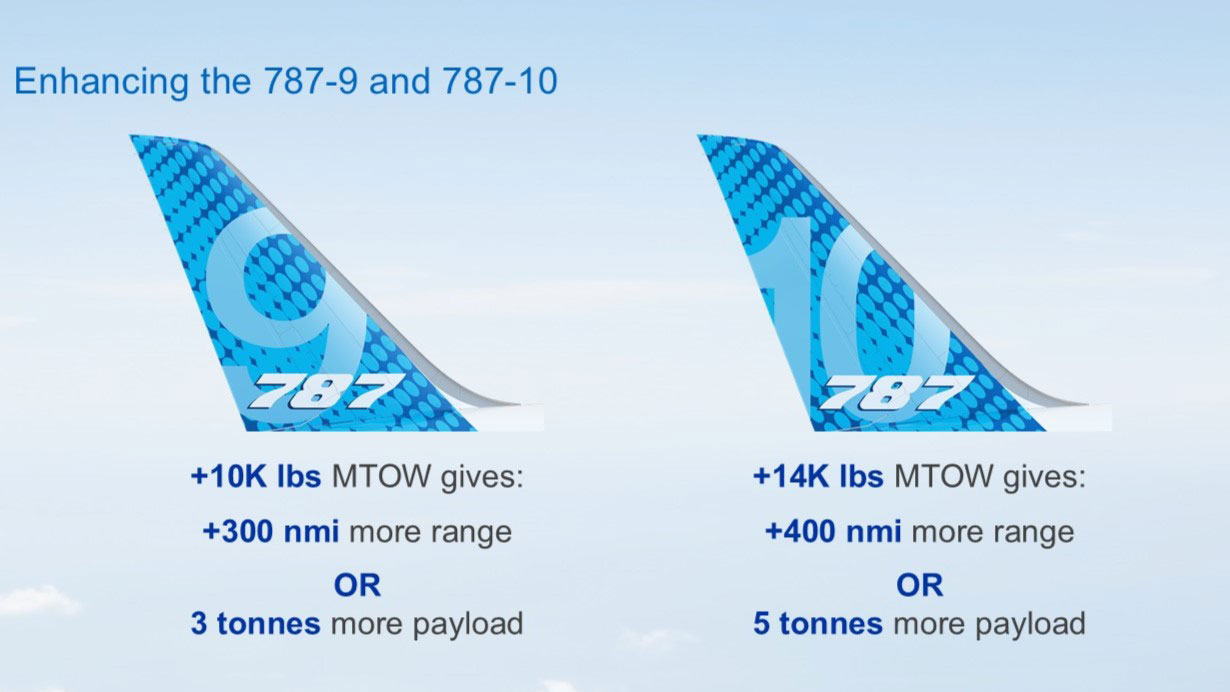
  • 787-9: Roughly 10,000-pound (4,540-kilogram) increase enables about three metric tons of extra payload, or more than 300 nautical miles (560 kilometers) of additional range.
  • 787-10: Roughly 14,000-pound (6,350-kilogram) increase enables about five metric tons of extra payload, or more than 400 nautical miles (740 kilometers) of additional range.

Since entering service, the 787 Dreamliner family has opened more than 530 new nonstop routes that were never previously served,” said Darren Hulst, Boeing vice president of Commercial Marketing. “With an increased takeoff weight, these airplanes don’t just fly farther— they expand what’s possible, enabling airlines to launch new routes, reach underserved markets and rethink how they connect the world,” said Darren Hulst.

Enhancing the 787-9 and 787-10

Certification achievement: Boeing engineers have been actively engaged with the FAA and global regulators to complete all certification and validation requirements before the first airplane can enter commercial service.

  • “Certification of an increased maximum takeoff weight for the 787 reflects years of rigorous engineering, testing and close coordination with our regulators,” said Lisa Fahl, vice president of 787 Engineering. “This certification approval has followed a structured, data-driven program of analysis to validate structural loads, performance and systems behavior at the higher weight that will deliver more capability and new opportunities for our customers.”

Designed to evolve: The upgrade comes about 15 years after the 787 Dreamliner first entered service in 2011, with more than 1,250 deliveries completed worldwide.

“These airplanes symbolize progress, and it shows the strength of our engineering, our partnership with our customers, and how the team is continuing to evolve the 787 Dreamliner family in a disciplined way to help our customers succeed for decades to come,” said Scott Stocker, 787 program vice president and general manager.