From labs and simulators in the Pacific Northwest to windy skies near the Rocky Mountains, engineers in Boeing’s Flight Controls and Stability and Control (S&C) departments have been working for decades on one goal: finding solutions to turbulence to make everyone’s ride in the skies a little smoother.
Why it matters: Most turbulence affects ride quality — the bumps passengers feel — not airplane structure. Better sensing, faster control responses and robust testing reduce shaking, lower injury risk and give crews more time to respond when conditions worsen.
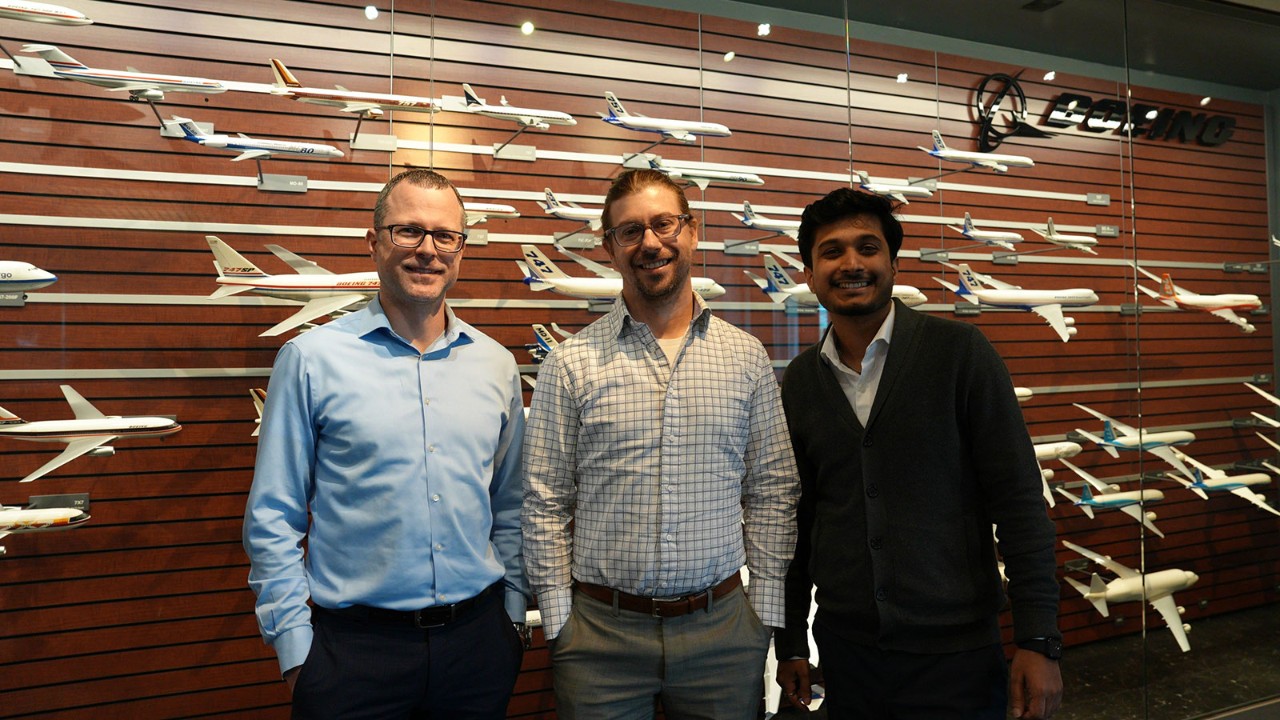
- Ryan Pettit is an Associate Technical Fellow and Paul Strefling is a Boeing Designated Expert in Flight Controls, specializing in automated fly-by-wire controls.
- Shubhank “Shubie” Gyawali works in Aerodynamics for S&C, assessing flying qualities and ride comfort.
Catch up quick: Over decades, turbulence mitigation moved from analog fixes to model‑based, multi‑sensor control systems. Strefling recalled a turning point on the 777‑9 program. After an early test system “didn’t work well enough,” Strefling said, “I drank a bunch of coffee and stayed up for, like, two nights straight. … I realized that we could solve this by using more surfaces and sensors. And then two years later, we flew it and it worked.”
- That shift led to using multiple sensors and actuators across the airplane — a multi‑input, multi‑output modal suppression approach that raises performance and complexity and will be applied to all future Boeing airplanes.
“After seeing what we test and how extreme some of the conditions are that we evaluate against, I’m very comfortable now,” Gyawali said. “My parents would be too.”
People first: Gyawali’s experience — growing up in Nepal and later feeling nervous as a flyer — drives his focus on passenger comfort. “After seeing what we test and how extreme some of the conditions are that we evaluate against, I’m very comfortable now,” he said. “My parents would be too.”
How the controls work: Designers build two main functions: modal suppression, which dampens structural bending so the wings and fuselage stop “dancing” in turbulence, and gust suppression, which counters whole‑airplane translations and rotations. Sensors — accelerometers, airspeed and angle‑of‑attack vanes, and dedicated gust sensors — feed algorithms that move elevators, ailerons and the rudder in milliseconds to oppose disturbances.
- Pilots give commands and “the computer figures out how to move all the flight surfaces to achieve it while trying to reject disturbances from turbulence,” Petit explained.
- “The atmosphere is chaotic. When the airplane gets introduced to this chaotic, unpredictable atmosphere, it gets excited,” Gyawali added. “And now I need to manipulate my control surfaces … so that my airplane doesn’t get as dynamically excited. Or, in other words, if my airplane is dancing in this cloud of atmosphere, I’m making it, like, a bad dancer, making it more stiff.”
From desktop to turbulence hunting: Most design begins in high-fidelity simulation then moves to the Boeing Multipurpose Engineering Cabin (MCAB) — a full-motion simulator whose abilities include mimicking turbulence — and ends with flight validation. MCAB provides real-time feedback within the simulator so engineers can gauge ride quality and pilot response before testing the design on an actual flight.