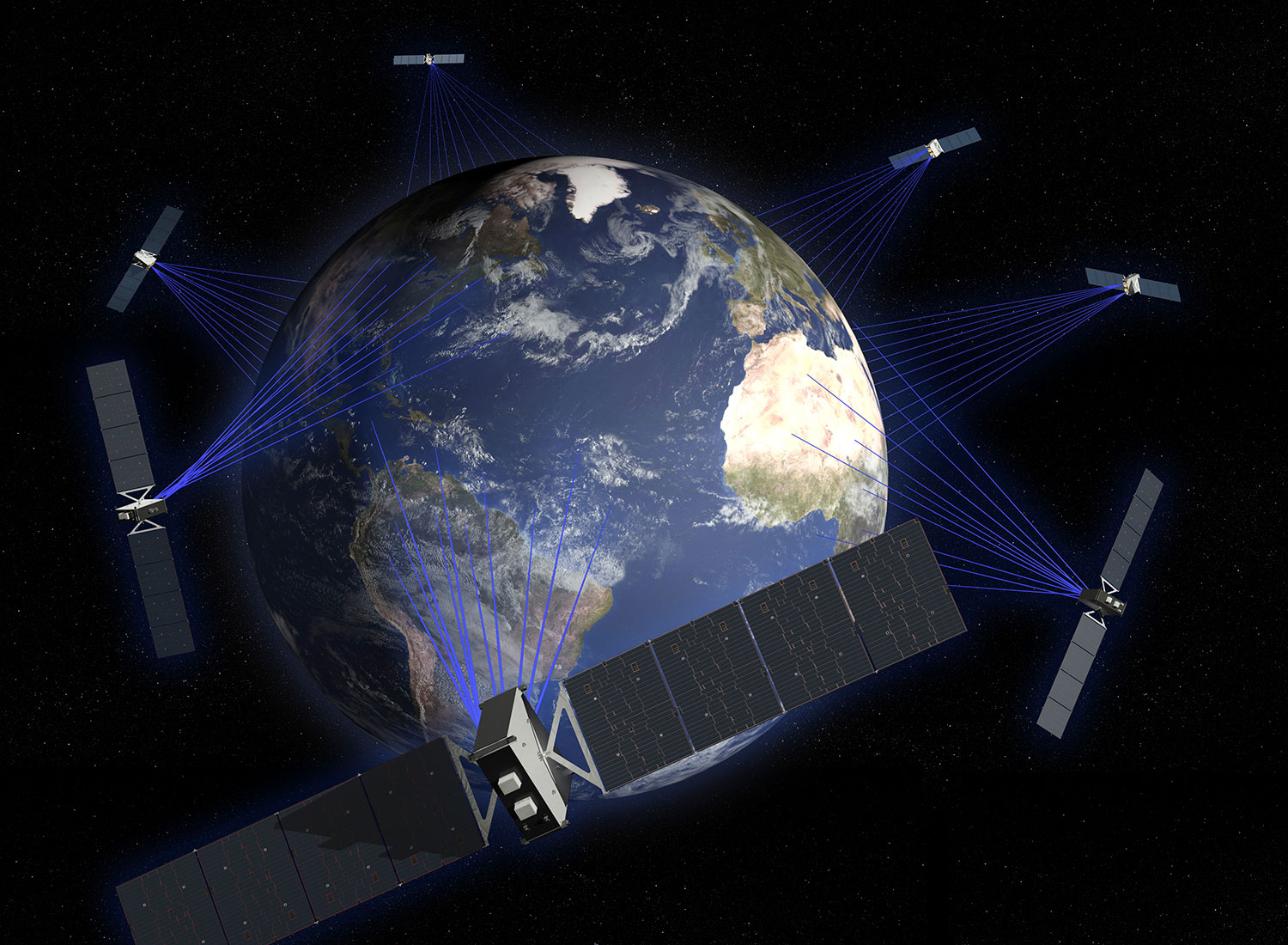
Global space solutions provider SES announced on March 2 that the ninth and 10th Boeing-built O3b mPOWER satellites have entered commercial service, enhancing global connectivity with their advanced, software-defined capabilities.
Why it matters: “The shift underway is from coverage to capacity on demand. That’s the promise of software-defined satellites like O3b mPOWER,” said Ryan Reid, president of Boeing Satellite Systems, International. “Instead of being locked into fixed coverage patterns, a software-defined satellite can electronically steer and shape beams and allocate bandwidth to where it’s needed, when it’s needed, using software instead of altering hardware.”
How it works: For average users, electronically steerable satellites mean fewer dead zones, more reliable connections for cellular networks and better performance for remote sites that still need modern connectivity. For government and enterprise customers, it means more options when missions move, weather changes or networks face interference.
The big picture: “With these two O3b mPOWER satellites now delivering service, we’re expanding our [medium Earth orbit] capacity and putting more high-throughput, low-latency connectivity into the hands of customers around the world,” said Adel Al-Saleh, SES CEO. “This added capacity strengthens what we can deliver today, and it’s a clear signal of what’s coming next.”
The path forward: This technology also matters for Boeing’s longer-term satellite portfolio. The software-defined payload approach demonstrated on O3b mPOWER is a foundation Boeing is building on for government missions that prioritize resilience and mission assurance. It also serves as a proof point that software-defined payloads are moving from promise to performance.
- “This milestone matters for where SATCOM is headed next, towards multi-orbit, layered networks that route traffic across different types of satellites and ground networks so users can stay connected without having to care which ‘pipe’ is carrying the data,” Reid said. “As those networks become more integrated, the ability to steer coverage, reconfigure capacity and manage resources dynamically becomes a real advantage.”
- The underlying software-defined technology on O3b mPOWER has also been hardened for military SATCOM (MILSATCOM) programs including the U.S. Space Force’s Wideband Global SATCOM (WGS)-11 and WGS-12, as well as Evolved Strategic SATCOM (ESS), the United States’ next-generation nuclear command, control and communication satellites.