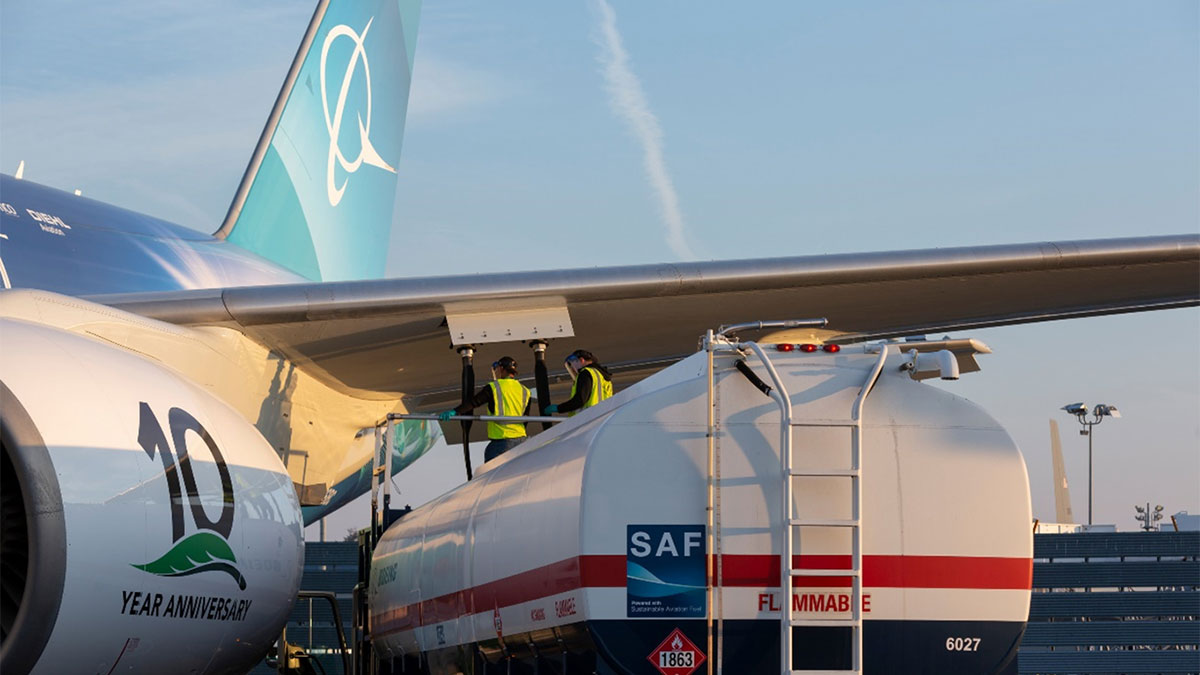
Boeing and Norsk e-Fuel are expanding their strategic collaboration to accelerate the production of synthetic aviation fuel, or e-SAF, and strengthen Europe’s energy resilience. The joint industrial initiative will explore how synthetic fuels can contribute to the future of both commercial and defense aviation while enabling a more secure and independent energy system in Norway and across Europe.
What’s happening: Boeing is advancing its commitment to supporting aviation’s energy transition through long-term solutions by shifting its early investment in Norsk e-Fuel to operational implication. Through targeted investment, the partners will generate practical data on fuel performance, operational benefits and supply requirements to help inform both civil and military contexts.
- The project reflects Boeing’s commitment to Norway industrial cooperation, innovation, partnerships and supporting resilient capabilities in Norway.
- It builds on Boeing’s 2025 investment in Norsk e-Fuel to support one of Europe’s first industrial-scale facilities to produce e-SAF through the Power-to-Liquids (PtL) process.
Understanding e-SAF: Sustainable aviation fuels (SAF), including e-SAF, are a well-known solution to reduce emissions in aviation. They also offer the ability to produce fuel from locally available materials.
- E-fuels are produced using renewable electricity, water and captured CO₂ – abundant in the Nordics region. This PtL process can significantly reduce the life cycle greenhouse gas emissions of air travel compared with conventional jet fuel.
The impact: Expanding this value chain is critical for both long-term competitiveness and decarbonization. By advancing e-SAF production locally in the Nordics, the European aerospace industry can significantly reduce its reliance on imported fossil fuels and build a stable, domestic and renewable energy supply for hard-to-abate sectors like aviation.
- “Scaling SAF, and particularly e-SAF, is important for the sustainable and resilient growth of both commercial and defense aerospace – this is only possible by reducing the cost through stable policy and incentives that de-risk investments for early developers,” said Steve Gillard, Boeing's regional sustainability director for Europe, Middle East, Türkiye, Africa and Central Asia.
- “This initiative goes beyond technology development,” said Lars Bjørn Larsen, chief commercial officer at Norsk e-Fuel. “Together with Boeing, we are contributing to a broader European objective: strengthening energy security, resilience and independence.”