
Chief Tech Officer sets Boeing’s technology and innovation strategy

CTO Lane Ballard answers how Boeing is investing in people, resources and innovation to advance technologies for the future.

April 30, 2026 in Innovation

Lane Ballard is Boeing Chief Technology Officer SEEING THE STRATEGY: Boeing Chief Technology Officer Lane Ballard leads technical experts to advance aerospace technologies. (Marian Lockhart photo © Boeing)

Boeing Chief Technology Officer Lane Ballard is guiding the company’s technology strategy with a clear goal: Provide solutions that help customers today while developing technologies to head off tomorrow’s problems and shape the future of aerospace.

Receiving his bachelor’s degree in mechanical engineering from Virginia Tech and master’s degrees in engineering and business from the Massachusetts Institute of Technology, Ballard’s background provides a unique perspective on innovation. His approach ties Boeing’s deep engineering talent to disciplined technical rigor, focusing on technologies that deliver measurable impact across production, operations and mission capability.

Serving more than 30 years at Boeing, Ballard has witnessed rapid technology development across the company’s products and services. From his early intern work on friction stir welding for space to building and testing composite wings for the Joint Strike Fighter and the F-22 program to later leading the 787 Dreamliner program and global engineering, Ballard has experienced the power of engineering as Boeing teammates embrace collaboration, creativity and curiosity.

Now as CTO, Ballard is focused on developing Boeing’s technical experts and advancing Boeing’s technologies for the future — a role that uniquely connects the company’s technology strategy, engineering capability and business outcomes. He emphasizes that innovation at Boeing is not about invention alone, but about turning bold ideas into producible, certifiable solutions that improve today’s business results and create products for a future yet to be imagined.

Below, Ballard shares how he defines innovation, explains how Boeing is investing to advance technologies, and projects what to expect next from Boeing Engineering & Technology Innovation.

Q: How do you define innovation at Boeing, and where will the company concentrate its efforts to deliver impactful technologies?

A: Innovation at Boeing is about turning ideas into safe, reliable, producible and certifiable solutions that create value for our customers and our business. It is not enough to invent something new. The real test is whether we can scale it, build it consistently, and put it to work in operations, programs and production.

That means we need to do two things at once: One, help programs and customers now. We must deliver solutions for their immediate needs. And two, develop technology that averts problems of the future or provides additional value to our many customers. We have to build the capabilities now that improve performance, reduce risk and make Boeing products better over time.

We are focusing on technologies that deliver measurable results, including digital engineering, model-based systems engineering, autonomy, sustainable materials, quantum computing, and advanced manufacturing.

For example, we’re developing technologies to support a high-rate commercial production system capable of delivering far more than we have ever delivered before — it’s an aspirational goal that requires us to think differently. It requires the right technology, disciplined execution and absolute integration of engineering and manufacturing.

To enable real-time inspections, for instance, we are investing in tools like digital twins and collaborative robots, or cobots, that improve productivity and safety on the factory floor. Those technologies shorten development cycles, reduce rework, and accelerate the transition of breakthroughs into daily operations.

We’re also prioritizing work on advanced wings and structures, like thin-wing technologies and other lightweight design approaches that can improve airplane performance, durability and producibility. Those advances reflect how we move from concept to certified product by embedding producibility, maintainability and sustainability into designs from the start.
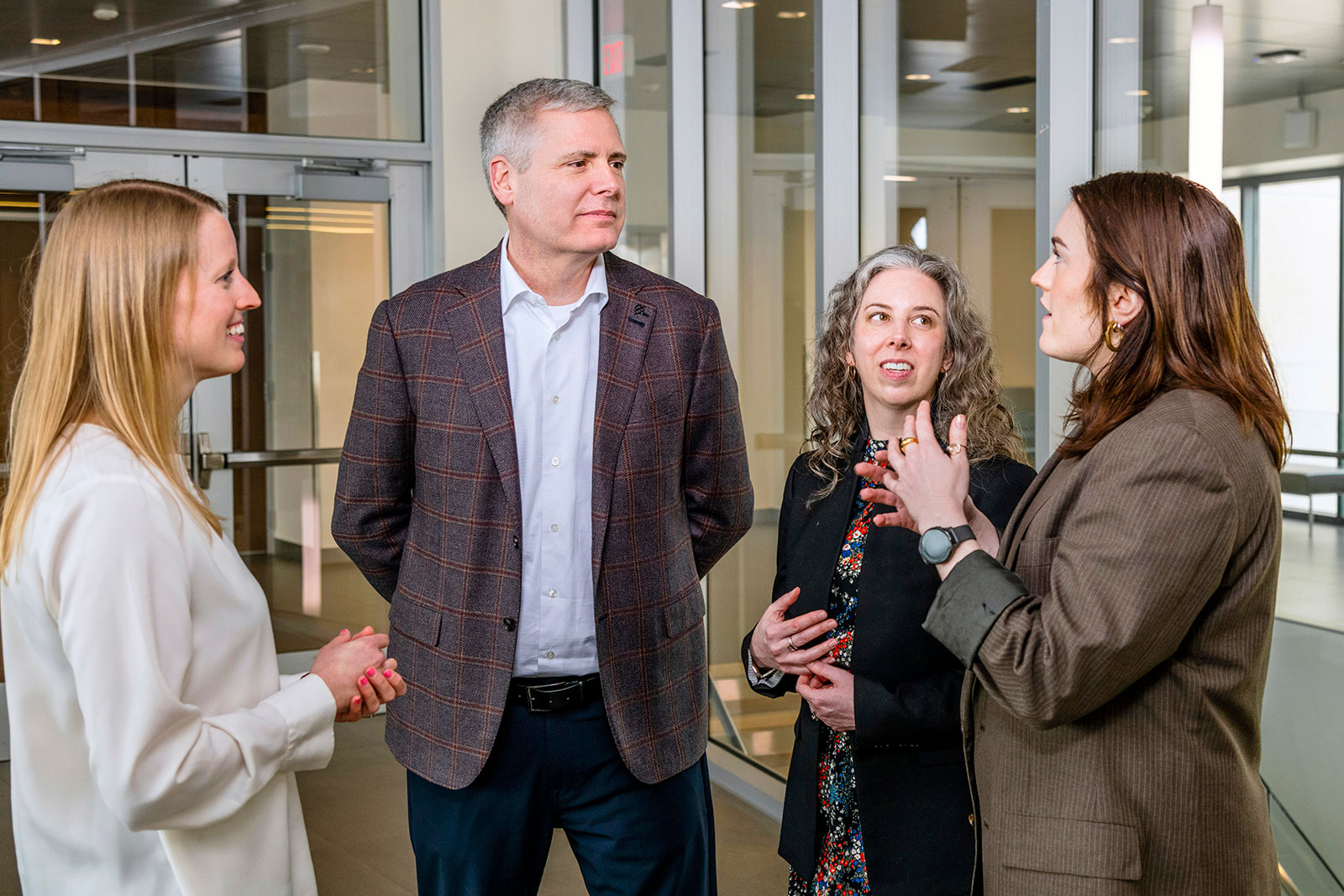
Lane Ballard Boeing CTO talks to three experts in office setting TALKING TECH: Ballard listens to Martha Neubauer, left, Alicia Walker-Howse and Bridget Boland, who inspire technology advancement with their curiosity and creativity. (Marian Lockhart photo © Boeing)

Q: You often emphasize that people matter as much as technology. What do you mean?

A: Technology only creates value when people can use it efficiently. Boeing’s future depends on the combination of great ideas, strong engineering judgment and the ability to scale solutions across programs.

Our engineering community itself is a strategic advantage. Boeing’s 60,000-plus engineers bring deep expertise, curiosity and creativity to solve the toughest challenges in aerospace. My job is to make sure they have the processes, tools, mentors and opportunities they need to turn that talent into measurable value for the company and for our customers.

That is why we are investing in our technical foundation — including Functional Chief Engineers, Boeing Technical Fellows, engineering team leaders and other experts who help set standards, accelerate learning and reduce reinvention. They help Boeing move faster, reduce risk and make better technical decisions across programs. This investment supports our core aim: Recruit and grow the world’s best aerospace engineers and ensure their knowledge spreads across the enterprise.

As we invest in our people and our technical systems simultaneously, we can scale innovation more effectively and deliver better outcomes for our customers and the industry as a whole.

"Engineering plays a unique role in the Boeing enterprise. We are not just exploring technical ideas — we are shaping the engineering capability and technology foundations that will help the company deliver today and advance innovation for tomorrow." - Boeing Chief Technology Officer Lane Ballard

Q: How do Functional Chief Engineers and Boeing Technical Fellows help advance engineering and innovation?

A: They play a critical role in connecting technical excellence to business execution.

Functional Chief Engineers help define technical direction, set standards and identify the most important challenges to solve. They help engineers grow as technical leaders while also ensuring programs stay aligned with customer priorities.

Technical Fellows bring deep domain knowledge and practical lessons learned from across the company. They help teams adopt proven methods faster — from model-based systems engineering and digital twins to advanced manufacturing and additive techniques. 

Together, they help us:

  • Leverage solutions that have already been developed.
  • Ensure a strong supply chain through solid requirements and closer Boeing engineer-to-supplier engineer integration.
  • Reduce program risk.
  • Improve time to market.
  • Strengthen engineering quality.
  • Scale solutions across the enterprise.

These experts also ensure our engineers use Boeing’s Design Practices and Technical Design Reviews, which capture and help us apply decades of engineering knowledge, lessons learned and best practices over the company’s long history. Design practices fuel our engineering innovations and ensure the safety and quality of our products. That is how we turn technical expertise into business value.

Q: What’s changing in the day-to-day work for engineers at Boeing?

A: Boeing engineers are collaborating more closely with not only their peers but their programs, technical experts, customers and business leaders. It’s a more connected, efficient and empowered environment.

That means:

  • Faster access to experts and mentors.
  • More opportunities to work on high-impact programs.
  • Better digital tools for design and analysis.
  • Stronger feedback loops between engineering, manufacturing and operations.

In practical terms, engineers will spend less time troubleshooting and more time developing solutions that prevent problems in the first place. Better digital engineering, digital twins and model-based design will help us get things right the first time. And tighter alignment between engineering and production will help our factories run more predictably and efficiently.

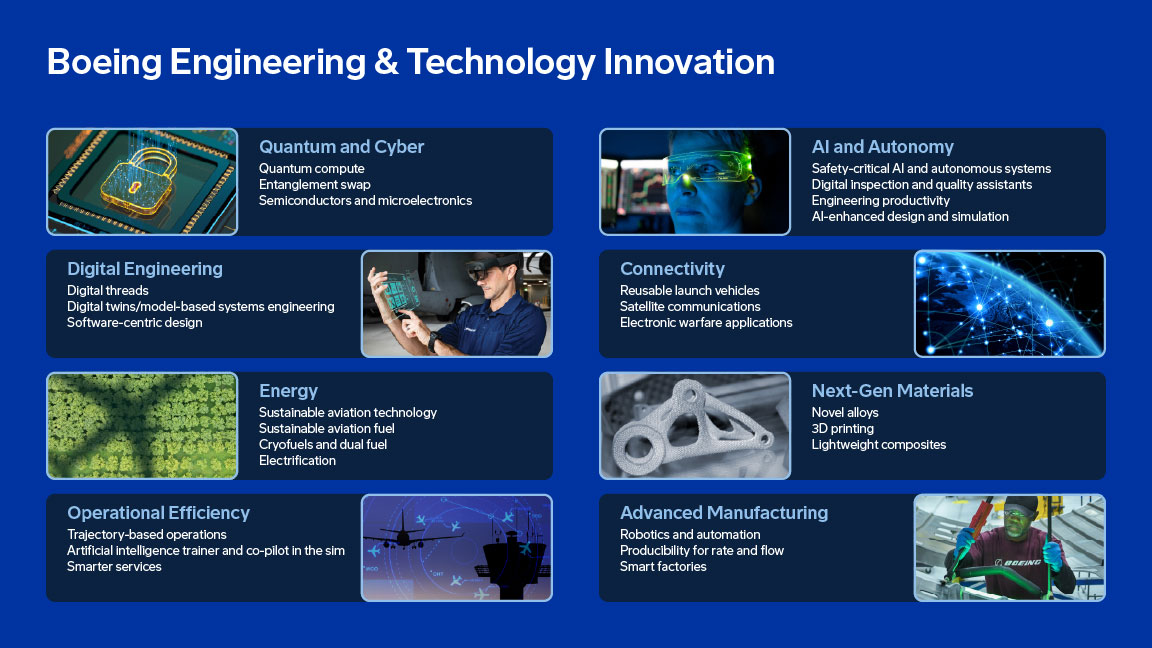
Eight areas of Engineering and Technology Innovation TECH THAT MATTERS: Boeing Engineering & Technology Innovation teams are focusing on breakthrough technologies that satisfy business and operation demands and safety and quality requirements. (Illustration © Boeing)

Q: Which technologies will Boeing prioritize over the next decade?

A: We’ll prioritize technologies that deliver measurable value across capability, sustainability and producibility. There are eight.

  1. Quantum and cyber: Develop quantum algorithms for materials discovery and supply-chain optimization, quantum-safe cryptography, and quantum sensing for high-precision navigation and timing.
  2. Artificial intelligence and autonomy: Build trusted, scalable autonomy and responsible AI to accelerate engineering excellence using computer vision, reinforcement learning, optimization, simulation, embedded machine learning, and generative AI.
  3. Connectivity: Advance technology development in mission systems, secure satellite networks and integrated space-to-ground communications, advanced computing, electro-optical and infrared sensors and payloads, optics and avionics.
  4. Next-generation materials: Develop materials and designs that reduce weight, cost and environmental impact while remaining producible and certifiable at scale.
  5. Advanced manufacturing: Expand automation appropriately and develop inspection technologies and smart manufacturing systems that improve quality, increase throughput and support high-rate production.
  6. Operational efficiency: Develop technologies and advanced digital information services that enhance airspace capacity and airline efficiency and reduce environmental impact.
  7. Energy: Explore power systems essential for long-term sustainability and regulatory compliance, reducing life cycle carbon emissions for new low-emissions platforms in emerging markets.
  8. Digital engineering: Accelerate model-based systems engineering, digital twins and data-driven decision-making so designs are right the first time, enabling smoother certifications.

The bottom line is simple: If a technology does not strengthen the safety of our products and services, improve the business, provide value to the customer, or support our ability to deliver at scale, it will not be a priority.

Q: What is your goal as Boeing’s CTO?

A: My top priority is to develop our people and advance technologies for our company.

Engineering plays a unique role in the Boeing enterprise. We are not just exploring technical ideas — we are shaping the engineering capability and technology foundations that will help the company deliver today and advance innovation for tomorrow .

That means supporting programs and customers now, while building the technologies, talent and systems that will keep Boeing and our industry strong for years to come.

It’s my responsibility to guide this team of brilliant engineers to crush the evolving challenges of connecting, protecting and exploring our world — and to make sure they are equipped and eager to turn their ideas into reliable solutions for the aerospace industry.