Weaving innovation with every fiber

New suite of software tools connects Boeing’s people, ideas and products.

April 03, 2026 in Technology, Innovation

ROLE MODEL: Kelly Zimmermann prepares a flight deck simulator to highlight the crucial role of aircraft simulation in large-scale integration labs. ROLE MODEL: Kelly Zimmermann prepares a flight deck simulator to highlight the crucial role of aircraft simulation in large-scale integration labs. (Jake Chappelle photo © Boeing)

When a Boeing software developer kicks off their day, their workspace looks simple — a clean dashboard, a few code windows and a progress bar subtly completing automated compliance checks. Beneath it all, an invisible shift is reshaping Boeing’s approach to building, testing and piloting technology.

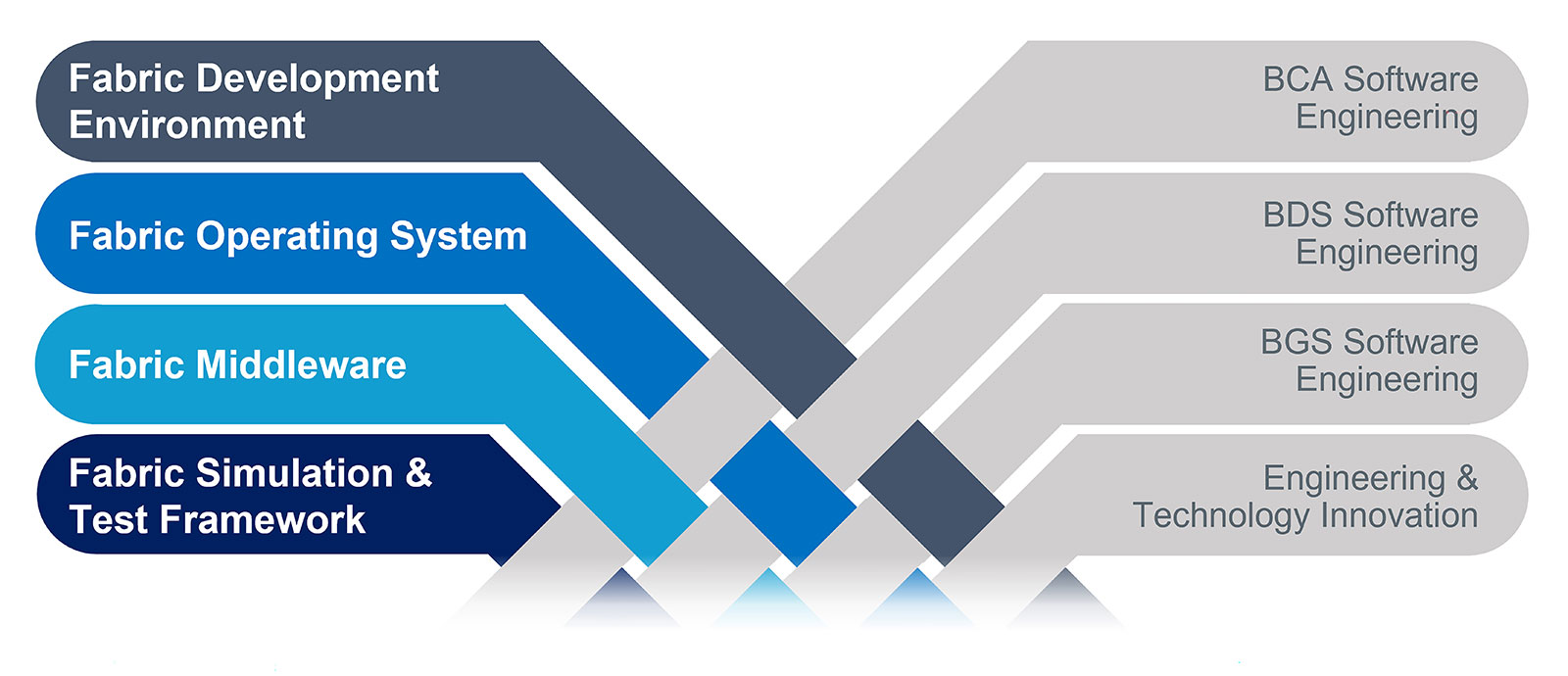
This shift, known as Boeing Fabric, is a comprehensive software platform designed for infusing order, speed and collaboration into one of the world’s most intricate engineering ecosystems. It’s more than a product — it’s a shared foundation built by and for the innovators who power Boeing’s innovation. Today, that foundation is built on a shared development environment, middleware, operating system and simulation-and-test framework — an intertwined approach shaped from years of modernization endeavors across the company.

SOFTWARE THAT FLIES: Boeing Fabric is the company’s cohesive approach to software development designed to streamline common solutions across programs, empowering teams to focus on innovative application development. SOFTWARE THAT FLIES: Boeing Fabric is the company’s cohesive approach to software development designed to streamline common solutions across programs, empowering teams to focus on innovative application development. (Illustration © Boeing)

A new thread in Boeing’s story

Boeing engineers have designed pioneering systems for the company’s products for decades — from flight control software to simulation tools — often tailored to specific products or programs. While effective, that approach can lead to replicated work, incompatible systems and extended development cycles.

Matt Kelly, Enterprise Software Products & Capabilities chief engineer, said Boeing’s legacy of program-by-program development also limited code reuse and fragmented infrastructure — pressures that have “driven costs and schedules to unsustainable levels.”

Fabric surfaced from a simple yet deep insight — Boeing can optimize safety, speed and precision by equipping engineers with a collective digital foundation. Efforts to modernize Boeing’s software ecosystem gained momentum when Adam Johnson joined the journey, and as Boeing Fabric executive director, he’s helped teammates advance those ideas, connect them across the enterprise and turn them into an interwoven strategy and equipped platform.

“Fabric represents our next evolution,” Johnson said, summarizing Fabric’s purpose. “It’s how we transform software from something each program builds on its own into something that can connect and empower every engineer at Boeing.”

PROVEN PATTERN: Adam Johnson oversees Boeing Fabric, drawing on his extensive experience across numerous software development efforts. He drives teams to elevate and deliver enterprise software solutions, ensuring safety, quality, integrity and customer value are at the heart of Fabric. PROVEN PATTERN: Adam Johnson oversees Boeing Fabric, drawing on his extensive experience across numerous software development efforts. He drives teams to elevate and deliver enterprise software solutions, ensuring safety, quality, integrity and customer value are at the heart of Fabric. (Photo © Boeing)

Building a common language for software

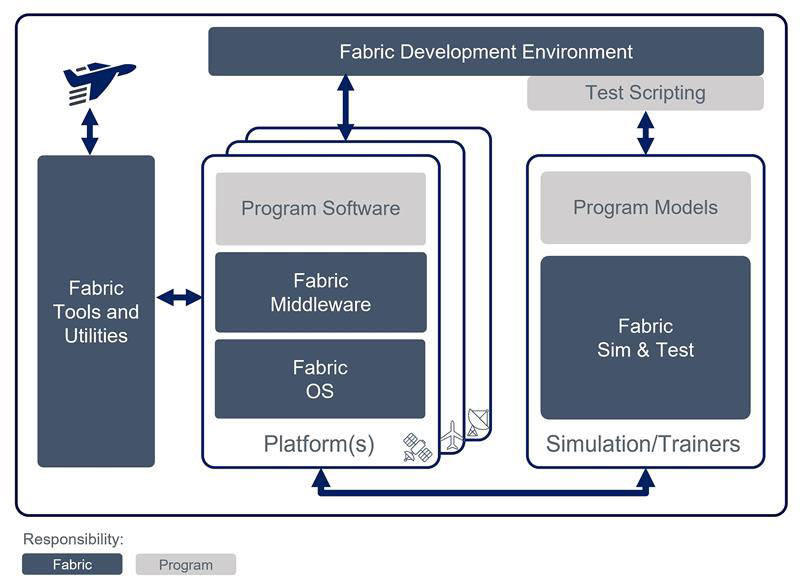
At its core, Boeing Fabric is a suite of shared platforms and tools — a centralized software development environment, middleware, operating system, integrated simulation and test framework, and common tools and utilities. But what makes it revolutionary isn’t only the technology — it’s the user experience.

Matt Kelly, Software Engineering Techical Fellow ENGINEERING REAL IMPACT: Matt Kelly helps to ensure Boeing’s software products and capabilities aren’t only safe but top notch and ready to deliver at scale. (Eric Shindelbower photo © Boeing)

The Fabric development environment enables new software programs to begin development in hours versus months and take advantage of on-demand scalability and built-in automation — all while prioritizing the aerospace industry’s most rigorous safety standards.

When Kelly describes Fabric to leaders outside software, he said they’re often most struck by how quickly it can stand up “a fully integrated software development environment,” including tooling and processes aligned with Boeing Design Practices, on-target software and robust simulation capabilities — the core items that drive efficiency and reduce risk.

Empowering engineers to focus on what matters most

Before Fabric, developers often spent time redeveloping tools, debugging custom middleware or navigating certification documentation — necessary tasks, but time-consuming.

Now, Fabric’s shared middleware provides reusable building blocks, allowing teams to spend more time on solving problems that matter — like improving aircraft safety, enhancing autonomy or advancing predictive maintenance.

For simulation teams, Fabric is also helping move programs toward what Kelly Zimmermann, Simulation Integration & Modeling architect, calls a “one-stop shop for their software and simulation needs,” encouraging the use of modern, high-integrity simulation products on new programs.

RAISING THE STACKS: Boeing Fabric’s software stack optimizes resources by enabling software teams to focus on program-specific application development, while helping to ensure compliance and simplify future upgrades. It accelerates setup, leverages automation and is designed to integrate seamlessly with application code bases, cutting development time. RAISING THE STACKS: Boeing Fabric’s software stack optimizes resources by enabling software teams to focus on program-specific application development, while helping to ensure compliance and simplify future upgrades. It accelerates setup, leverages automation and is designed to integrate seamlessly with application code bases, cutting development time. (Illustration © Boeing)

Stitching the pieces

Before Fabric, simulation and testing environments varied across programs — a natural result of Boeing’s scale and heritage. Fabric changes that by weaving more than two dozen simulation and test frameworks into one cohesive construct. Zimmermann said Boeing develops dozens of simulations across and within programs, and bringing teams together helps clarify where use cases align and where they differ — creating opportunities to combine products and achieve economies of scale.

The result is a shared environment where digital twins, emulations and flight tests speak a shared language, allowing engineers to test and model aircraft behavior with earlier integration and faster, continuous feedback, enhancing seamless collaboration and decision-making across the enterprise.

For Zimmermann, a key aim is enabling “trustworthy” simulation — tools proven across environments such as desktops, test stations, integration labs and trainers, and that match flight-test data in the critical areas engineers and regulators care about. She said Fabric partners with business units to modernize simulation products without impacting program-critical milestones and checks simulations against baseline data to help ensure reliable, repeatable performance while steadily reducing technical debt.

CRAFTING WITH CARE: Zimmermann explains how the next-generation architecture, test and lab-integrated environment is used as a safe space to rapidly prototype and mature simulation and systems labs technology for current and future programs. CRAFTING WITH CARE: Zimmermann explains how the next-generation architecture, test and lab-integrated environment is used as a safe space to rapidly prototype and mature simulation and systems labs technology for current and future programs. (Jake Chappelle photo © Boeing)

Achieving this level of synthesis doesn’t happen overnight. It requires technical mastery — and cultural buy-in. Teams that work on individual programs are part of a tethered network where lessons learned in one area can instantly benefit others. The Boeing Fabric team helps program teams fill in the gaps, modernize where tools or processes have aged, and synchronize capabilities around evolving program needs and the latest in industry trends.

“The key to success is managing and minimizing the complexities of new system development while driving rapid innovation. Fabric improves software release velocity, keeping Boeing at the front of a competitive marketplace.” Rodin Lyasoff, Boeing Software Engineering functional chief engineer

Stepping stones to success

Standardizing software development across Boeing “is an unfolding journey,” Johnson said. New methods and technologies constantly redefine best practices. Fabric is designed to seamlessly adapt with emerging tools and regulations, helping prevent future large-scale migrations. It’s easy to upgrade and maintain, built to ensure minimal to no impact on the software programs built on the platform. That adaptability drives Boeing Fabric’s game plan: Shift from a knot of program-specific solutions to a streamlined, reusable set of options for each layer of the software stack.

Rodin Lyasoff, Boeing Software Engineering functional chief engineer, recognized that launching a new system presents challenges as products grow more advanced and complex. “They rely more on software,” he said. “The key to success is managing and minimizing the complexities of new system development while driving rapid innovation. Fabric improves software release velocity, keeping Boeing at the front of a competitive marketplace.”

Zimmermann said as simulation teams modernize, they’re also deliberately balancing model accuracy, performance and usability — an ongoing dialogue with stakeholders — with a renewed focus on making modeling and simulation more accessible to more engineers.

Efficiency is only part of Fabric’s promise — trust is at its core. One of its most ambitious tools is a real-time operating system designed to meet the highest safety certifications. Leveraging open-source solutions and industry collaboration, it aims to ensure Boeing’s crucial systems run on secure and certifiable code.

Training, communication and shared ownership have been key to Boeing Fabric’s rollout. Each step has been guided by engineers who understand that standardization isn’t about suppressing creativity — it’s about enabling it.


Matt Kelly, Software Engineering Techical Fellow DOING COOL THINGS: Kelly runs tests against program hardware. (Eric Shindelbower photo © Boeing)

The benefits are paying off. Traditional programs that operated independently now align under Fabric’s common standards. Early migrations have saved Boeing hundreds of thousands of hours, with engineers reporting speedier onboarding and less redundant work. The company foresees significant returns over the next decade — in the speed and confidence with which next-generation systems are delivered and the quality of the end product. For a platform like Fabric, Kelly said success can be measured in outcomes program teams feel day to day — reduced development timelines, improved code quality and lower defect rates.

The path ahead

As Boeing modernizes its digital ecosystem, Fabric stands as both a milestone and a model — a prototype of how innovation and teamwork thrives at scale. Kelly said Fabric will continue evolving across development environments, on-target software and simulation — including integrating artificial intelligence technologies directly into the development environment to help accelerate development while maintaining the rigorous safety and quality standards Boeing products demand.

Zimmermann also sees a major opportunity in bringing engineering and training simulations closer together so improvements can flow both ways, enabling a higher-fidelity, highly configurable simulation used across more of the product life cycle. It’s a reminder that behind every string of code is an engineer, designer or pilot whose work helps weave safety and efficiency into the world.

While Fabric’s architecture is built on technology, its foundation is undeniably human.


By Jake Chappelle, Boeing Writer