
Boeing’s ecoDemonstrator program takes promising technologies out of laboratories and tests them in flight tests and other operational environments. The learnings from these tests help solve real-world challenges for airlines and passengers.
The ecoDemonstrator’s 2026 test program will evaluate innovations that could improve an airplane’s fuel efficiency and reduce its noise emissions.
In the spotlight: Tested in flight will be:
- The Next-Generation Inlet, a reduced-length engine inlet demonstrator with advanced acoustic treatments.
- The inlet enables the integration of more fuel-efficient engines onto future platforms.
- It improves fuel efficiency because it allows for a shorter nacelle, which reduces weight and drag.
- It mitigates noise thanks to a novel expanded acoustic liner that covers much more of the inlet’s surface.
- Modified flight operations procedures, including Intelligent Operations flight paths, which aim to reduce community noise around airports.
- These flight paths are algorithmically generated using multiple data sources to identify opportunities for fuel-efficiency and noise benefits.
- Intelligent Operations evaluates techniques that use existing airplane equipment and capabilities, and operate within current air traffic control constraints to reduce fuel use and community noise. These techniques include higher altitude constraints and continuous descent arrivals.
These advances are part of phase III of the FAA CLEEN (Continuous Lower Energy, Emissions and Noise) program, a public-private partnership that evaluates innovative aircraft technologies.
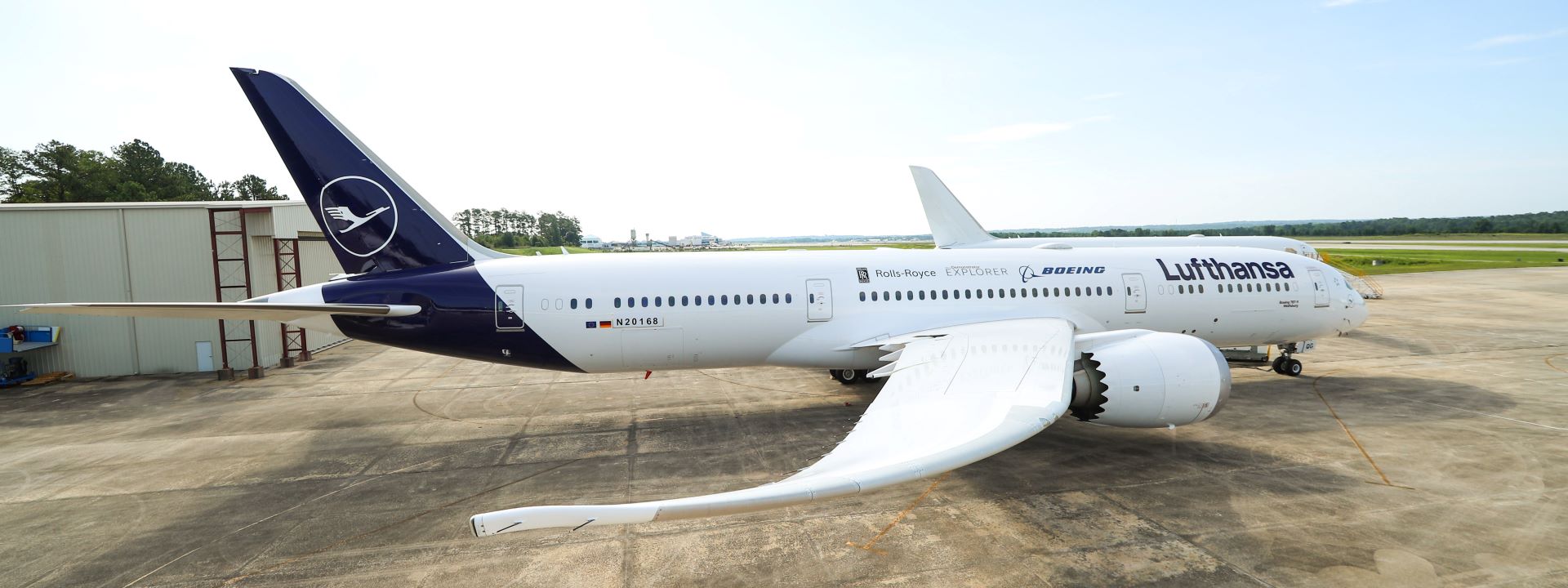
Meet the airplane: The 2026 ecoDemonstrator Explorer airplane is a Boeing 787-9 destined for Lufthansa and powered by Rolls-Royce’s Trent 1000 engines.
Boeing is using this airplane model and these engines to be consistent with previous testing: Rolls-Royce led testing on a previous version of this inlet at its ground test stand in Stennis, Mississippi, and in flight on its 747 Flying Test Bed as part of the FAA CLEEN Phase II program.
Working together to innovate: Boeing has a legacy of bringing together customers, suppliers, government agencies, academia and other stakeholders to help test and strengthen safety, advance innovation and mature sustainable technologies.:
- Boeing, which leads the development of the technologies being tested on this airplane. Boeing is also the lead integrator for this testing and will provide the infrastructure and personnel to conduct the flight tests.
- Lufthansa Group, which generously agreed to partner with Boeing and allow the use of this airplane for the ecoDemonstrator testing.
- Rolls-Royce, which makes the Trent 1000 engines on this airplane and has provided engineering support and oversight for operating the engine with the Next Generation Inlet installed.
- FAA and its CLEEN program, which evaluate innovative aircraft technologies with improved performance and safety. Through this program, the FAA partners with aerospace manufacturers via a cost-sharing approach to support the development and integration of these advanced technologies into current and future aircraft.
Zoom in on the testing: The ecoDemonstrator team is performing flight tests in July and August 2026. The testing will take place at the Boeing site in Glasgow, Montana, which is equipped with a ground-based microphone array. That equipment will help quantify community noise as the airplane flies low and slow over the array, to let engineers study the source and magnitude of the noise from the airframe and engines.
The airplane will be set to a variety of configurations as it flies over the microphones, including different flap, landing gear and engine power settings.
The engineers will also explore how the Next Generation Inlet changes interior noise using microphones in the cabin.
Crunching the data: After the testing concludes, Boeing will process the raw data and work with the FAA and Georgia Tech to understand the benefits at the airplane level. A final report will be released as part of the FAA CLEEN Phase III program and made available to the public.
Boeing will use the learnings from the Next Generation Inlet testing to inform its next steps toward implementation on its airplanes.
Before any learnings from Intelligent Operations testing are implemented by airlines, Boeing will work closely with air navigation service providers, air traffic control and local regulators to coordinate industry agreement and acceptance. Specific airports then would be identified where these changes would drive the greatest benefit.