Boeing spotlights Poseidon demand and partnerships at Farnborough

Boeing leaders joined the German military to discuss the P-8’s growing mission.

July 23, 2026 in Services, Farnborough International Airshow, Defense

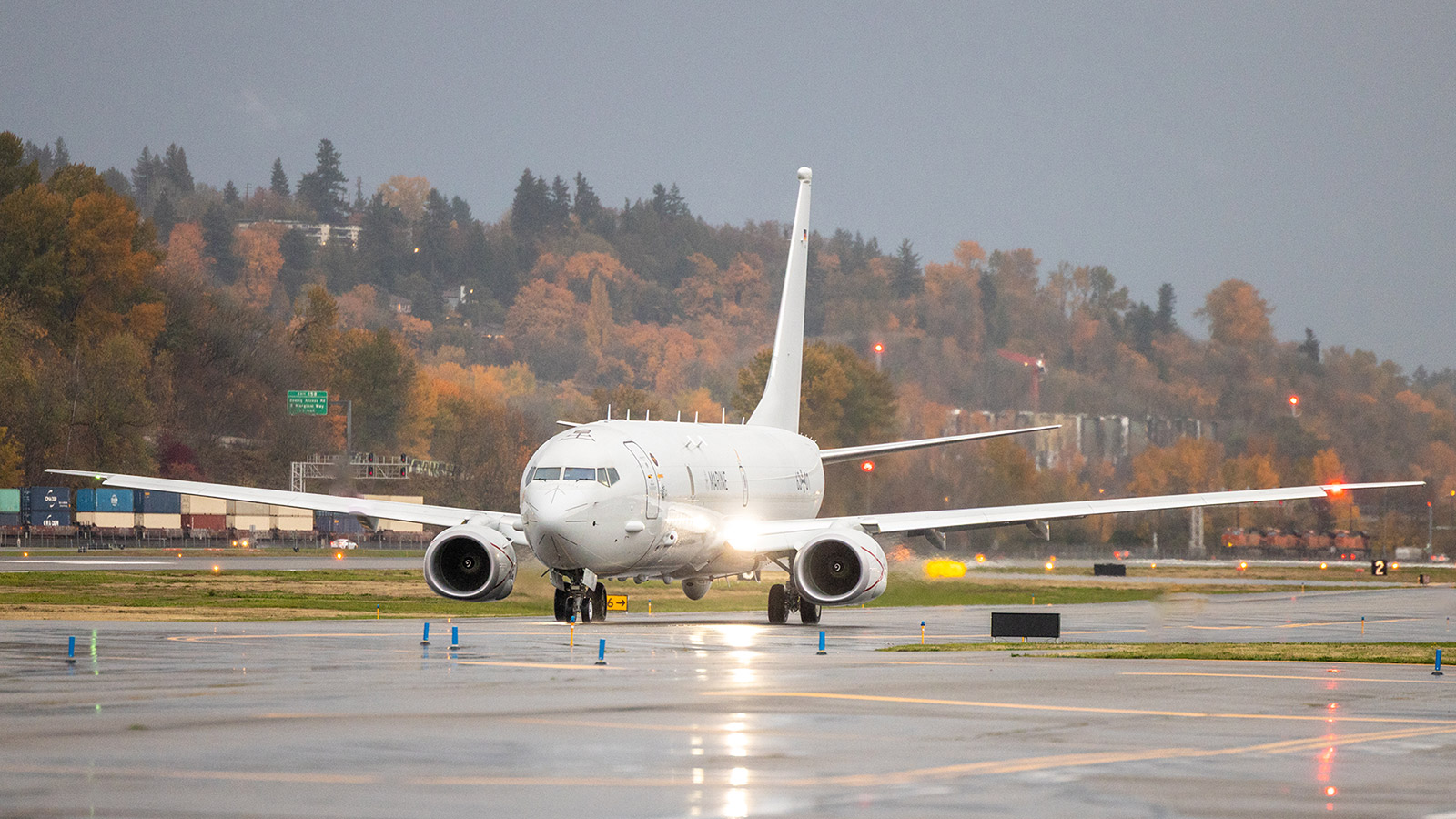
The first of three P-8As delivered to the German Navy.

The P-8 Poseidon took center stage at the Farnborough International Airshow as Boeing and its German customer shared insights on the aircraft’s service record, capabilities and the partnership behind it. Boeing hosted the briefing Wednesday to give global journalists and industry leaders a closer look at the marine patrol and reconnaissance aircraft’s growing mission, demand and collaborative opportunities. 

Captain (N) Broder Nielsen, Commanding Officer, German Naval Aviation, shared support for the platform, which first entered service in 2013, and has flown in Germany since 2025.

“This aircraft is wonderful,” said Capt. Nielsen. “We received it nine months ago, and we were already around the globe basically with this aircraft. We flew to India, and we flew to Lossiemouth in the U.K. and to Norway. And this aircraft is so, so important for us. It just really makes a difference in operations.”

He went on to thank Boeing teammates for doing important work producing the P-8 and providing the services to keep it mission-ready.

Why it matters: The P-8 is in high demand as countries look for maritime patrol capability. The program supports jobs, training and local industry in several countries. It is a multi-mission aircraft for anti-submarine warfare, anti-surface warfare, intelligence, surveillance and reconnaissance, maritime domain awareness, and search and rescue.

The platform, based on the commercial 737 Next Generation, is operated by the U.S. Navy, United Kingdom, South Korea, Norway, New Zealand, India, Germany and Australia, with orders from Canada and Singapore.

Voice of customer: German Navy on the P-8 Poseidon and a message for Boeing employees

Driving the news: Capt. Nielsen was joined by Turbo Sjogren, Global Services vice present and general manager for Government Services, and Tim Flood, senior director of Business Development, Europe and Americas, for Defense, Space & Security.

This session highlighted the P-8 as a “battle-proven capability” with multi-domain integration, interoperability, data sharing and flexibility. It also pointed to the aircraft’s open mission systems architecture and its ability to add technology over time.

  • Boeing has delivered 178 P-8s, with more than 730,000 combined flight hours.
  • Boeing has delivered the first three P-8A aircraft to the German Navy, which increased the global fleet to eight operators.

Zoom in: The event also showed how Boeing works with local industry in the United Kingdom, Germany, Canada and Denmark.

  • Boeing Defence U.K. employs about 2,000 people across 18 sites, including sustainment and training at RAF Lossiemouth. More than £300 million of direct investment has been made in the United Kingdom since 2015, including £50 million at RAF Lossiemouth.
  • In Germany, partners include Lufthansa Technik and Hendsoldt ESG.
  • In Canada, the CP8A Industrial and Technological Benefits Program supports about 3,000 jobs and adds $358 million to the economy each year.
  • In Norway and Denmark, Boeing has pursued local partnerships tied to P-8 sustainment and support.

The bottom line: Customers around the world are seeing the P-8’s operational value and Boeing’s long-term role as a partner to customers and local industries.

  • “When Boeing makes a commitment to deliver the P-8 Poseidon to a customer, we also promise a partnership,” said Turbo Sjogren. “That is a commitment that continues to build sovereign industrial strength for that customer.”
  • “The introduction of the P-8A represents much more than just the arrival of a new aircraft,” said Capt. Nielsen. “It marks the establishment of modern maritime patrol and anti-submarine warfare capability for the German Navy, and it will significantly enhance our contribution to NATO’s maritime security as well. Looking back over the past nine months, I can say with confidence that the program has developed extremely well. The aircraft has demonstrated its operational value, and the pace of progress has been really impressive.”

By Jeremy Alexander