Inside the cockpit with the Boeing Employees’ Flying Association

The group opens doors to aircraft and experiences that many Boeing teammates could not get anywhere else.

July 29, 2026 in Community

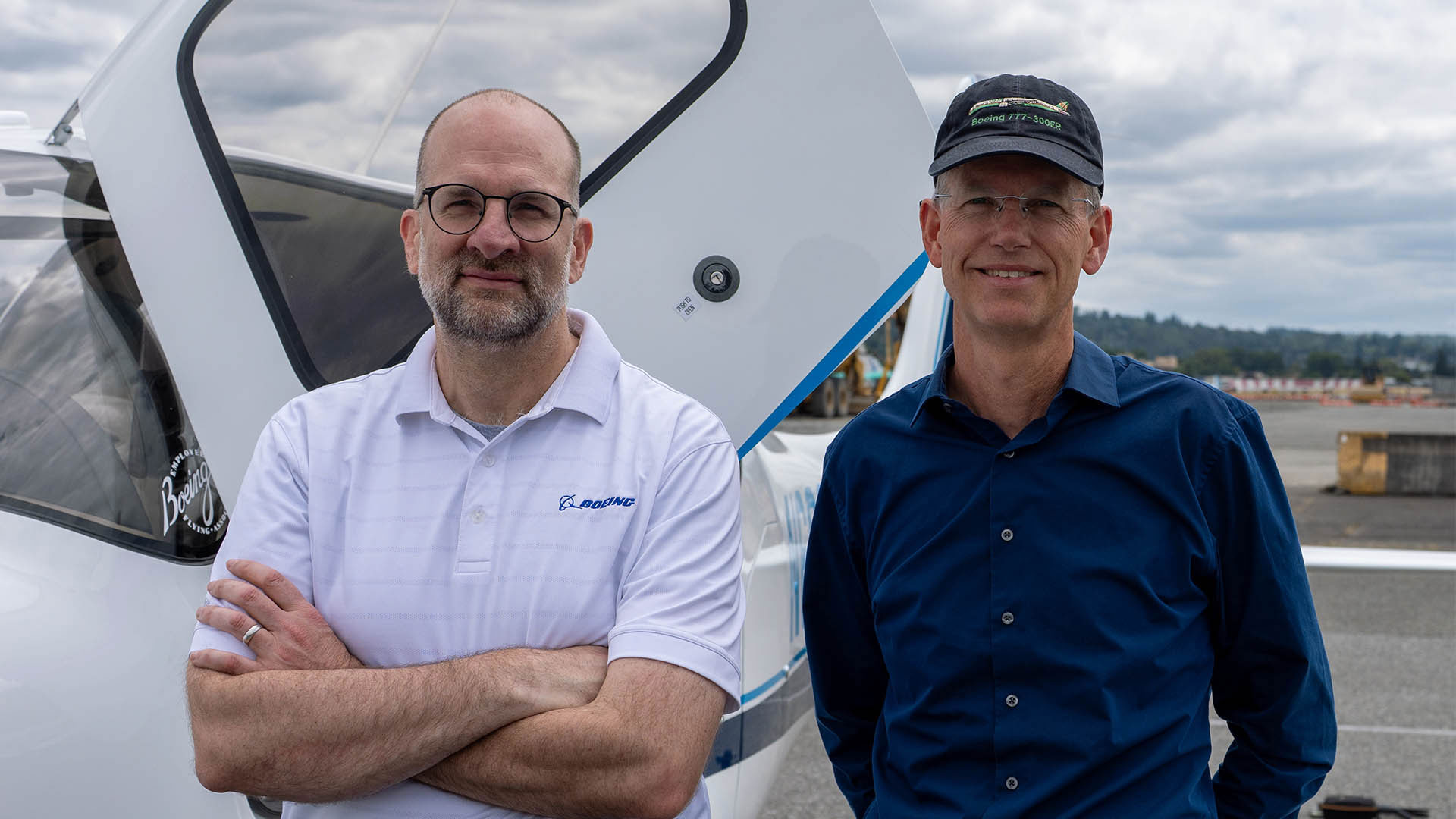
Boeing Employees' Flying Association members Tom Sanderson, left, and Jim Dobberfuhl, right, pose in front of the group’s special-edition Cirrus airplane. Boeing Employees' Flying Association members Tom Sanderson, left, and Jim Dobberfuhl, right, pose in front of the group’s special-edition Cirrus airplane. (Pat Chiesa photo)

The wind whips across the tarmac, so relentless that it cuts through the audio of Tom Sanderson’s video dispatch.

“Hey team, we’re here at Sturgis Municipal Airport in Sturgis, South Dakota,” Sanderson says into his front-facing camera between gusts, the airport’s powder-blue “terminal” in the frame behind him.

To call Sturgis an airport might be a bit of a stretch; it’s basically just a strip of blacktop flanked by a few weathered hangars. But the setting is in keeping with the spirit of Sanderson’s mission: piloting a Boeing Employees’ Flying Association plane all the way from the Pacific Northwest to EAA AirVenture in Oshkosh, Wisconsin.

This is merely the second pitstop out of five for Sanderson and co-pilot Jim Dobberfuhl, another BEFA member, given the cruising range of the four-seater Cirrus personal aircraft they’re flying.

And they’ll be diverted a few more times due to wildfire smoke affecting visibility in the upper Midwest — to South Wisconsin Regional, then Green Bay before finally landing at the show — but if Sanderson is any worse for the wear, it isn’t evident in his voice.

“It was a beautiful day for flying,” Sanderson said, undeterred by the whipping wind and the dark clouds over his shoulder, capturing something close to BEFA’s group ethos.

The specially painted blue-and-white BEFA Cirrus will be the belle of the ball at Oshkosh, but for Sanderson and Dobberfuhl, the journey there and back — in total, 11 stops and 3,133 nautical miles traveled — is worth it all on its own.
Watch Sanderson and Dobberfuhl's journey from takeoff to touch down at EAA AirVenture. (Pat Chiesa video)

The Boeing Employees’ Flying Association has served company teammates, retirees, and their families since 1954. What keeps BEFA going, members say, is not just the airplanes — it is the access, the range of flying, and the shared sense that aviation should be open to more people.

Joel Purificacion joined BEFA in 2008 while he was designing flight decks and looking for a way to build flight-hours. He said the club was “the natural place to begin” because it connected him to Boeing and made it easier to move from interest to actual flying.

Over time, BEFA has grown into much more than a place to log time: the group now operates from three airports, has more than 25 airplanes, and serves roughly 700 members. That growth matters, members said, because BEFA offers access to aircraft that are hard to find anywhere else.

“BEFA gives members access to airplanes you’d never otherwise get to fly — float planes, aerobatic planes, twins, and taildraggers — that’s the club’s crown jewel,” Dobberfuhl said.

For Dobberfuhl, the appeal of aviation started early, with childhood visits to airfields with his father and later flights in gliders. He said gliders helped teach him both community and affordability, and that lesson still carries through the club’s mission.

“Experimental and homebuilt aircraft lower the barrier to entry for general aviation — you can build something in a garage for the price of a car,” Dobberfuhl said. “Without experimental aircraft, general aviation would be largely unaffordable for most people.”

And everybody should get to try this, BEFA members say, if they have the desire. It’s easy to be tempted, listening to Sanderson’s description of landing on the natural grass strip at Point Roberts, Washington, just below the British Columbia border.

“It’s remote and beautiful — beaches, views of Vancouver Island and the Olympic coast,” Sanderson said. “The ramp is a little rough and it’s very small, but it’s an unforgettable place to land.”

Sanderson describes the appeal of flying as something like a motorcyclist’s fabled freedom of the open road.

“Once you get through the training — which is rigorous and takes money and time — you can just pick a day, call flight service, and go,” he said. “You can land at tiny airports you’d never drive to and be in the middle of nowhere with a beach next to a runway. It shouldn’t work, but when everyone follows the rules, it works beautifully.”

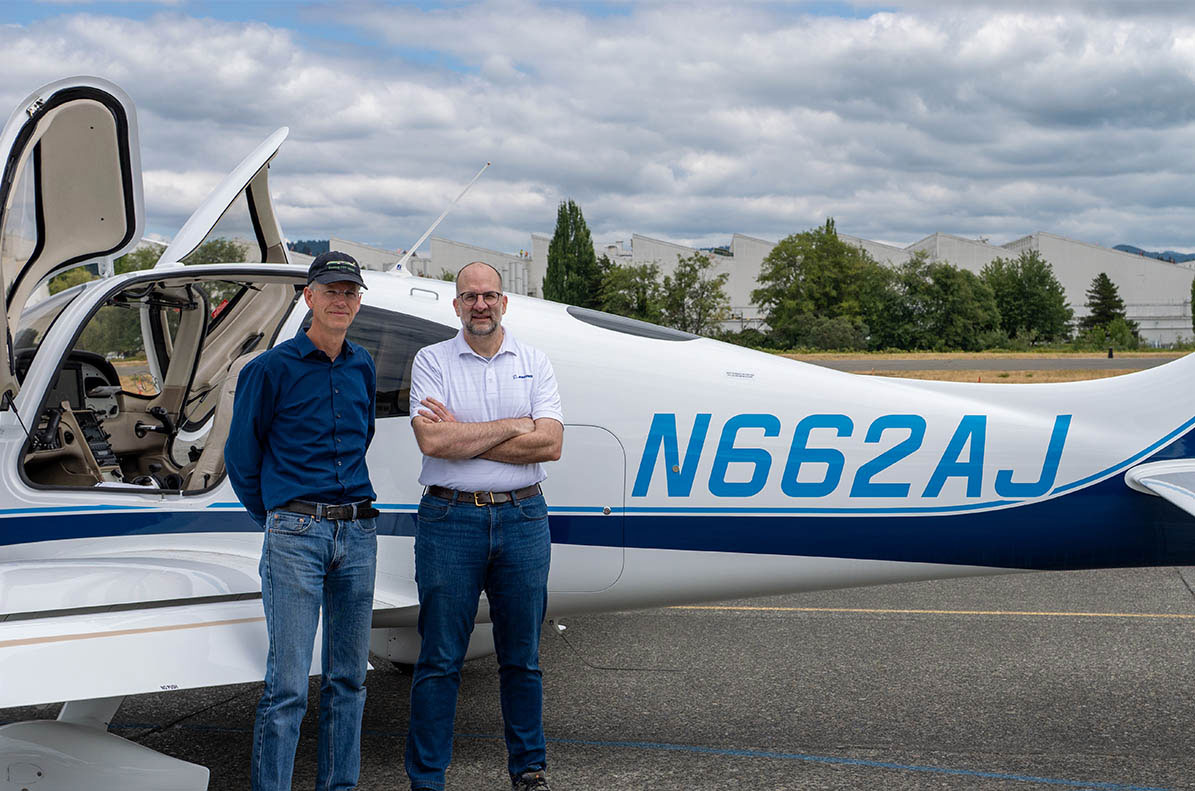
A fuller look at the BEFA-painted Cirrus the crew flew to Oshkosh. A fuller look at the BEFA-painted Cirrus the crew flew to Oshkosh. (Pat Chiesa photo)

Purificacion can still recall his very first solo flight.

“There’s a moment every pilot remembers: The instructor steps out, you taxi, you take off, and suddenly you’re alone in the cockpit,” Purificacion said. “It’s equal parts terror and triumph — the adrenaline hits, and you realize you can do this on your own. Whether you go on to fly 100 hours or 10,000, that first solo sticks with you for life.”

That visceral sensation is part of his sales pitch to prospective members, a pitch made easier by a Boeing Learning Together Program stipend of up to $10,000 for a private pilot rating with the potential for more for advanced ratings.

That is part of what drew the group to Oshkosh, beyond the obvious appeal of connecting with like-minded enthusiasts. Part of Boeing’s stated goals for the show were to both inspire and attract the next generation of aviation professionals. What better recruiting pitch than the chance to earn your pilot license, at least in part, on the company dime?

“There’s nothing like being around people who share the same interests and the same passion,” Dobberfuhl said. “Oshkosh has an infectious energy.”

Dobberfuhl felt it even from above, on their belated final approach into Wittman Regional Airport and EAA AirVenture. Coming in low, beneath the smoky haze still hanging in the air, Boeing Plaza was visible off to their right. Rows of airplanes parked on the North and South 40 were spread out as far as the eye could see.

He and Sanderson both felt giddy, as if they were landing back home.

By Matt Pentz