A fitting finale for Freedom Plane in the city that defines aviation

The 737 carrying America’s founding-era documents makes its final stop where Boeing began

August 03, 2026 in History, Our-Community

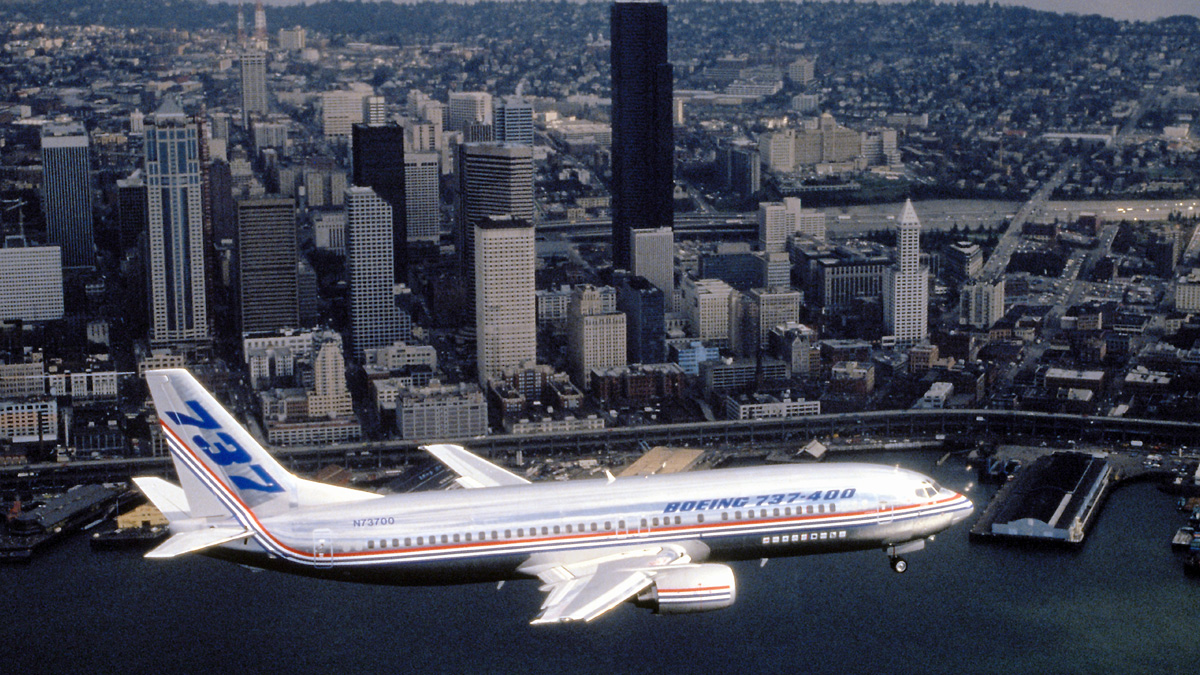
A Boeing 737-400 flies over the Seattle skyline, date unknown. The first flight of the 737-400 was on February 19, 1988. All photos courtesy of the Boeing Archives unless otherwise noted.

From July 30 to August 16, founding-era documents carried by the Freedom Plane will be on display at the Museum of History & Industry (MOHAI) in Seattle, WA. A fitting end to a journey that has spanned eight states in four months, the Freedom Plane makes its final stop in the city where it was not only built, but where the Boeing Company was founded 110 years ago. To honor the newest and final stop, here’s a look back at the revolutionary products and moments that not only helped define Boeing as a leader in aerospace, but as an iconic American company.

On March 11, 1910, American aviator Charles K. Hamilton conducted the first airplane flight in the state of Washington at The Meadows racetrack in South Seattle. That same year, a young timber magnate named Bill Boeing purchased Heath Shipyard, a small ship-building business in the same neighborhood.
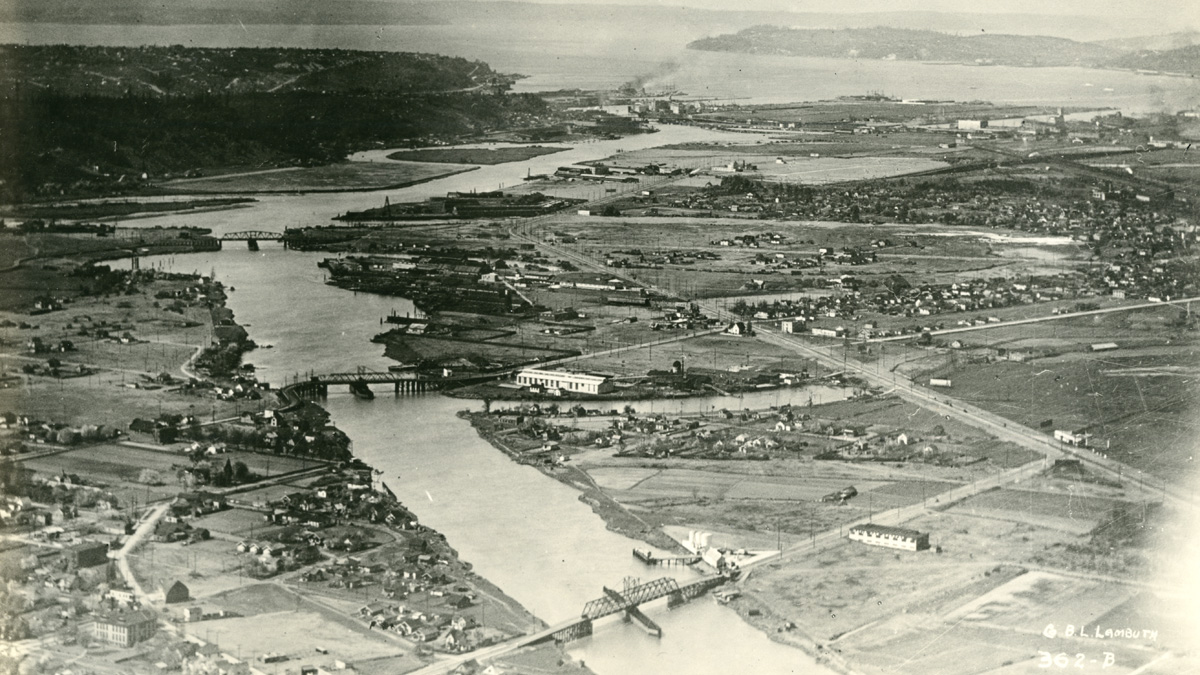
Aerial of the Duwamish River, 1923. Boeing opened its doors on the banks of the Duwamish River in South Seattle near today’s Georgetown neighborhood.

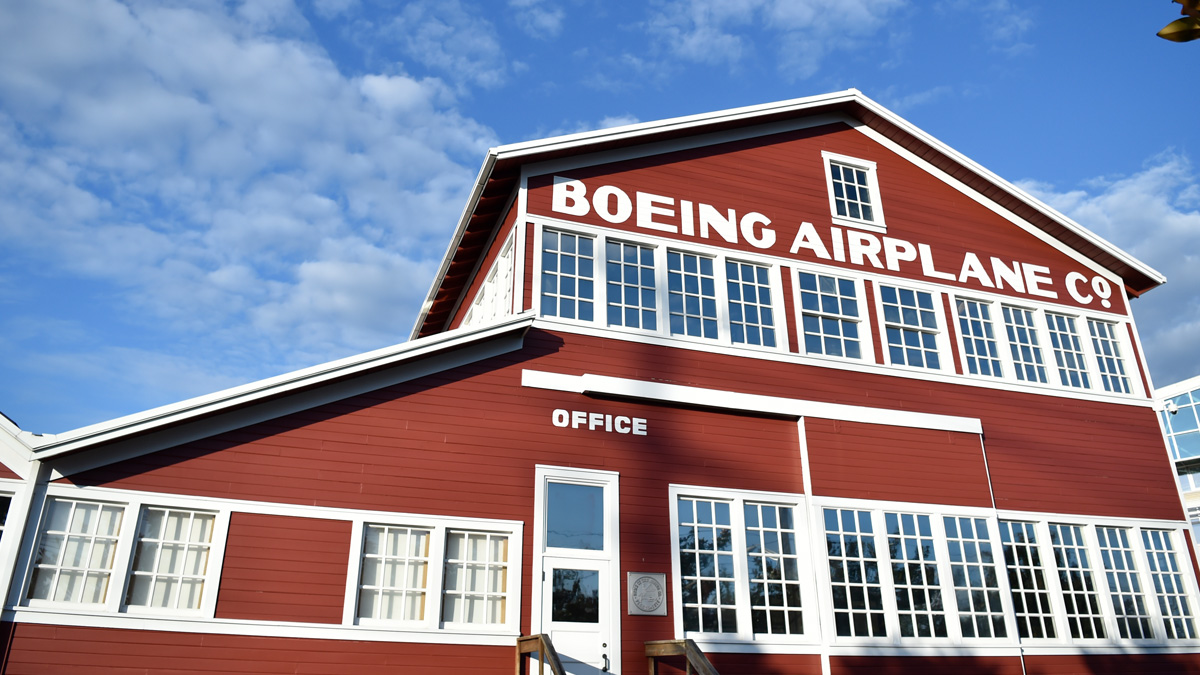
Ed Heath was building a yacht for Bill at the time, but his business was struggling. So, Boeing bought the shipyard and acquired Heath’s debts.  Within 6 years, the shipyard became the first headquarters for the Boeing Aircraft Company. Today, we know it as the Red Barn – an aviation landmark almost as iconic as the airplanes that were built there.

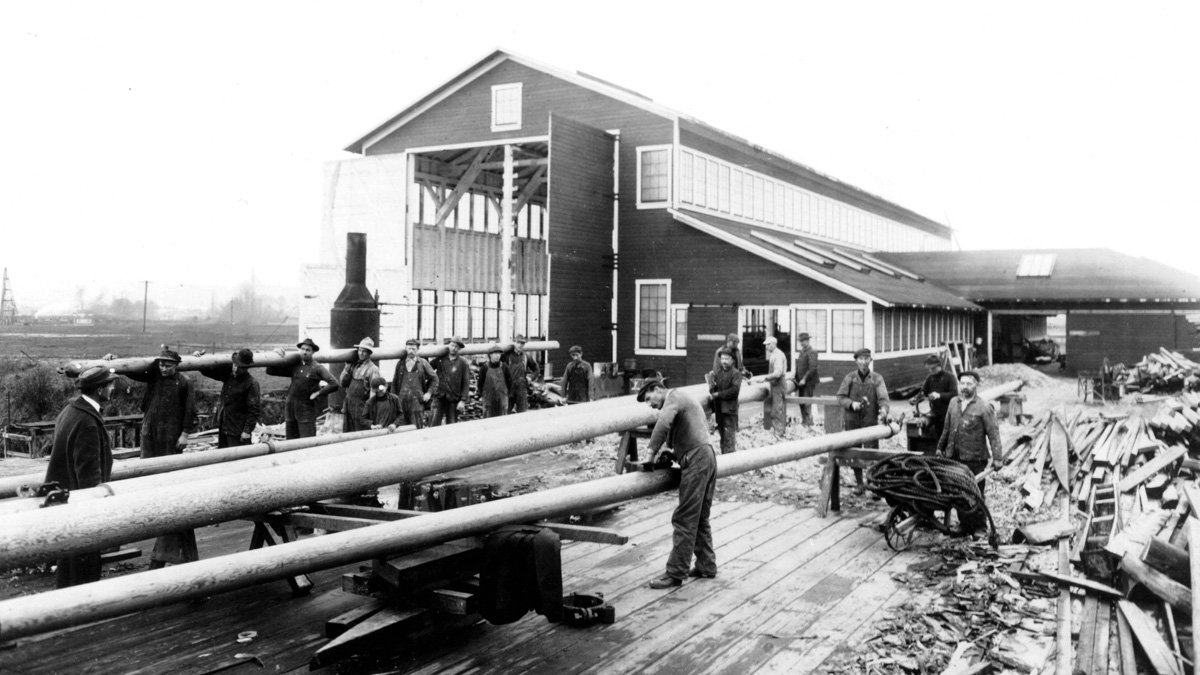
Workers at the Red Barn, c. 1910s. In the Red Barn, builders and accountants worked downstairs, while engineers worked upstairs.
In use from 1916 to 1970, the Red Barn is now part of the Museum of Flight in Seattle.

For those in and around Seattle, Boeing is a staple. Manufacturing facilities, trains carrying fuselage sections through town, planes flying overhead, the blue Boeing logo on buildings throughout the region – all reminders of the company that made Seattle its home 110 years ago. And throughout the decades, the impact that Boeing has had on American history is undeniable. From the mass production of aircraft during WWII to ushering in the Jet Age, some of Boeing’s most influential designs began in Washington, the company’s home state.

In the early years, Boeing was still gaining ground. After almost going under in 1919, the company continuously found ways to evolve and meet challenges, whether it was flying the mail cross-country, designing early military fighters or revolutionizing commercial travel with all-metal planes.  It was a time when competition was strong and the world was still discovering what the airplane could do. While there were milestone moments that propelled Boeing forward, World War II would become the catalyst that transformed the company into an industrial giant. It would also be the period that reshaped Puget Sound.

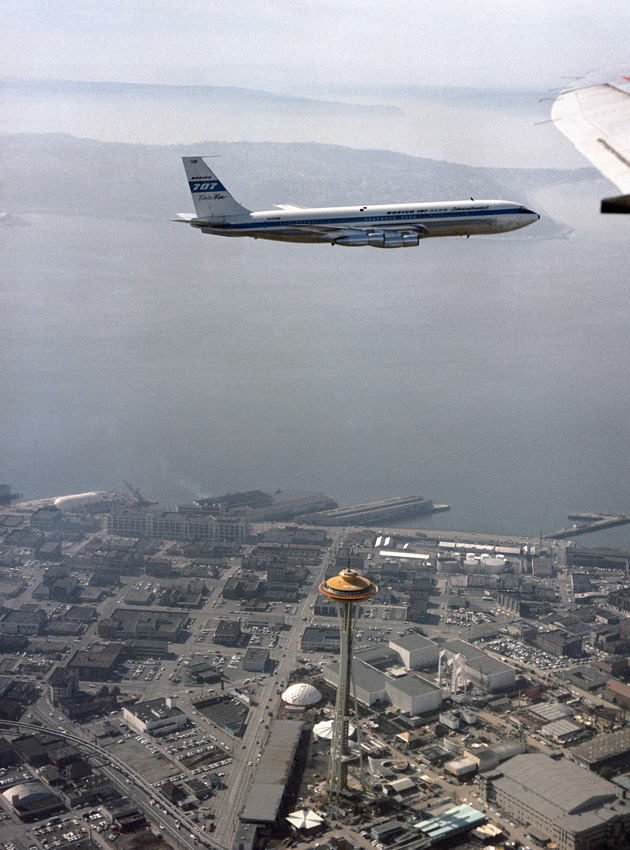
A Boeing 707 flies above Seattle’s Space Needle, 1962.

The Arsenal of Democracy concept articulated by President Franklin D. Roosevelt redefined industries, societies and communities around the United States. This “arsenal” was the immense cache of military supplies for the Allied nations. If the Allies could out-produce the enemy, they would be able to win the war. When it came to aircraft manufacturing, Boeing helped lead the way, both in engineering and mass production.

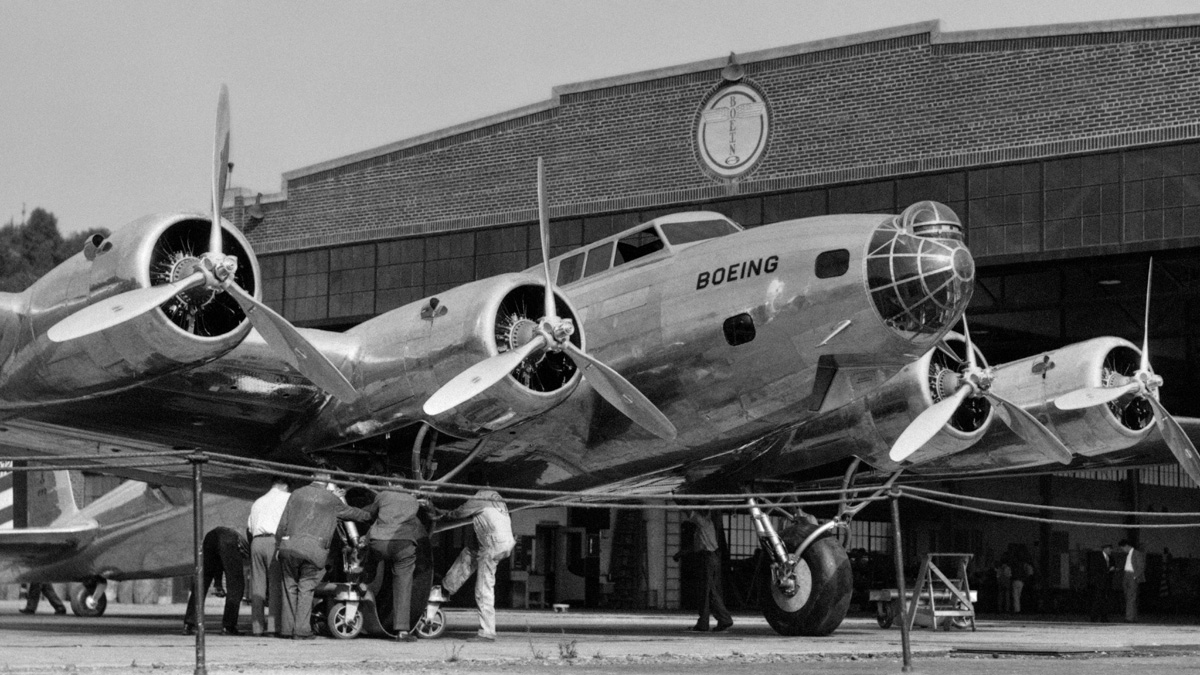
That journey began with the Model 299, the four-engine bomber prototype designed and built by Boeing engineers at Plant I in Seattle. Through a series of challenges, including the loss of both the prototype and Boeing test pilot Les Tower during a series of tests at Wright Field in Dayton, OH, the Model 299 would go on to become one of the most influential products of the war – the B-17 Flying Fortress.

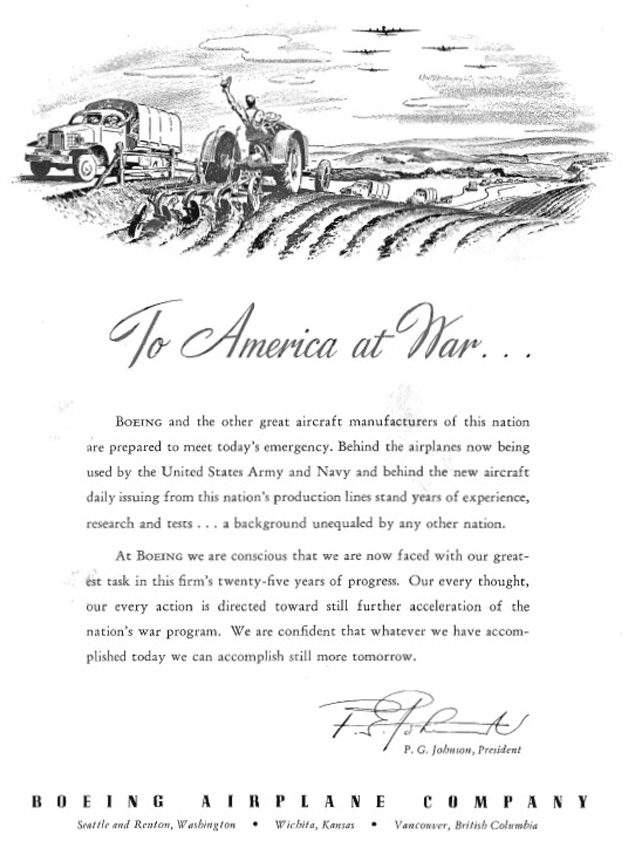
Published in Time Magazine in February of 1942, the company’s wartime President Phil Johnson addressed the nation on behalf of Boeing. “Our every thought, our every action is directed toward still further acceleration of the nation’s war program.” This is when the company shifts from an engineering focus to becoming a manufacturing powerhouse.
Model 299 prototype in front of the hangar at Plant I in Seattle, 1934.

The B-17 is a triumph of Boeing’s engineering excellence, an iconic symbol of the war effort, and the foundation of many successful military campaigns. Other companies would build the Boeing-designed B-17 as well. There was no competition, only cooperation, as Americans joined together for a shared purpose. The only thing more impressive than the aircraft production itself were the communities that built up around it.

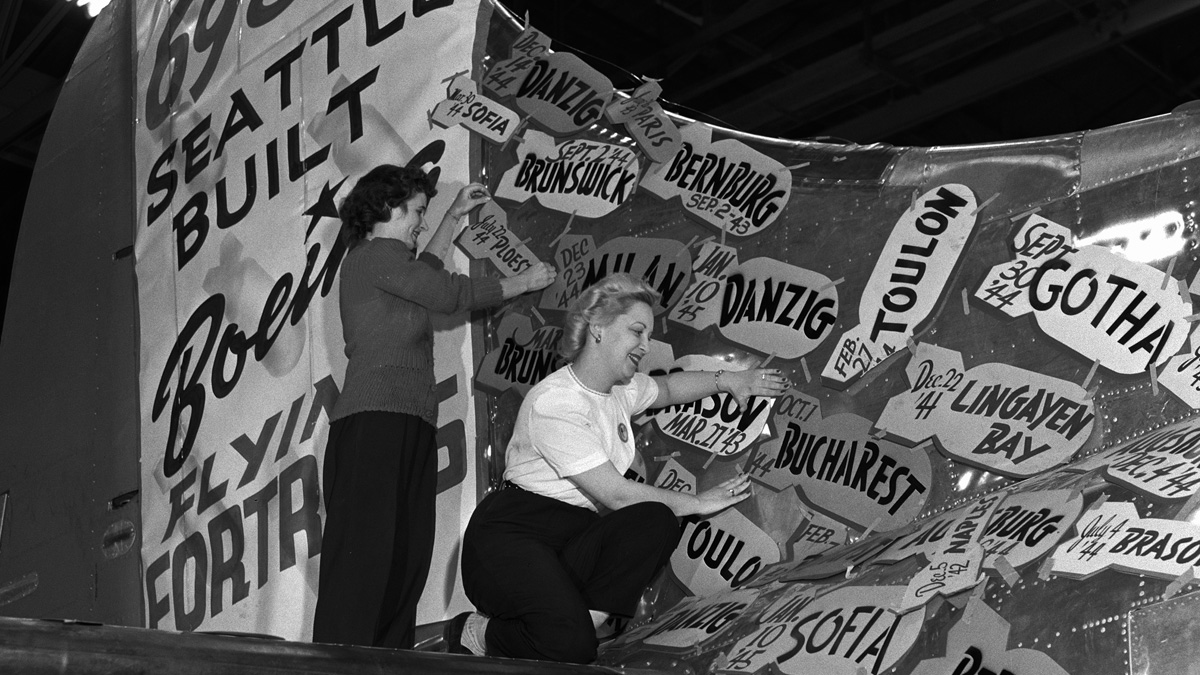
Nearly half of all B-17s were built at Plant II in Seattle, which was constructed in 1936 to accommodate mass production. By 1944, nearly 50,000 people were employed at Boeing’s Seattle facilities, many of whom were women.
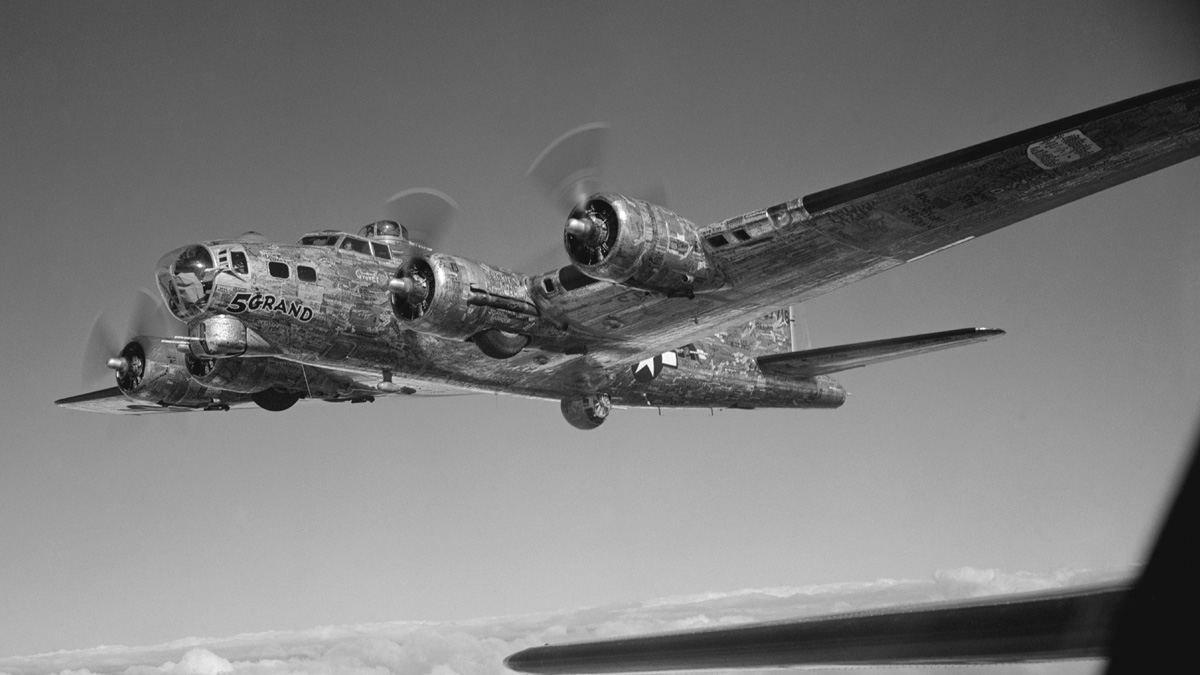
The 5,000th B-17 takes flight, c. 1940s. The B-17 was the third most-produced bomber of WWII, with just under 13,000 built by Boeing, Douglas and Lockheed.
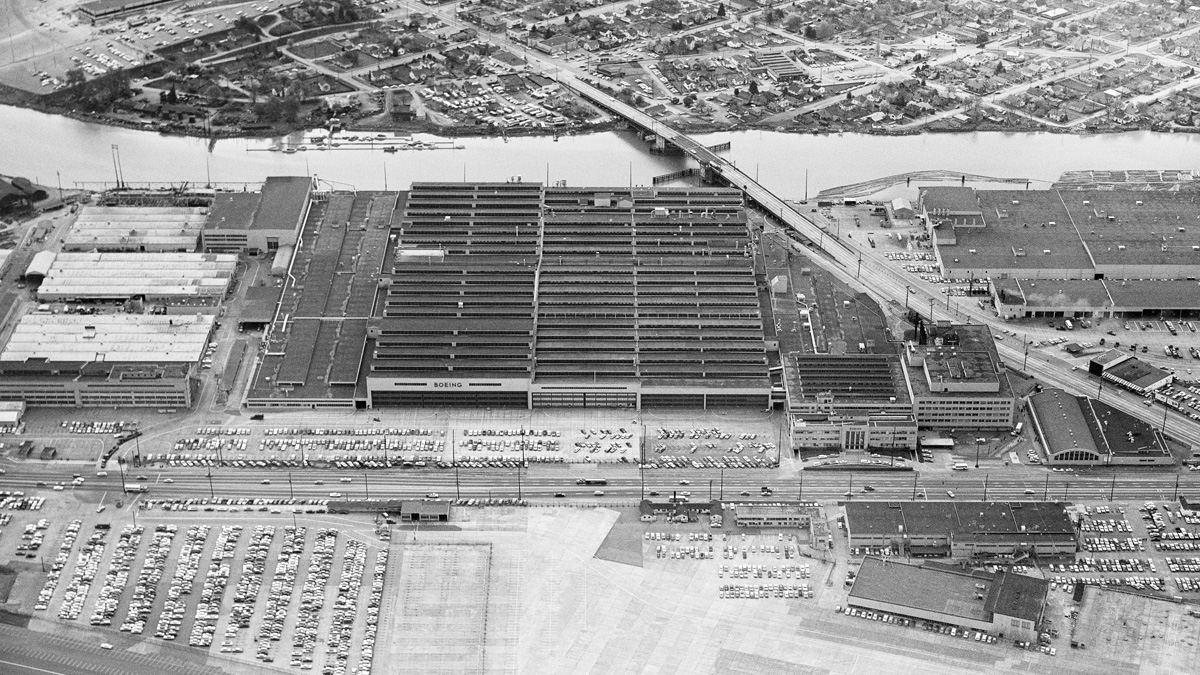
Aerial of Plant 2, 1960. Boeing’s Plant 2 no longer exists, having been demolished in 2011 as part of Boeing’s commitment to cleaning up the habitat around the Lower Duwamish Waterway. But it was the home to some of Boeing’s most iconic designs. The B-17, 307 Stratoliner, B-29, B-50, 377 Stratocruiser, B-47 and the B-52 all rolled through its doors.

Just 12 miles south of downtown Seattle, the city of Renton sits alongside Lake Washington. Once a small coal mining community of less than 5,000, its population quadrupled from 1940-1945 after Boeing came to town to build the B-29 Superfortress in 1941. Initially a plant built to produce the Navy’s XPBB-1 Sea Ranger, the Boeing Renton Factory shifted to production of the B-29. 

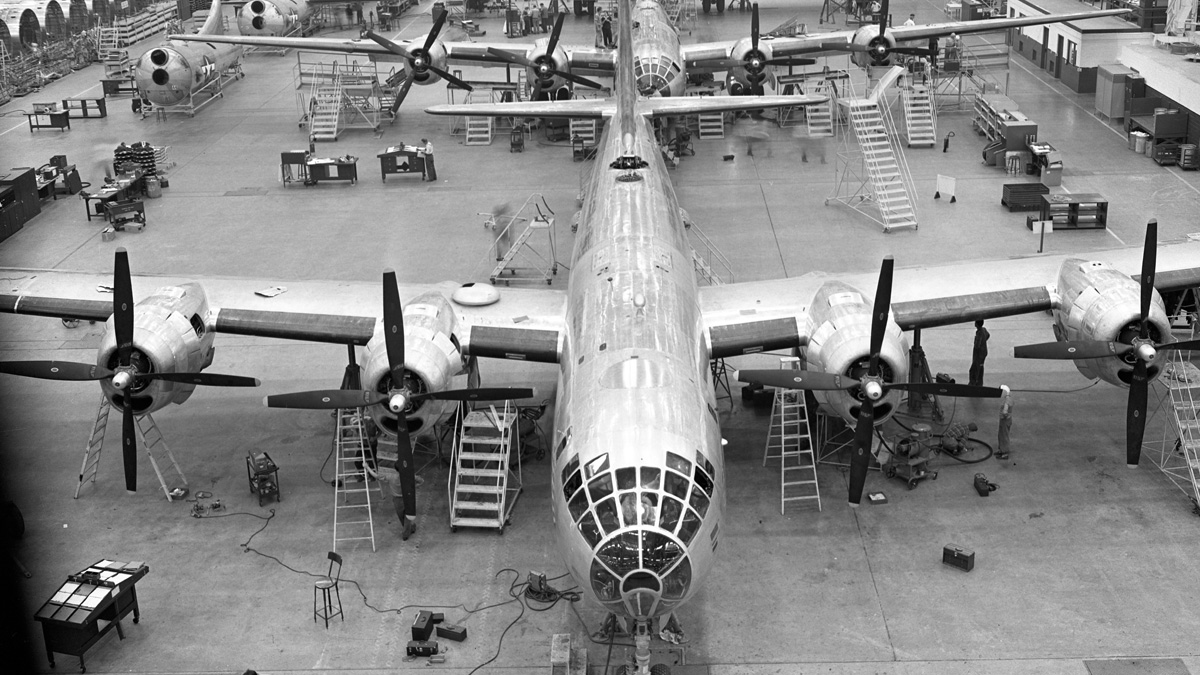
B-29A final assembly line at the Renton Factory, c.1940s. The B-29 was the most technologically advanced bomber of the time. 3,970 were built by Boeing, Bell Aircraft and Glenn L. Martin Co. Along with 3 prototypes, 1,122 were built in Seattle but the majority were built by Boeing Wichita which produced approximately 44% of all B-29s during the war.
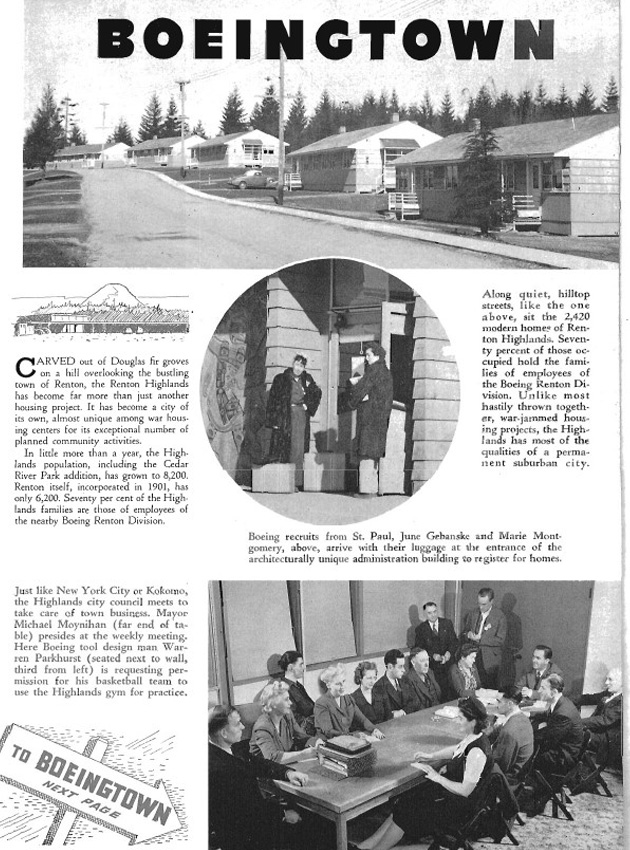
Image from the Boeing News, c. 1940s. The Renton Highlands neighborhood built up rapidly as workers moved to the area to work for Boeing. Initially designed as a temporary community, today the Highlands remains a permanent part of the city. This was true for other cities across the United States as well that found themselves at the center of wartime production. Cities like Tulsa, Wichita and Los Angeles experienced population booms.

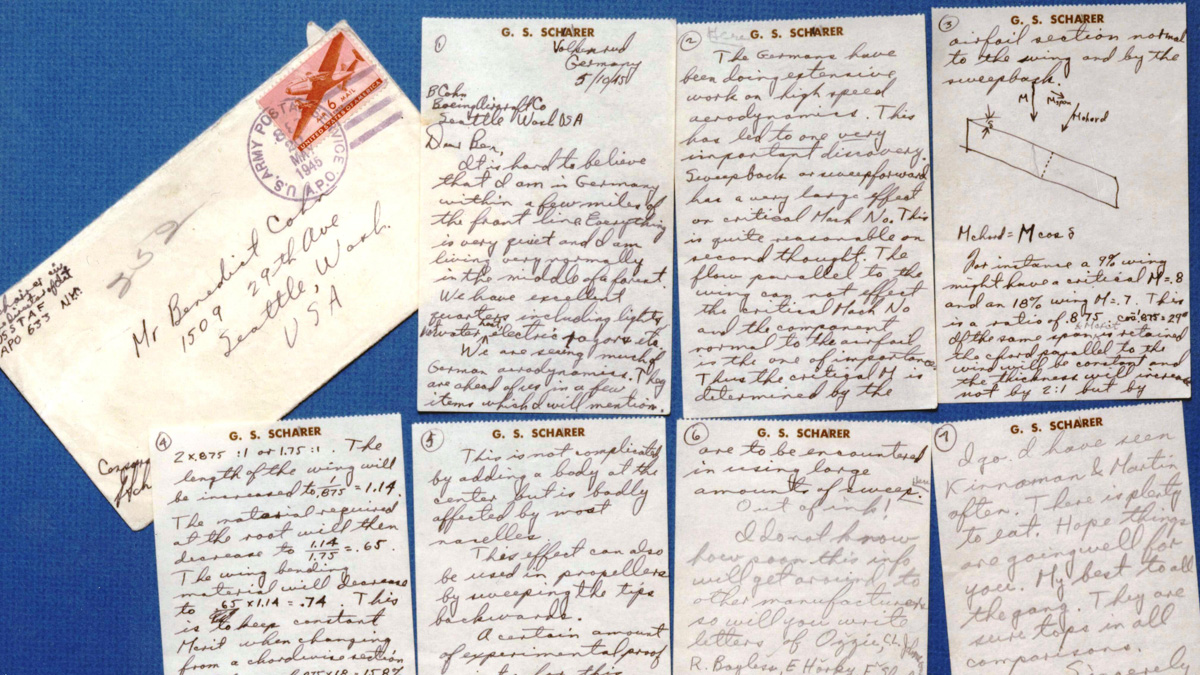
After WWII, the military began its transition to jet bombers as the nation shifted into the Cold War era. And once again, Boeing engineers rose to the occasion. On a trip to Germany in 1945, Boeing Chief Aerodynamicist George Schairer came across the technology of a swept-back wing. Recognizing its importance, he wrote back to his colleagues in Seattle and instructed them to use this technology on their new jet bomber prototype – the XB-47.

George Schairer’s letter resides at the Museum of Flight.
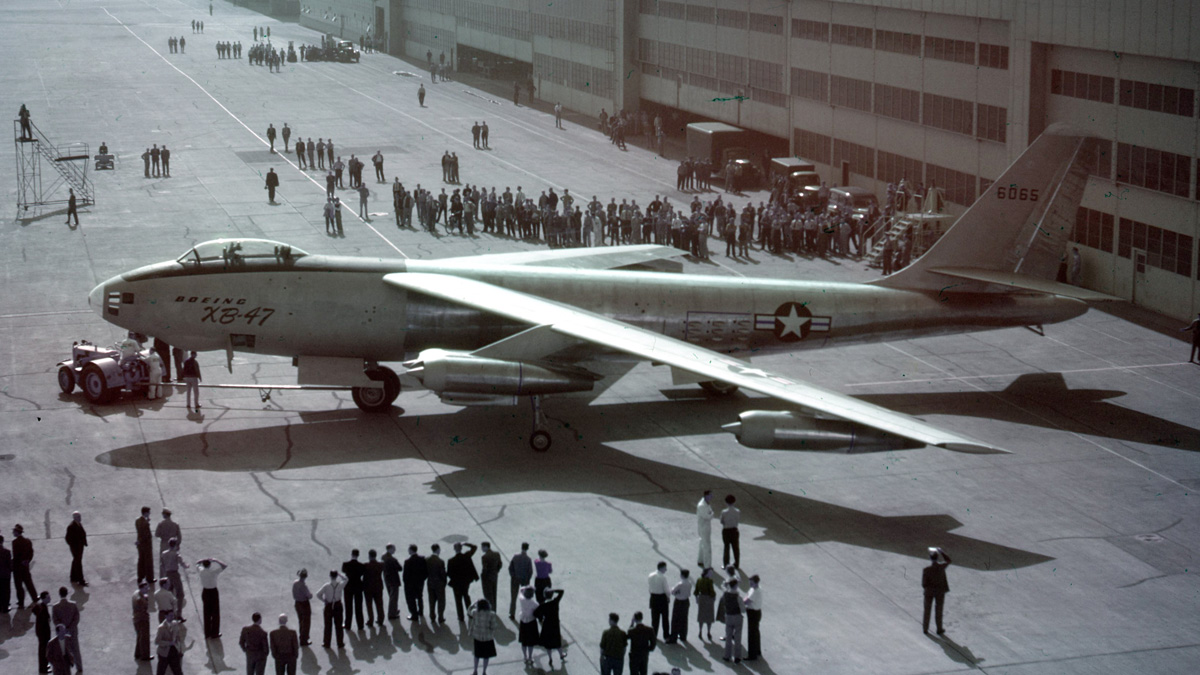
The XB-47 rolled out in Seattle on Sept. 12, 1947. Designed as a Cold War deterrent, the new jet bomber from Boeing was a testament to the engineering excellence that continued after the war. 2,032 B-47s were produced by Boeing and under license by Lockheed and Douglas.

The B-47 Stratojet changed aviation forever.  As the world’s first large swept-wing aircraft, it set the design precedent for all aircraft to follow. Along with the 35-degree angle of the wings, pod-mounted engines were placed underneath, improving speed, safety and structural weight. Today, this is the standard design for all modern jetliners.

In the 1950s, Boeing CEO Bill Allen committed the company to designing a prototype for a commercial jetliner. With no orders on the table, it was a risky business decision, but one that paid off.

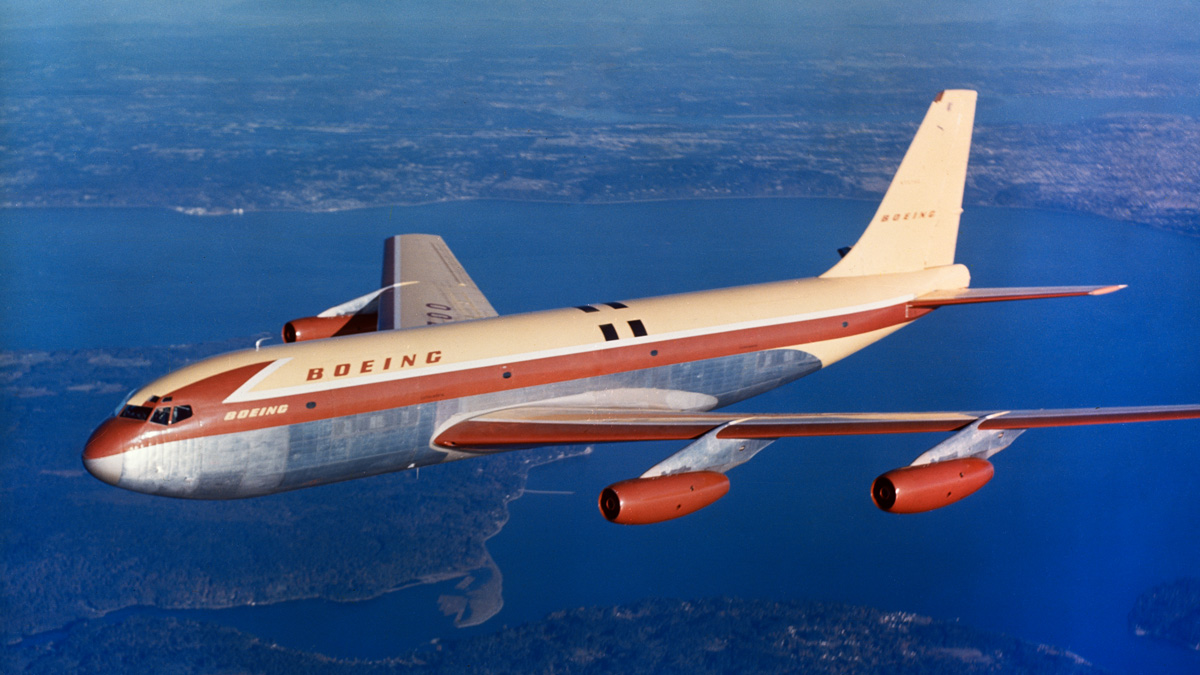
Dash-80 takes its first flight over the Puget Sound, 1954.

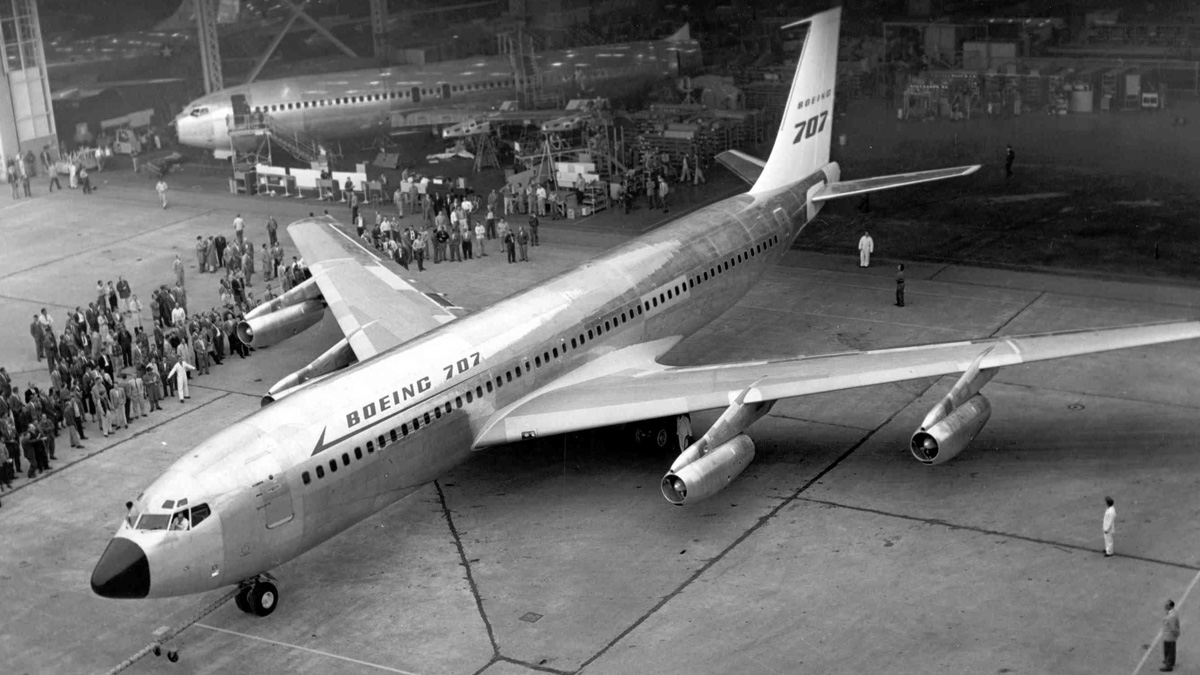
The 367-80, also known as theDash-80, rolled out of the Renton plant on May 14, 1954, symbolizing a new future of aviation. By 1955, Pan American placed 20 orders for what came to be called the 707, becoming the launch customer for the world’s first successful commercial jetliner. Utilizing key features of the B-47 like the swept wing and podded engines, Boeing had officially ushered in the commercial Jet Age.

On Oct. 28, 1957, the first 707 for Pan American Airways rolled out. Other 7 series to roll out of the Renton Plant include the 727, 737 and 757, earning Renton the name “Jet City.”

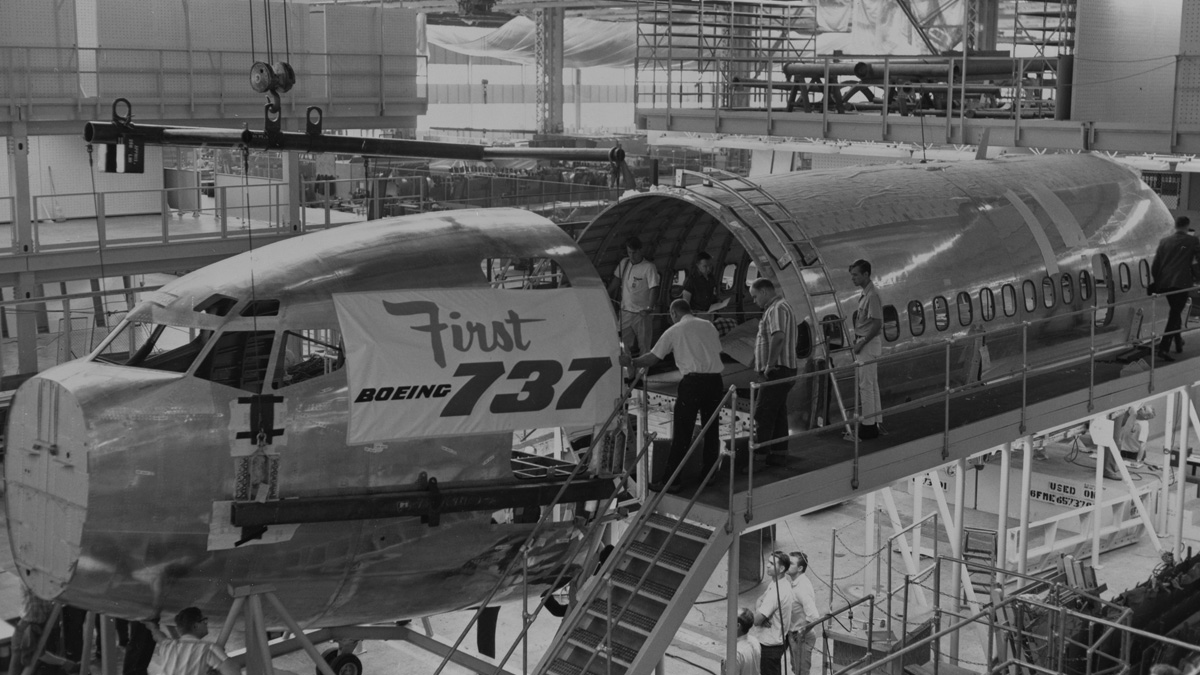
A decade later, the first model of what would become the most successful commercial jet of all time, rolled out of Boeing’s Thompson Site in Tukwila, WA. Bordering Seattle directly to the south, the facility located 5 miles from the Red Barn became the birthplace of the 737 in 1967. In 1970, production moved to the Boeing Renton Factory, where the newest series of the 737 family is still being built today.

The first Boeing 737 being built at the Thompson site, 1966.

Boeing’s impact in Washington is nothing short of incredible. From the Everett factory to the north that was built to accommodate the iconic 747, to the Fabrication Division in Auburn, to the Space Center in Kent and the flight testing and maintenance operations at Moses Lake, Boeing’s role in shaping aviation in the state has grown beyond Seattle. Current programs in the Seattle/Puget Sound region include the 737 MAX, 777, 777X, 767, KC-46 Pegasus, P-8A Poseidon, E-7A Wedgetail and support for the VC-25B Presidential Airlift. There are more Boeing employees in Washington than anywhere else in the world.

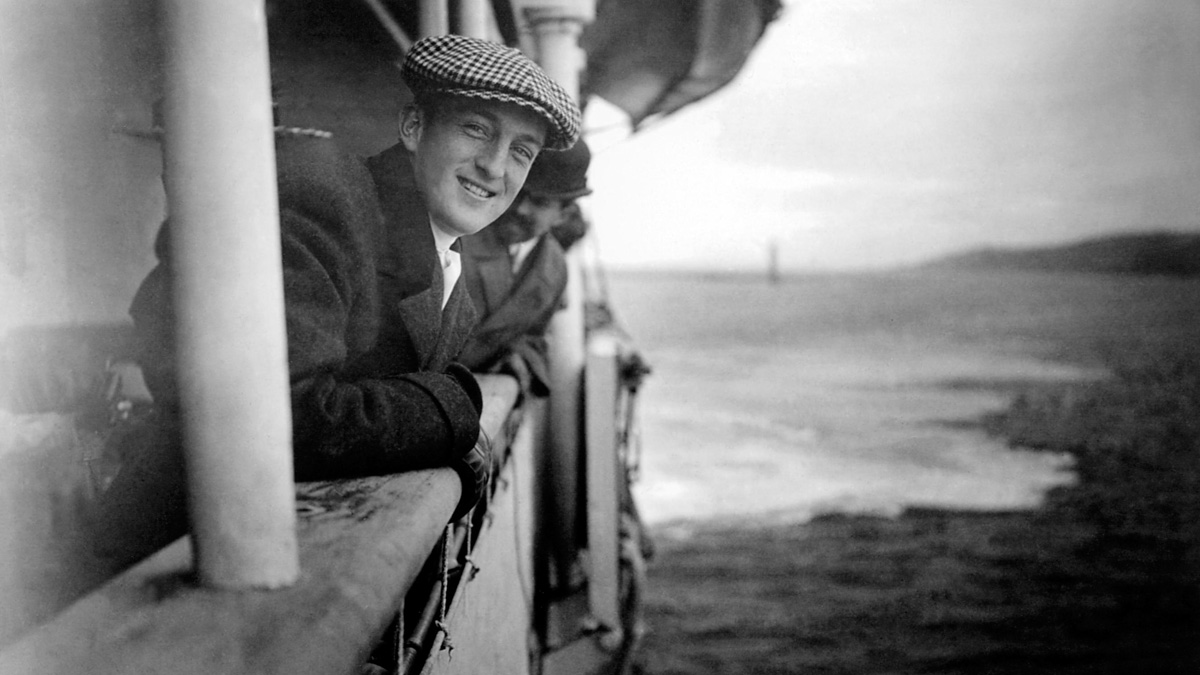
Bill Boeing retired from the company in 1934, but his foundational principles – quality, integrity, safety and honest value – continued. Twenty years later, he attended the rollout of the Dash-80. Bill Boeing passed away in 1956, having lived long enough to see the company he started usher in the Jet Age and change the future of aviation.

A young Bill Boeing aboard a steamer in 1903 — the year he moved to Seattle. Photo: public domain.

The Boeing Company’s story is ultimately an American one. It began as a small company struggling to gain footing in a new industry, fighting hard to stay in business, and overcoming challenges until it was able to thrive in an industry it helped create. American aviation and The Boeing Company grew up together, and the success of both are intertwined. Each period of American aviation history has been shaped by Boeing, especially in Puget Sound. 

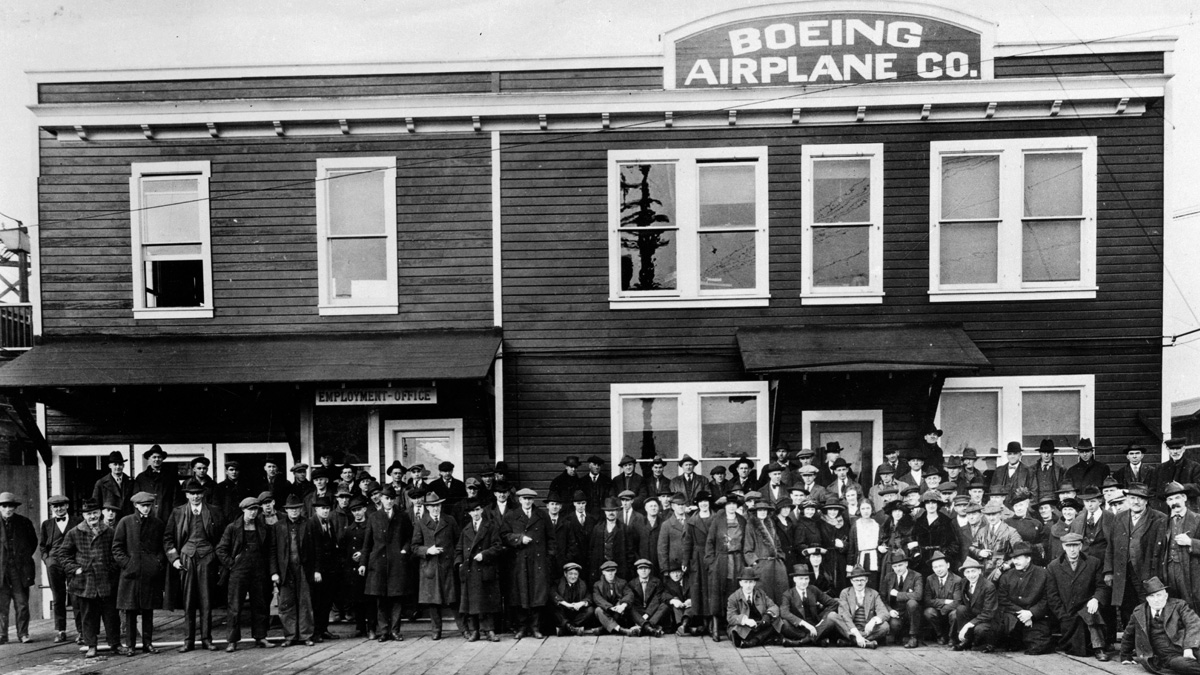
Company employees, c. 1920s. The original Boeing Main Office building was just off to the side of the Red Barn, on the banks of the Duwamish River.

Today, Boeing is a global company with a presence in over 65 countries. With products that connect the world and as an enterprise that operates across borders, the Boeing Company continues to positively shape the aerospace industry. But as the scale of Boeing’s business continues to expand, it’s important to remember where the company started – with a handful of people building airplanes in an old Seattle shipyard, sharing a vision of what could be possible in America.

By Anna Italiano