Boeing releases Cascade 3.0 to explore aviation’s future

New model updates and a refreshed website offer deeper insights into aviation's emissions reduction.

August 30, 2026 in Environment

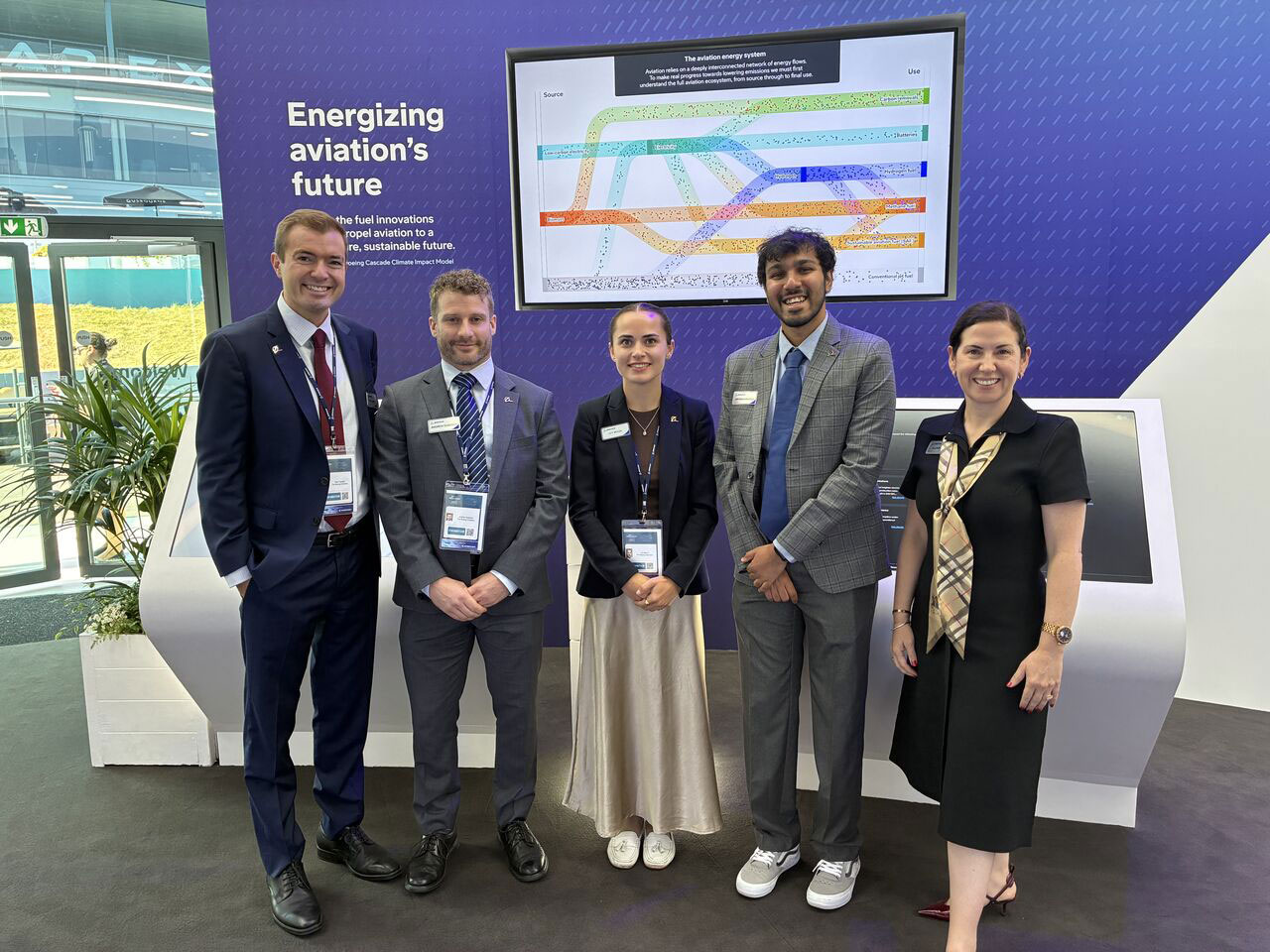
The Global Enterprise Sustainability and the Boeing Cascade teams showcase the Cascade interactive exhibit during the Farnborough Airshow. From left to right: Ryan Faucett, VP of Global Sustainability Engagements and Partnerships; Andrew Sweeney, Cascade Senior Analyst, Lily Meech, Cascade Energy Carrier Engineer; Abhinav Mahesh, Cascade UX/UI Design Lead; Allison Melia, VP of Sustainability. The Global Enterprise Sustainability and the Boeing Cascade teams showcase the Cascade interactive exhibit during the Farnborough Airshow. From left to right: Ryan Faucett, VP of Global Sustainability Engagements and Partnerships; Andrew Sweeney, Cascade Senior Analyst, Lily Meech, Cascade Energy Carrier Engineer; Abhinav Mahesh, Cascade UX/UI Design Lead; Allison Melia, VP of Sustainability.

Boeing has released version 3.0 of its Cascade Climate Impact Model, featuring several new updates and capabilities through the renewed website. Launched at the Farnborough Airshow, the data modeling and visualization tool continues to help airlines and policymakers in evaluating pathways and see end-to-end trade-offs – demonstrating that reducing aviation’s carbon emissions requires a combination of strategies.

Why it matters: Demand for commercial aviation continues to grow globally, connecting people and enabling economic growth. To do so sustainably, Boeing is committed to helping airlines and governments achieve their climate goals. Cascade supports this by turning data into actionable insights.

  • It is a free, open-access tool built on public flight and energy data, allowing stakeholders to evaluate how today’s technology, policy, and investment decisions shape future emissions.

What’s new in Cascade 3.0: The latest version further informs conversations on aviation’s emissions reduction journey with new features:

  • Economic insights: The user can now explore the impact of fuel savings, conventional and alternative fuel costs, and the cost of carbon offsets and removals. This helps to understand the energy-related operating costs and the economic impact of each preferred strategy.
  • Energy system insights and advanced scenario building: A new Scenario Manager has been added for improved functionality to access and build scenarios, and a new Energy System Sankey Diagram to easily visualize the flow of renewable and non-renewable energy. 
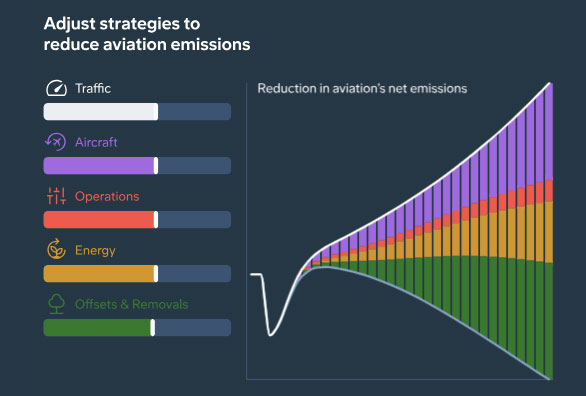
A free to use tool to explore ideas, challenge assumptions and experiment with potential pathways to reduce emissions. View of Cascade - a free to use tool to explore ideas, challenge assumptions and experiment with potential pathways to reduce aviation emissions.
  • Alternative fuels: Boeing continues to invest in sustainable aviation fuel (SAF) while exploring other alternative fuels. Cascade now allows users to model the potential of methane alongside SAF, advanced fuel and carbon removal pathways.
  • Modeling beyond 2050: While Boeing continues to support the commercial industry's goal of net-zero emissions by 2050, Cascade now allows the user to manually extend the model’s timeline to 2100. This provides visibility for long-term technology development, reflecting the reality that aviation R&D cycles take decades historically.

What's next: Later this year, Boeing will introduce Innovation and Exploration Scenarios developed in Cascade to stretch minds on innovative solutions.

Go further: Explore data-driven visual stories on the Cascade website.