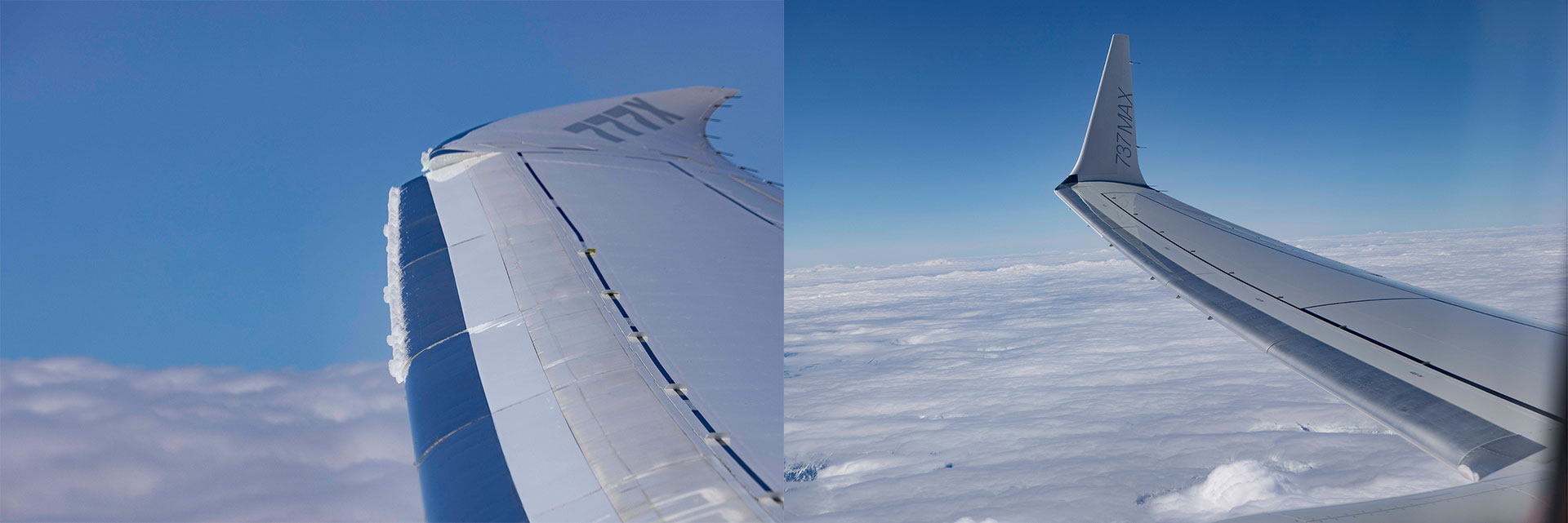
Why it matters: Boeing conducts natural ice testing as part of certifying new airplanes to show they continue to handle safely and systems perform as designed when ice accumulates on the wings, horizontal and vertical stabilizers and other critical surfaces.
- “Once we’ve accumulated the right amount of icing – typically an inch to a couple inches – we do an assessment to make sure the handling qualities remain good and the pilot can predict what the airplane is going to do,” explained Capt. Heather Ross, 787 chief pilot, who was at the 777-9’s controls for the natural ice testing.
Chasing ice: Boeing meteorologists tracked weather patterns for weeks and communicated with crews in flight to pinpoint the right locations to find supercooled water prime for ice formation.
- “As we get closer, we're refining the locations, the altitudes and the kind of temperatures that we're looking for,” said Dr. Robert Conrick, Boeing meteorologist.
Teams had configured the airplanes with special instrumentation to confirm the clouds contained the exact type of water needed.
- “There are very impressive design probes that can measure the water droplet diameter and all the atmospheric conditions that we’re flying through,” said Nick Biddle, 777X test director.
Outfitting the 777-9 flight test airplane with Wi-Fi helped teams communicate in real time to find the best locations and efficiently conduct testing.
- “Having Wi-Fi was great because I could send messages and relay the best coordinates out there,” said Conrick. “We had both the 777-9 and 737-10 in separate bands of clouds collecting ice.”
A unique finish: Both programs completed their multi-day natural ice test campaigns the same day, following an 8.5-hour flight for the 777-9 and a six-hour flight for the 737-10.
- “It’s unusual that we would have two flight test programs going for natural icing at the same time,” said Hanley. “And that we both completed on the same day -- I don’t think it’s ever happened before.”
The pilots reported the airplanes performed well in challenging conditions.
- “Had the instrumentation not told us there was icing (on the 777-9), I’m not sure I would have been able to tell,” said Ross. “It’s an amazing flying airplane, and it has really good handling qualities. That’s the kind of well-performing airplane we want to provide to our customers and to the flying public.”
- “Our customers can be confident that we’ve fully investigated the effects of icing on these two great airplanes,” added Hanley.
Catch up quick: Flight test pilots have flown the 737-10, the largest member of the 737 family and the lowest-unit-cost single-aisle airplane on the market, for more than 950 flights and 2,050 flight hours. Teams are working toward completion of certification tasks in 2026 and first delivery in 2027.
The 777-9, the largest twin-engine jet in the world, has logged more than 1,700 flights and 4,800 flight hours. First delivery of the 777-9 is anticipated in 2027.
“Every test that we accomplish is just one step closer,” said Bryan Marden, 737-10 Flight Test engineer. “One day, flying on it as customers will just be an awesome moment.”
By Jen Cram and Jeff Hidalgo