
It’s a rare treat to see a classic 1957 T-bird or Corvette classic car cruising down the road. It might not seem as nostalgic to see a KC-135 Stratotanker fly overhead, even though the airplane type went into service the same year as those classic cars. This month, Boeing celebrates the 70th anniversary of the first flight of the KC-135, which continues to fly a variety of support missions for the U.S. Air Force as well as allied air forces. The most important of these is the role of aerial tanker, a flying gas station able to refuel other military planes while in flight.
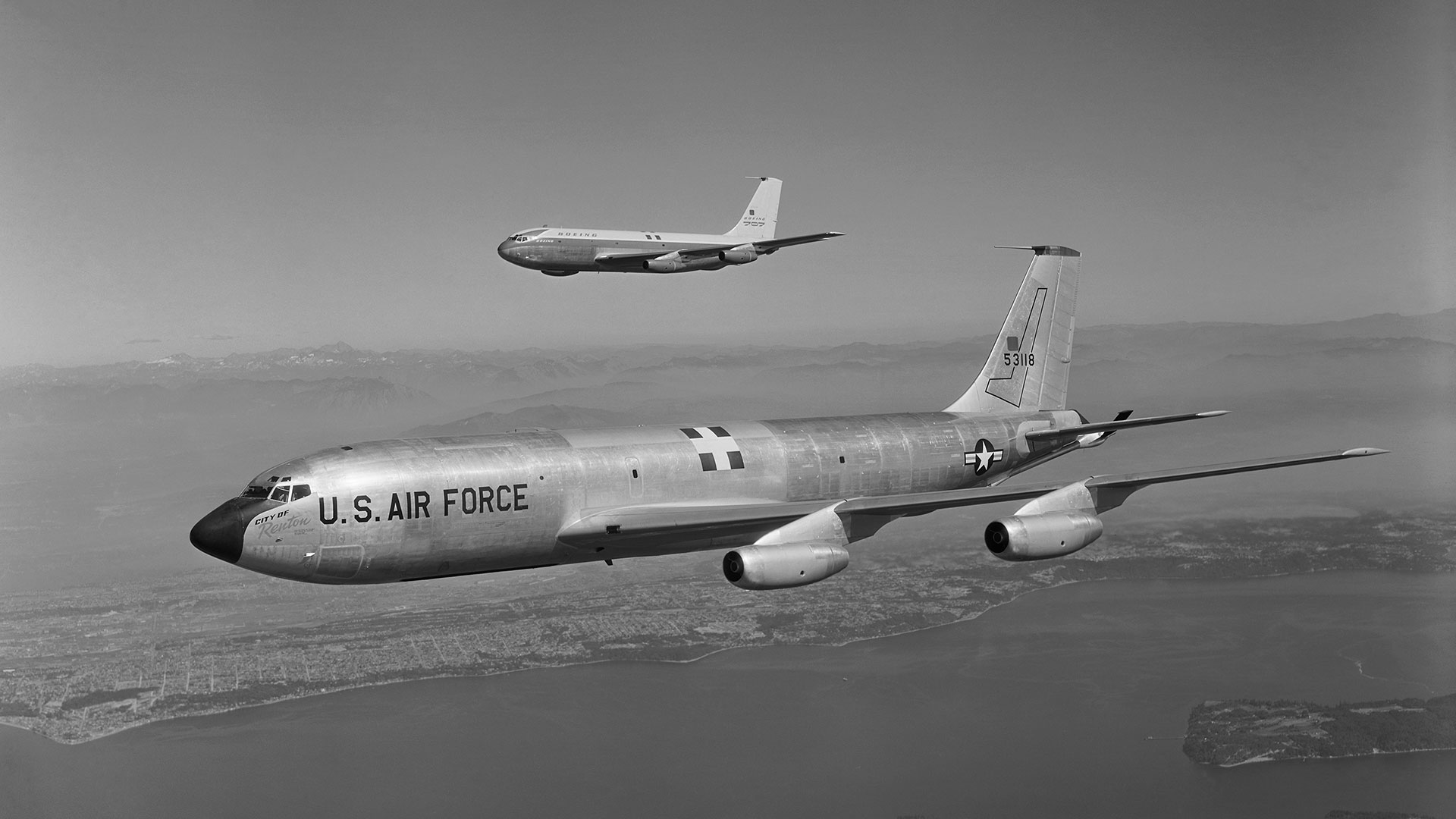 First flight of the KC-135A alongside the Dash 80, Aug. 31, 1956. All photos courtesy of the Boeing Archives.
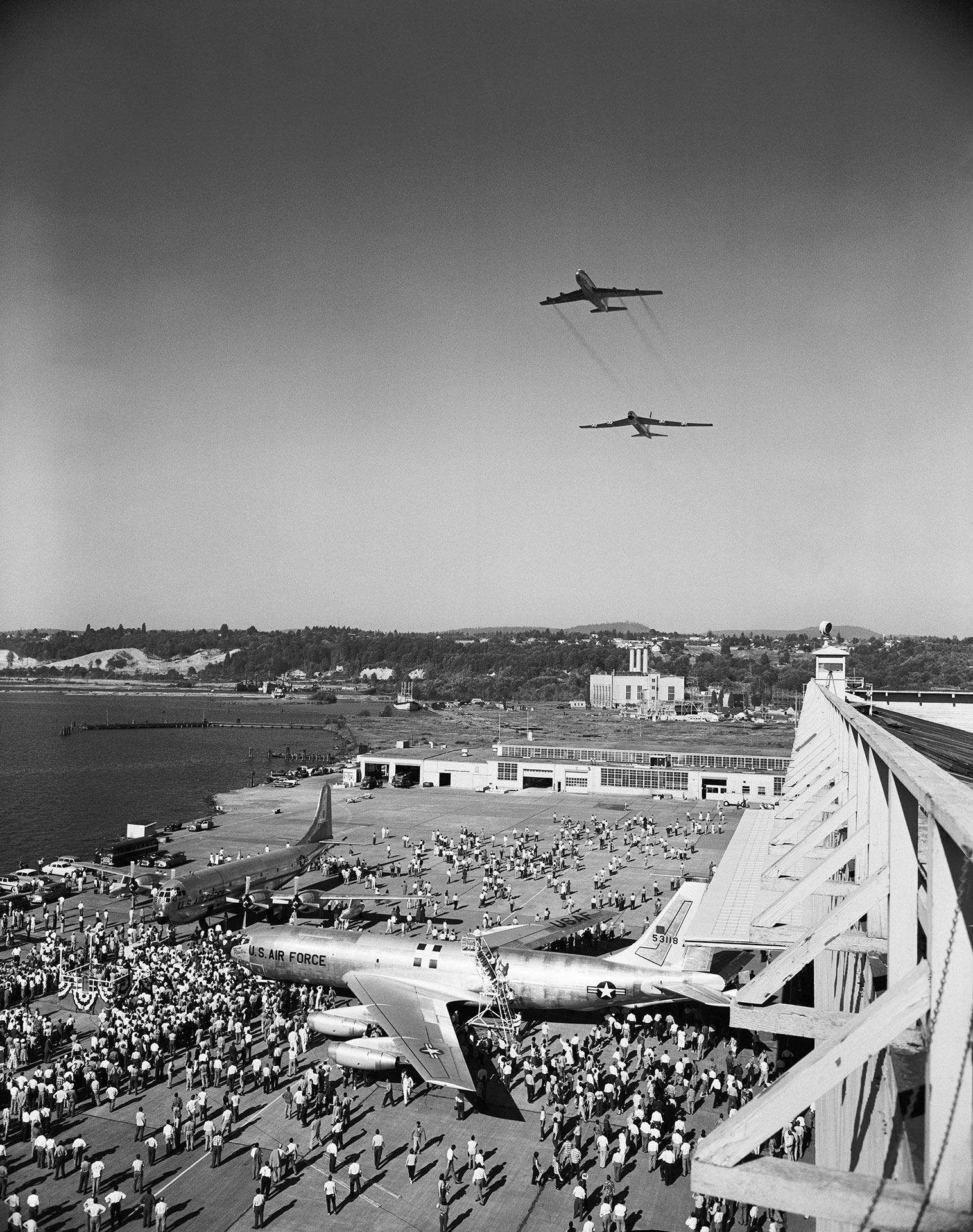 The Dash-80 (top) and a B-52 Stratofortress salute the rollout of the first KC-135 and the last KC-97 at the Boeing site in Renton, Washington, on July 18, 1956.
The KC-135 was born out of necessity and innovation. In the early 1950s, Strategic Air Command was beginning to operate the new jet-powered Boeing B-52 Stratofortress that with in-flight refueling was capable of striking targets anywhere in the world. At the time, however, the only tankers in the SAC inventory were piston-engine Boeing KC-97s. The difference in performance between the two planes forced the B-52 to fly near its aerodynamic stall speed while performing the already difficult process of aerial refueling. This situation created an opportunity for Boeing to introduce a jet-powered aerial refueling tanker — and further refine the “flying boom” refueling technology it invented in the late 1940s.
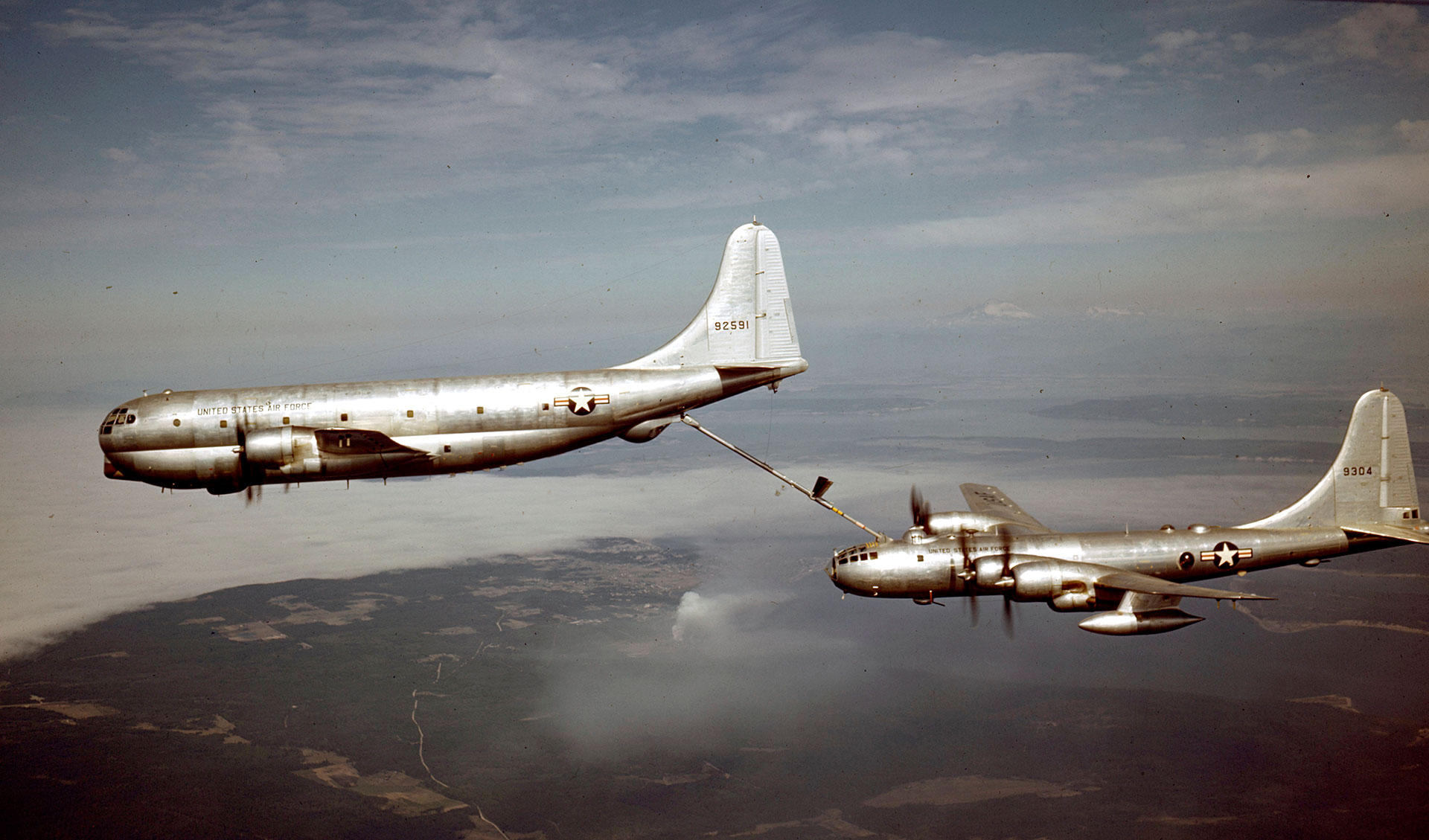 KC-97A refuels B-50D, 1951.
In 1948, the Air Force asked Boeing to develop a more efficient aerial fueling system that would address the deficiencies of the hose system developed in Great Britain. The existing system, which trailed a hose behind the tanker, had many drawbacks including slow rate of fuel transfer, as well as difficult and dangerous contact procedures. In response, Boeing invented the flying boom. This system features a telescoping tube that trails underneath the tail of a tanker aircraft and is flown by an operator controlling two small wings called “ruddevators.”
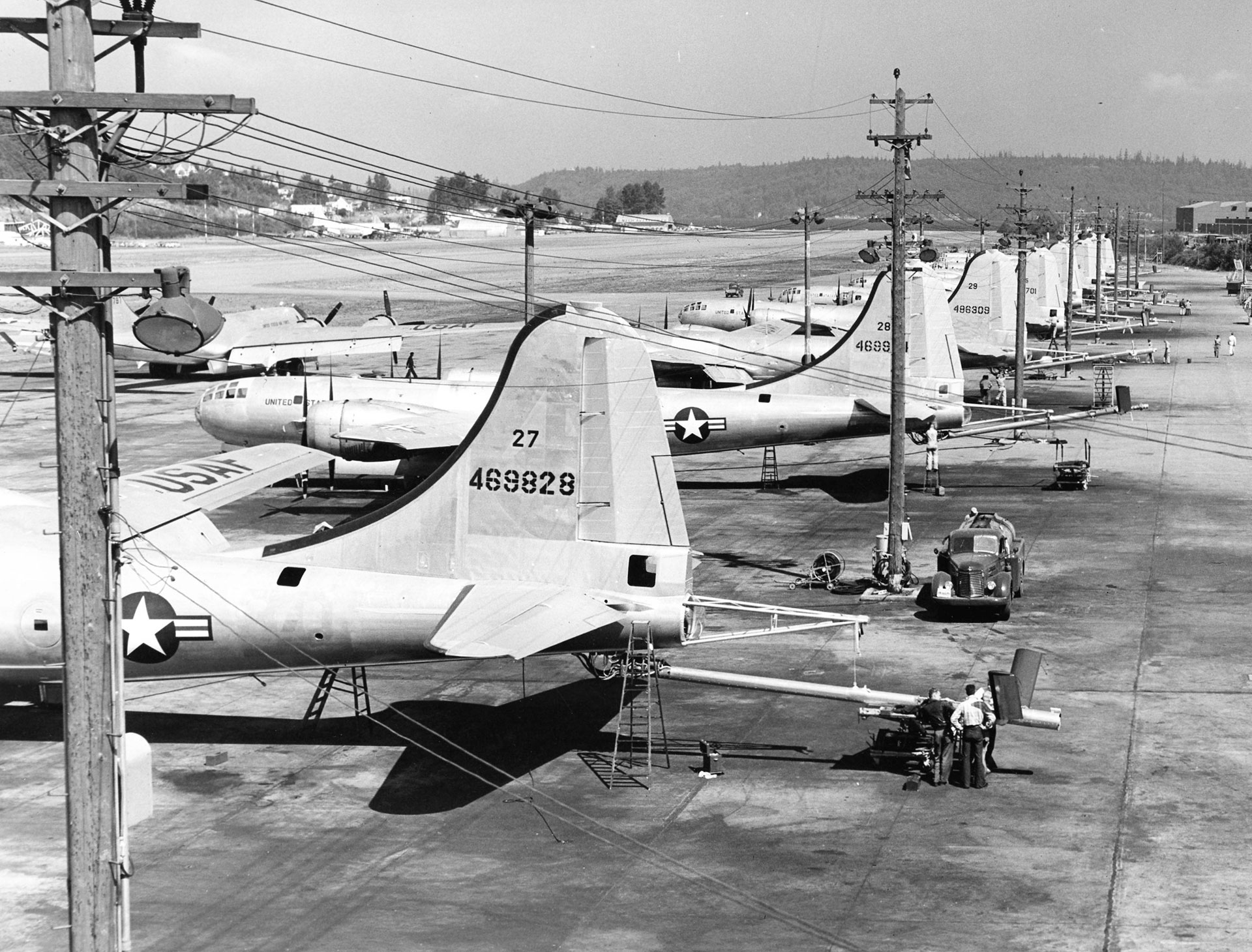 Line of KB-29 Tankers.
The first airplanes equipped with the flying boom were 116 Boeing B-29 Superfortresses modified at the Boeing plant in Renton, Washington, and re-designated KB-29Ps (the letter “K” is the U.S. military code for a tanker aircraft). In response to a demand for even more capable tankers, Boeing redesigned the C-97 Stratofreighter into a dedicated aerial refueling tanker and built 811.
Seeing the need for a jet-powered tanker to keep pace with the B-52, as well as the potential for such a plane to be used as both a commercial and military transport, Boeing used $16 million of its own funds to develop a prototype jet transport, the Model 367-80 — popularly known as the “Dash 80.” The Dash 80 led to two airplanes: the 707, the world’s first successful commercial jet, and the Model 717, the world’s first production jet tanker, the KC-135.
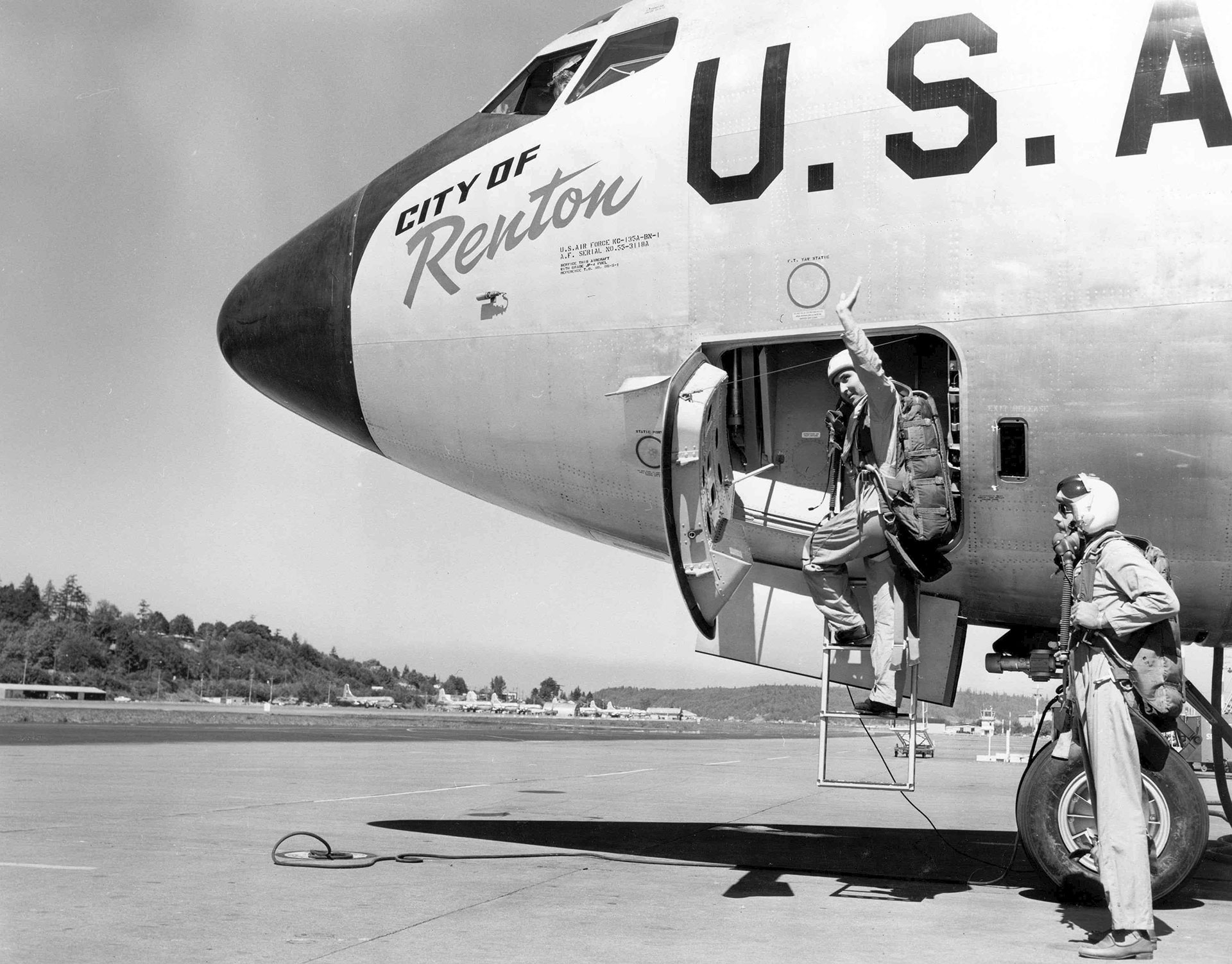 Boeing test pilots Tex Johnston and Dix Loesch (on ladder) prepare to take the first KC-135 up for its first flight on Aug. 31, 1956.
To honor its birthplace, the first KC-135 proudly displayed the name “City of Renton” on its nose when it rolled out on July 18, 1956. To christen the airplane, the wife of Renton’s mayor used a bottle of water from the Cedar River, which runs through both Renton and the Boeing site. In the same ceremony, the last KC-97 — the world’s first production aerial tanker, and the last production piston-powered airplane Boeing built — rolled out as well.
The last KC-135 entered the U.S. Air Force fleet in 1965, and 376 of the 732 tankers built remain in service. Boeing continues to maintain, upgrade and support the KC-135 fleet.
In 2011, the U.S. Air Force selected Boeing’s KC-767 derivative as the winner of the renewed KC-X competition, later formally designating it the KC-46A Pegasus. The Pegasus completed its first successful test flight from Everett, Washington, in 2014. Today, the KC-46A Pegasus is the world’s most advanced multi-mission aerial refueler, designed to meet the full spectrum of U.S. Air Force and allied mission needs while delivering proven capability today and continuing to evolve for tomorrow. In 2025, the USAF announced it would forgo a competition and extend production beyond the current program of 188 aircraft, securing KC-46 production through the next decade. To date, Boeing has delivered 112 KC-46s to the U.S. Air Force, six to the Japan Air Self-Defense Forces and two to the Israeli Air Force.
As the KC-135 is incrementally phased out, the KC-46 will continue to carry on its legacy of unmatched connectivity, survivability and next-generation aerial refueling capabilities for years to come.