
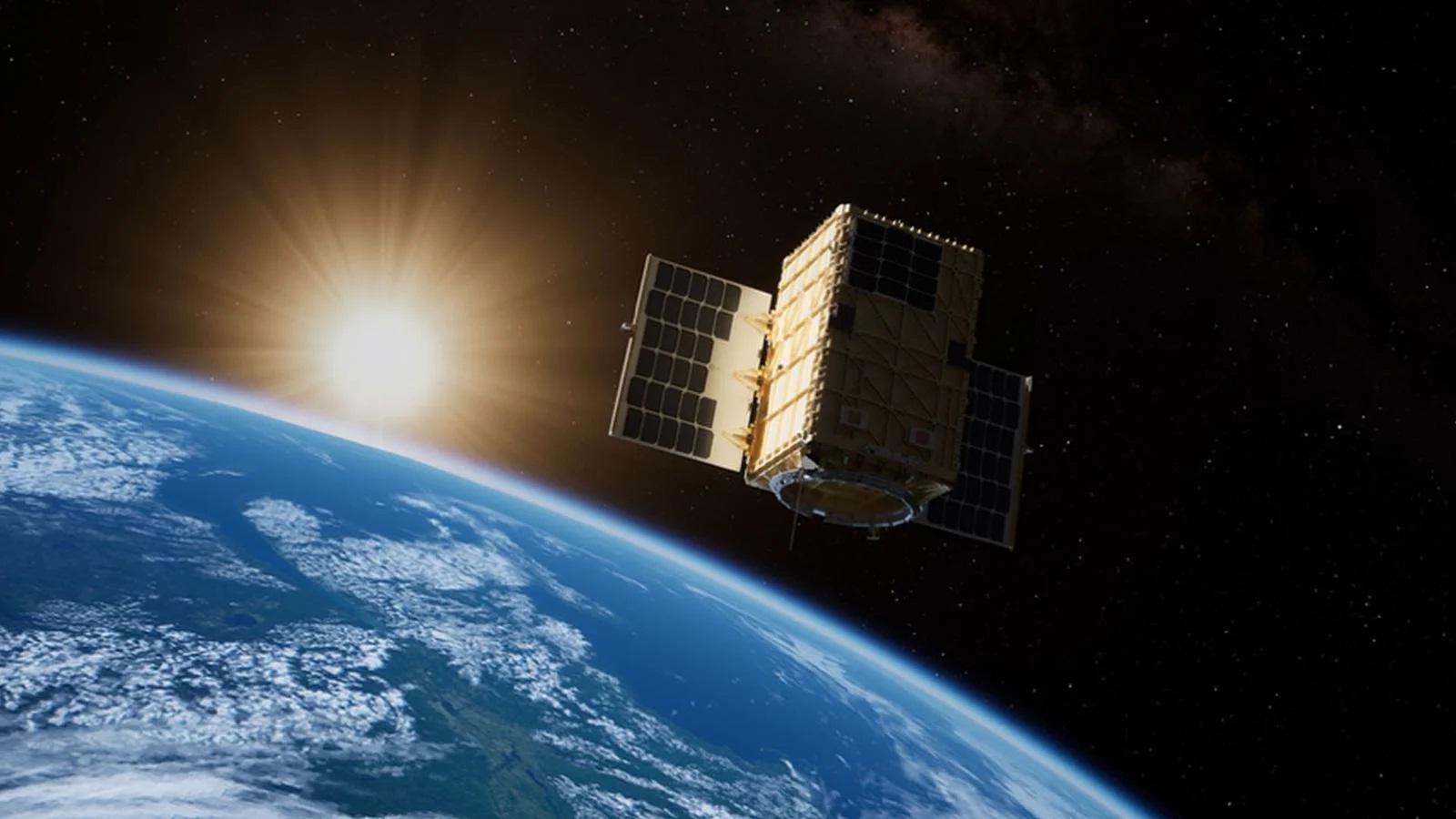
Boeing is moving its Q4S quantum communications satellite into major environmental testing this month, a key milestone ahead of a rideshare launch.
Why it matters: Quantum technology could translate into better navigation and timing when GPS is disrupted, earlier detection of faint signals that today get lost in the noise, and new ways to verify whether a secure link has been tampered with.
- “Q4S moves us closer to a future where we can connect across the planet with greater trust and precision and unlock new ways to explore and understand our world and space,” said Jay Lowell, chief scientist of Boeing Disruptive Computing, Networks & Sensors.
The big picture: Getting quantum networks to global scale is mainly a distance problem, researchers say.
- Fiber and air links quickly lose photons (particles of light) over long ranges, but space links can avoid much of that loss. That’s why many researchers expect space nodes to be part of any future global quantum network.
- Boeing’s Q4S mission aims to prove a key capability in orbit: entanglement swapping, a method for extending quantum connections beyond point-to-point links.
Go deeper: A new peer-reviewed review article in Optica Quantum co-authored by Boeing researchers argues that satellite architectures are likely essential for global-scale quantum networks because free-space links avoid the exponential loss that limits ground networks over distance.
- “If we want quantum networks to scale, we have to prove the core operations in the real space environment,” Lowell said. “Q4S is designed to do that.”
What’s next: The Q4S team is focused on environmental qualification, end-to-end mission rehearsal, and integration readiness for a soon-to-be-announced launch and one year of on-orbit operations.