Frightful fighters and mystical monikers

James S. McDonnell expressed his passion for the supernatural through the names of his fighter jets.

October 29, 2026 in History

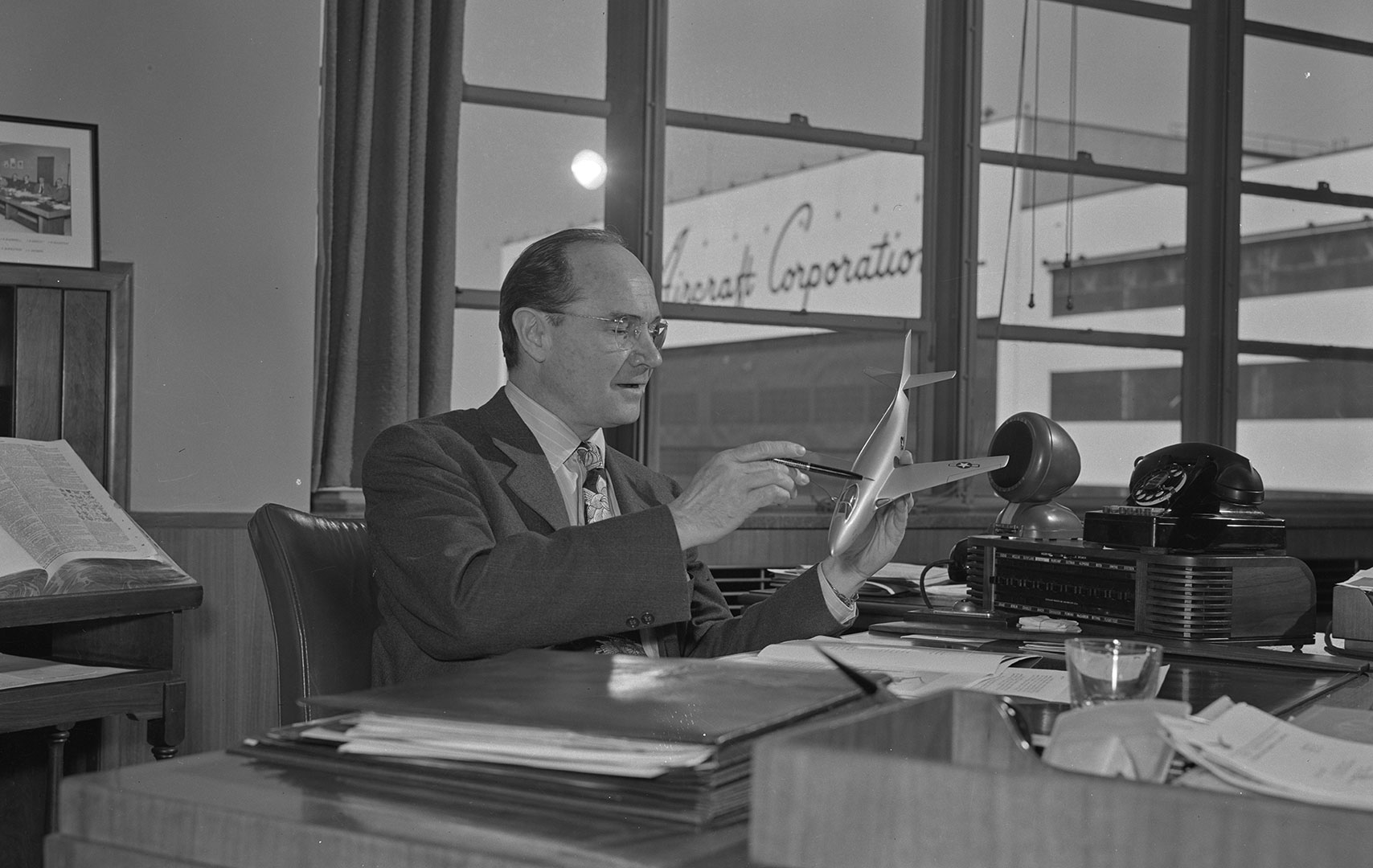
A black-and-white photo of a man, James McDonnell, seated at a desk examining a small airplane model, with office equipment and a window view of an airplane hangar behind him.

James S. McDonnell (“Mr. Mac”) always had a passion for the unknown. Fourteen years before founding Boeing heritage company McDonnell Aircraft Corp., he wrote, “I feel like I want to be on the forefront of our contact with the unknown, in the exploration of the universe … discovering … creating … exploring … right at the forefront … a leader into the mystery of being & of nature.” This desire to explore and create led him to build a company that pushed the boundaries of the aerospace industry. This exploration was paired with Mr. Mac’s interest in another mysterious aspect of life: the supernatural and the spirit world.

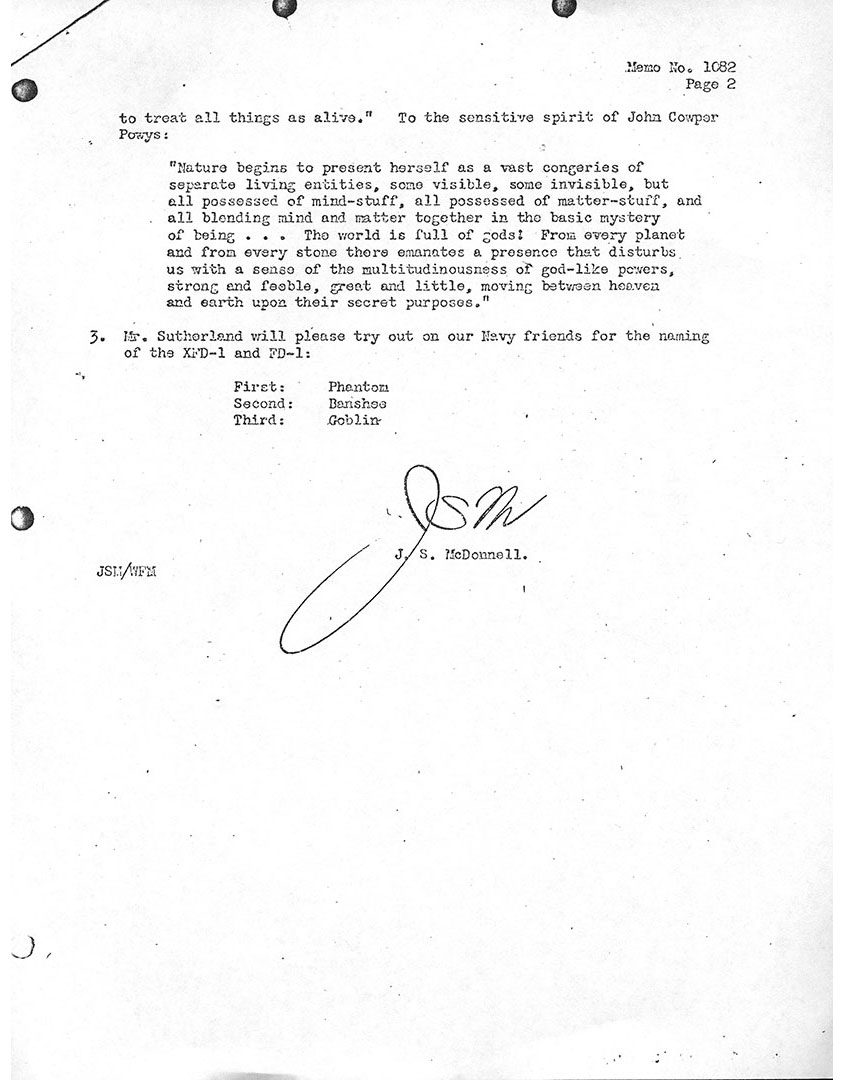
In the below memo to his McDonnell team, Mr. Mac shared a series of supernatural names along with some background on the “world of animism.” These names would be proposed to the U.S. Navy for the naming of the XFD-1, which soon became known as the FH-1 Phantom.
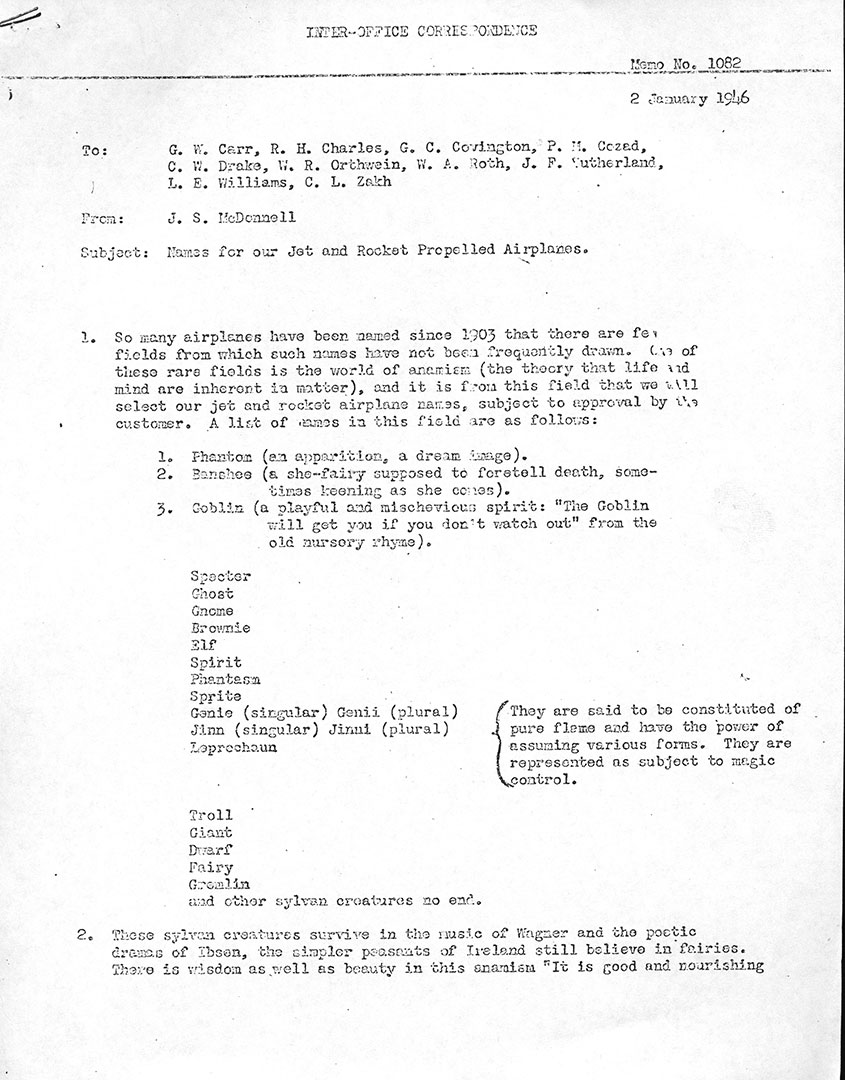
A scan of a memo that reads: INTER-OFFICE CORRESPONDENCE Memo No. 1082 2 January 1946 To: G. R. Carr, R. H. Charles, G. C. Covington, P. H. Czeck, C. D. Drape, W. R. Durham, K. R. Roth, J. V.utherland, L. E. Williams, C. L. Zelch From: J. S. McDonnell Subject: Names for our Jet and Rocket Propelled Airplanes 1. So many airplanes have been named since 1903 that there are few fields from which such names have not been frequently drawn. One of these rare fields is the world of anamism (the theory that life and mind are inherent in matter), and it is from this field that we will select our jet and rocket airplane names, subject to approval by the customer. A list of names in this field are as follows: 1. Phantom (as apparition, a dream image). 2. Banshee (a she-fairy supposed to foretell death, some-times keening as she comes). 3. Goblin (a playful and mischievous spirit: "The Goblin will get you if you don't watch out" from the old nursery rhyme) Specter Ghost Gnome Brownie Elf Spirit Phantasm Sprite Genie (singular) Genii (plural) Jinn (singular) Jinni (plural) Leprechaun {They are said to be constituted of pure flame and have the power of assuming various forms. They are represented as subject to magic control.} Troll Giant Dwarf Fairy Gremlin and other sylvan creatures to no end. 2. These sylvan creatures survive in the music of Wagner and the poetic dramas of Ibsen, the simpler peasants of Ireland still believe in fairies. There is wisdom as well as beauty in this anamism "It is good and nourishing"
Continuation on page 2, scan of a memo that reads: Memo No. 1082 Page 2 "to treat all things as alive." To the sensitive spirit of John Cowper Powys: "Nature begins to present herself as a vast congeries of separate living entities, some visible, some invisible, but all possessed of mind-stuff, all possessed of matter-stuff, and all blending mind and matter together in the basic mystery of being … the world is full of gods: From every planet and from every stone there emanates a presence that disturbs us with a sense of the multitudinousness of god-like powers, strong and feeble, great and little, moving between heaven and earth upon t heir secret purposes." 3. Mr. Sutherland will please try out on our Navy friends for the naming of the XFD-1 and FD-1: First: Phantom Second: Banshee Third: Goblin J.S. McDonnell JSM/WFM

Over time, supernatural names became the signature of McDonnell jets.

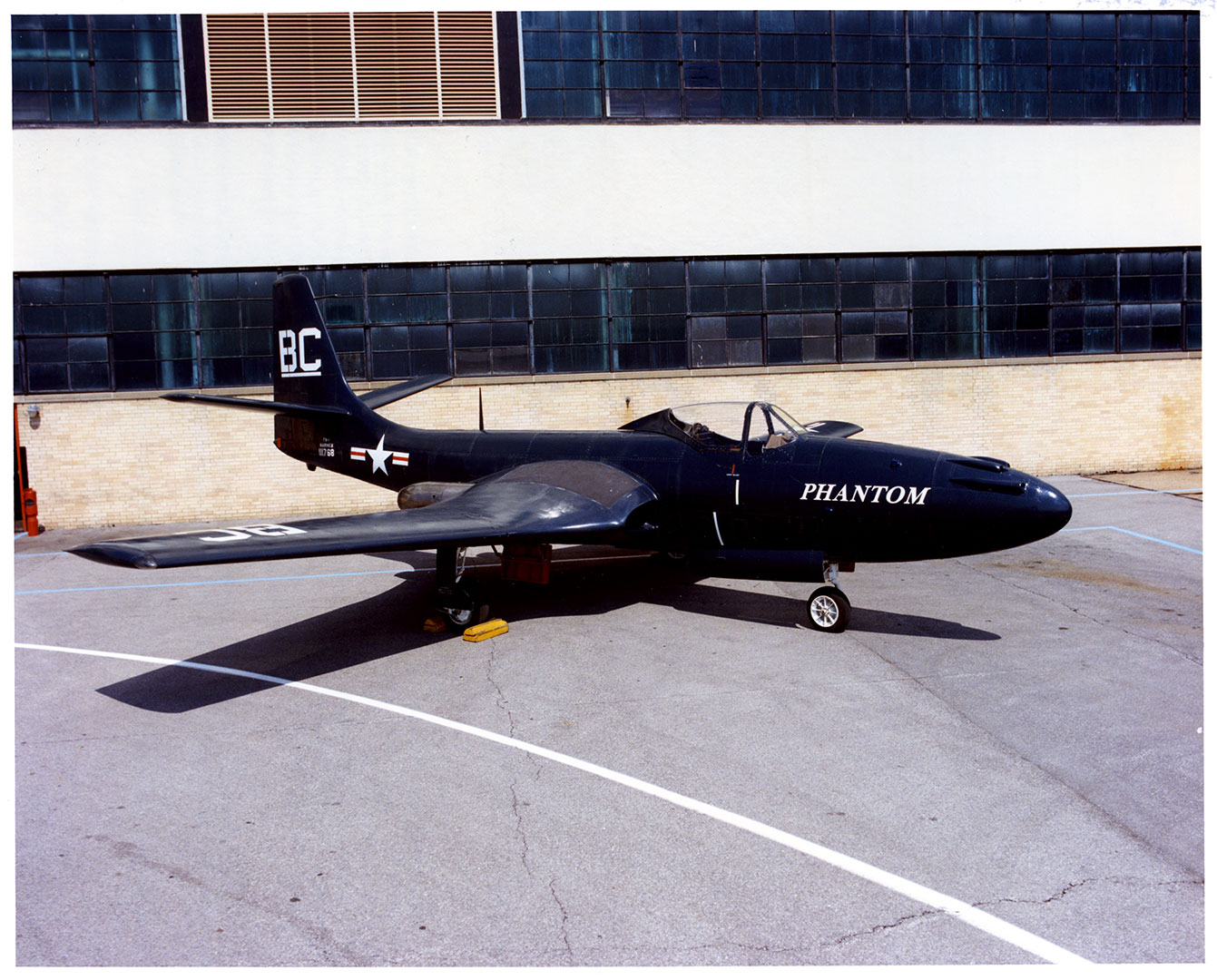
A color photo of a navy FH-1 jet aircraft on a tarmac, marked “PHANTOM” on the nose and “BC” on the tail, parked in front of a hangar.

The FH-1 Phantom was the first McDonnell aircraft to go into production. Designed for the Navy, it was the first jet fighter to operate from the deck of a U.S. aircraft carrier and the Navy’s first airplane to fly 500 mph (800 kilometers per hour). The name Phantom fit, in Mr. Mac’s words, because its great speed “would make it appear and disappear like an apparition.”

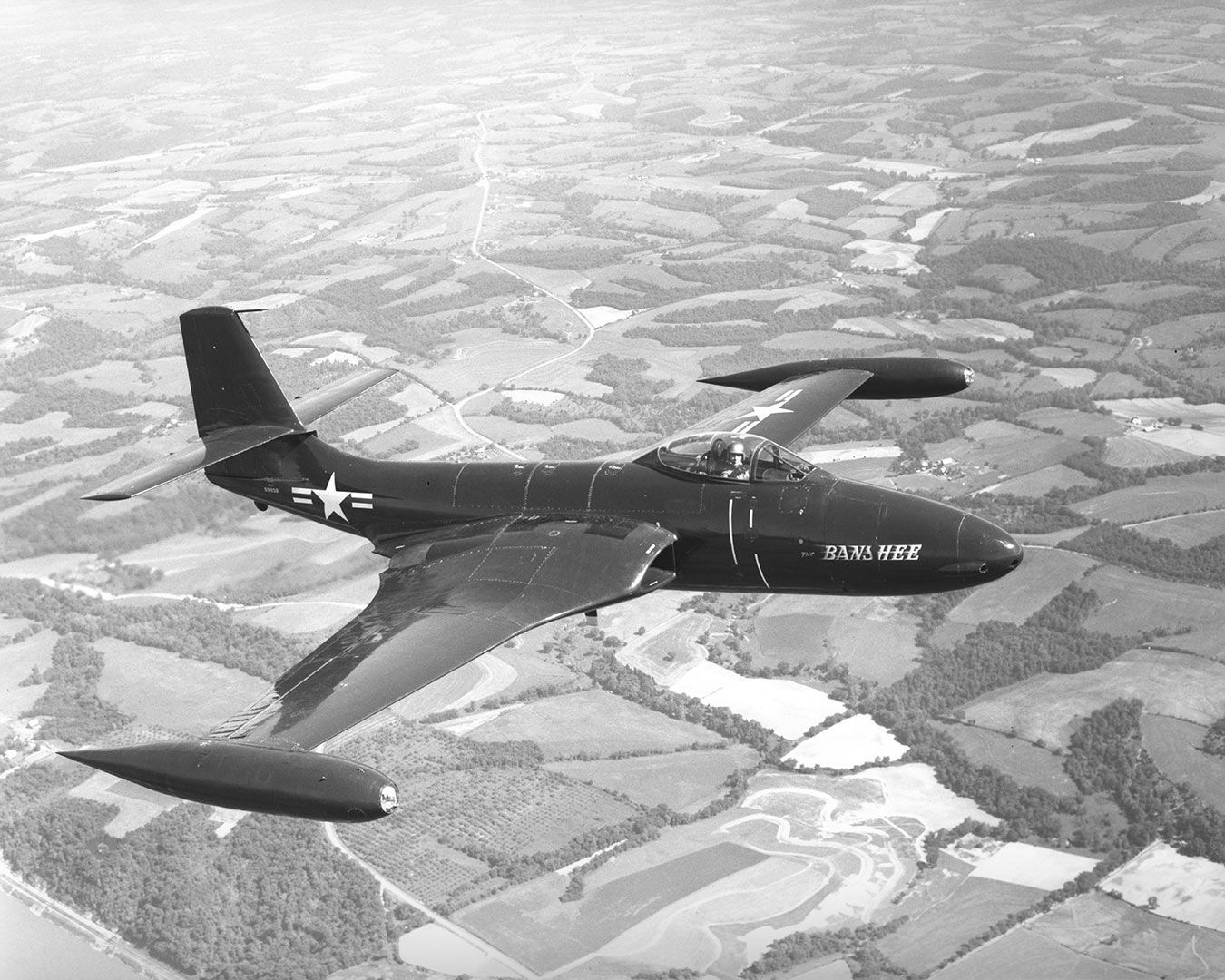
A black and white photo of a navy F2H Banshee jet aircraft in flight over a landscape, marked "BANSHEE" on the nose.

Before the first Phantoms were delivered, the Navy contracted McDonnell to design a new fighter: the F2H Banshee. The Banshee entered combat in 1951 and served as one of the principal Navy fighters during the Korean conflict. Nearly 900 were built.

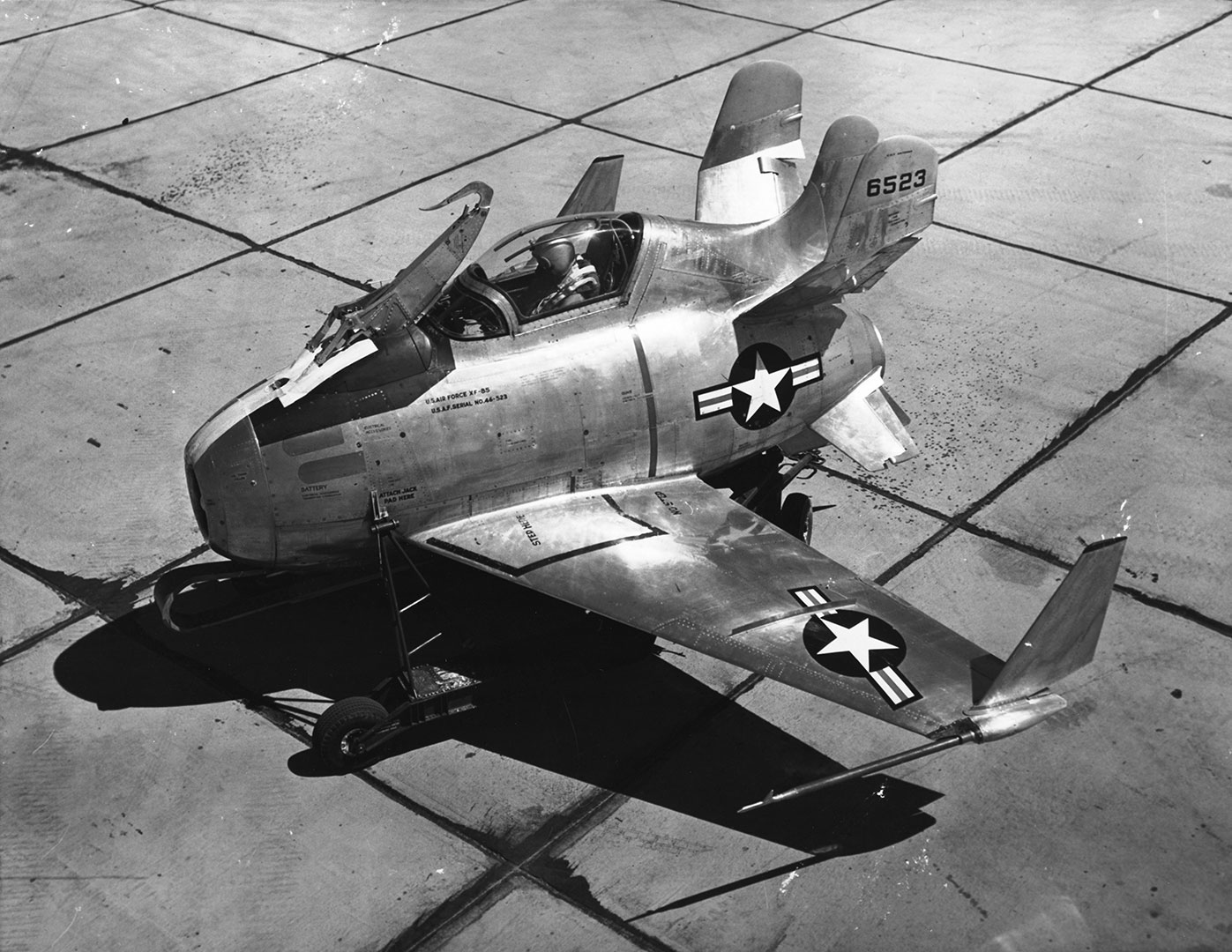
A black-and-white photo of a small experimental XF-85 jet aircraft parked on a concrete surface, viewed from above with its cockpit open and U.S. military markings visible.

The smallest jet-propelled fighter ever built was given a fitting name: Goblin. The XF-85 Goblin was a parasite fighter designed to be carried by a B-36 bomber and launch from the bomb bay to protect it. It had no landing gear and would be recovered using a hook and a retractable trapeze under the bomber. Only two prototypes were built, and the test program was canceled in 1949.

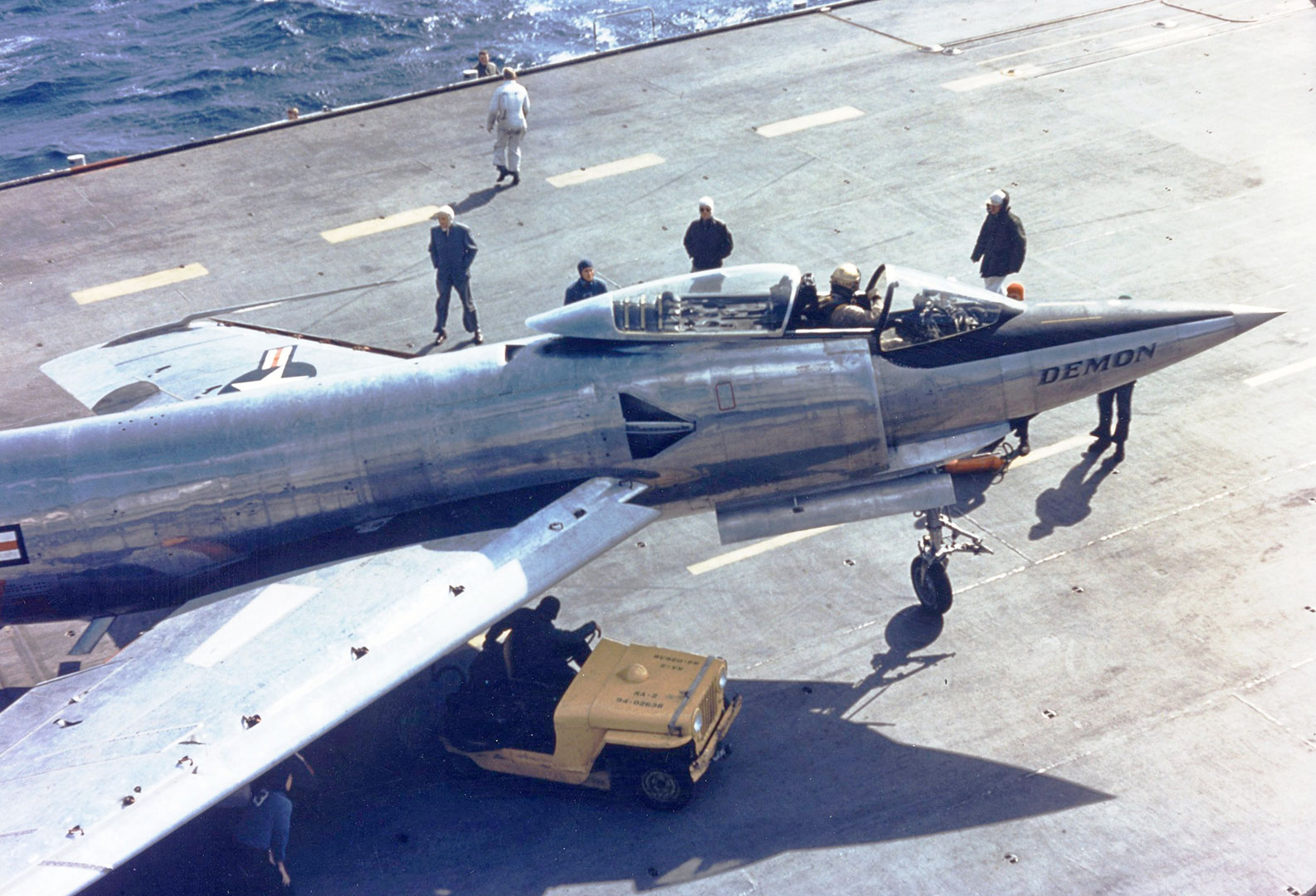
A color photo of a F3H Demon jet on an aircraft carrier deck, with crew members nearby and a tow vehicle positioned under the wing.

The F3H Demon was the company’s first swept-wing fighter and the first aircraft designed to be armed without guns, only missiles. It was one of the first swept-wing jets commissioned by the Navy. Per the Navy’s request, the Demon was designed with only one engine, making it McDonnell’s only single-engine naval fighter.

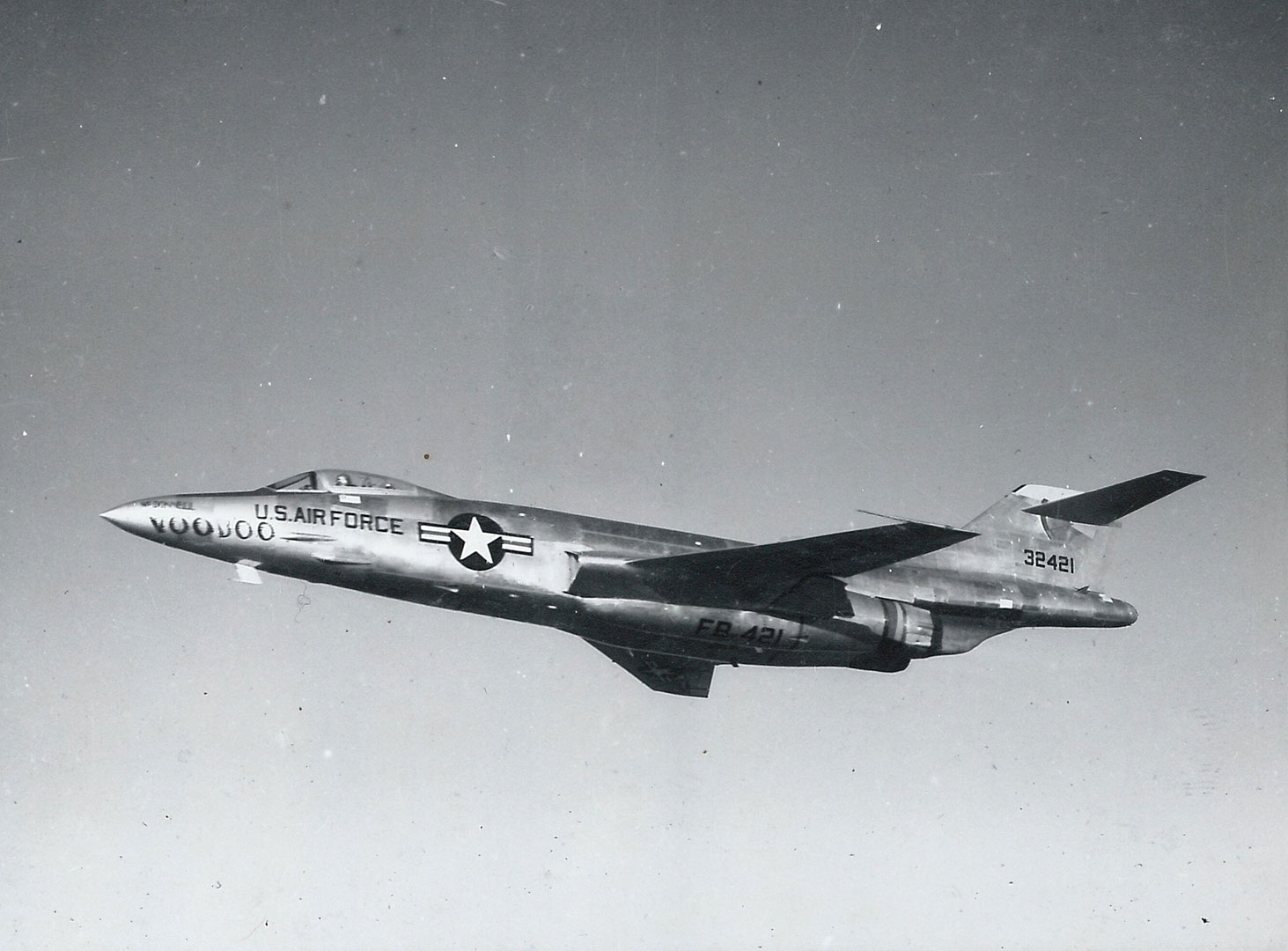
A black and white photo of a F-101 Voodoo jet in flight marked "VOODOO" on the nose

The Voodoo began as the XF-88 all-weather interceptor. Only two were built, and the U.S. Air Force canceled the project at the start of the Korean conflict. In 1952, McDonnell received a development contract for the F-101 Voodoo, based on the XF-88. The F-101 was a long-range twinjet fighter designed to escort bombers, attack distant targets and provide close support for ground troops. It was the first aircraft to break the sound barrier on its first flight.

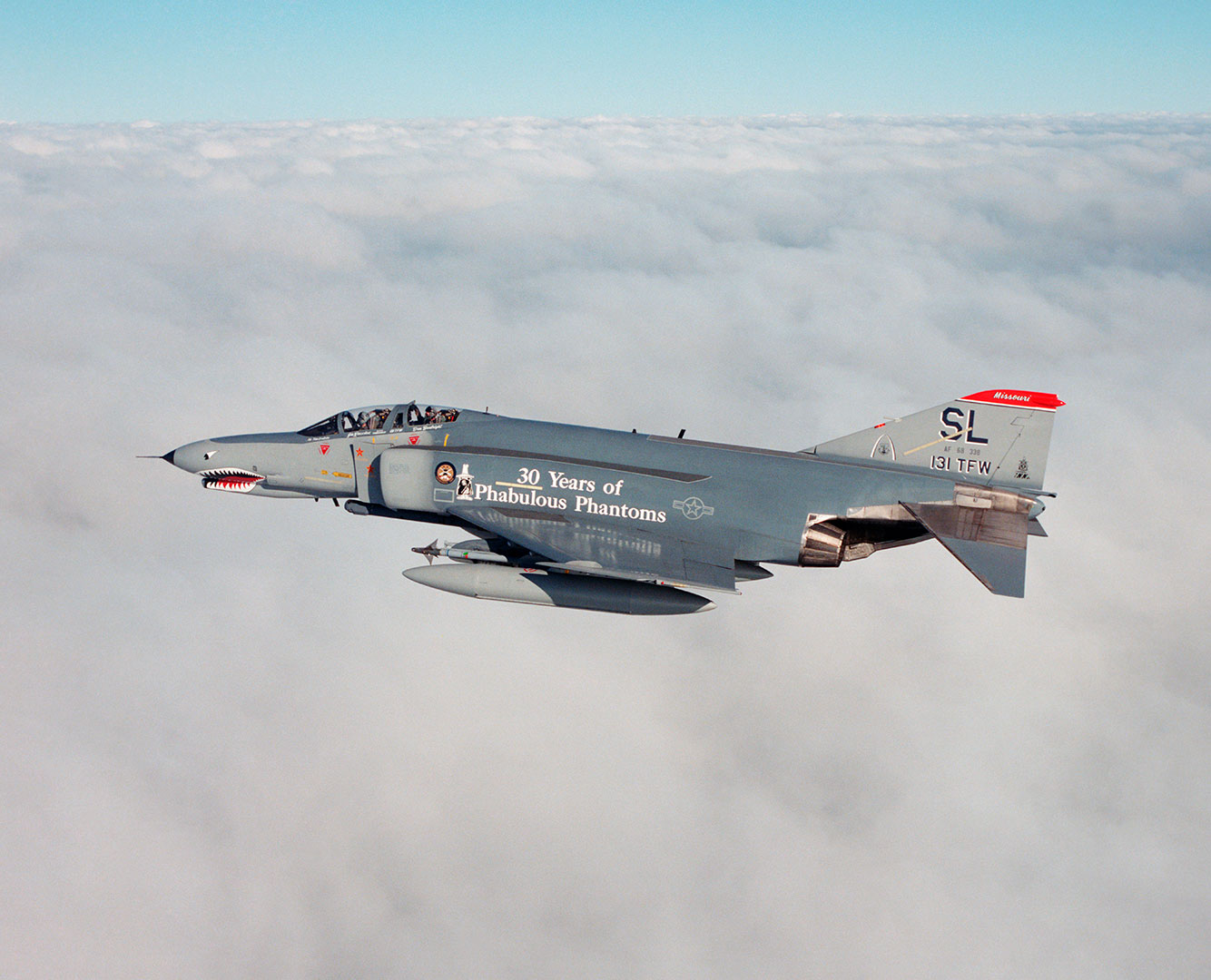
A gray F-4 Phantom II jet flying above a blanket of clouds, marked with “30 Years of Phabulous Phantoms” on its fuselage.

The last McDonnell aircraft to bear a supernatural name was the F-4 Phantom II. Mr. Mac initially wanted to name it “Satan,” but was cautioned against this. This two-seat twinjet fighter flew concurrently with the U.S. Navy, Air Force and Marine Corps. It was christened the Phantom II at a ceremony commemorating McDonnell’s 20th anniversary in July 1959. By the company’s 40th anniversary, it had become the most-produced American supersonic military aircraft, with more than 5,000 delivered.

By Allison Balderrama