Twin engine transition: 777 Freighter fleet overtakes 747

Learn more about the industry-leading freighter that carries $4 trillion in global trade each year.

October 22, 2026 in Commercial

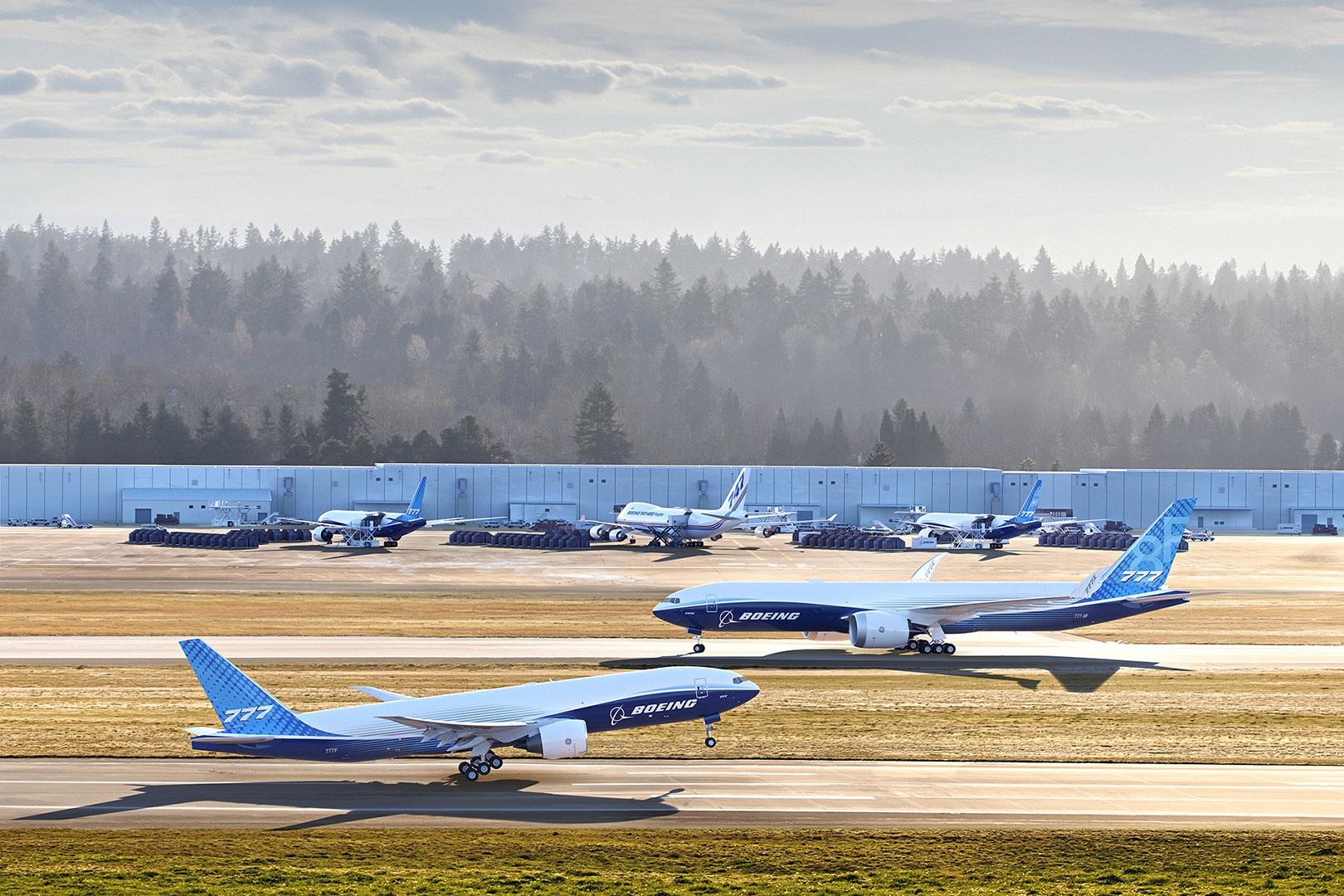
Boeing artist rendering of a 777 Freighter taking off in the foreground, with a 777-8 Freighter taxiing on the runway behind it. Several other freighters, including a 747-400 Freighter and additional 777 Freighters, are parked near airport buildings in the background. Trees and a hazy sky surround the airport. The 777 Freighter is now the most operated widebody freighter and will continue to operate alongside past and future Boeing freighters. (Artist rendering)

For decades, the ‘Queen of the Skies’ was synonymous with air cargo as the dominant option for long-haul transportation. Beginning with the delivery of the first 747-200 Freighter in 1972, Boeing 747 freighters set the standard for global air cargo, an industry that supports global trade and commerce by providing fast and dependable transportation for high-value goods. Each successive model delivered performance improvements, culminating in the 747-8 Freighter. 

Following recent deliveries, the 777 Freighter fleet has overtaken the in-service fleet of 747 freighters of all types to become the most widely operated freighter in the world today.

For decades, the Queen of the Skies has been a powerhouse in moving global cargo. Now, the 777 Freighter is carrying the 747's legacy forward—as the world's most operated widebody freighter and setting the pace for what’s next—the 777-8 Freighter.

Now, the 777F has picked up that baton – both in usage and reputation – as the new industry standard.

Why it matters: As the in service 777F fleet surpasses 330 aircraft, the fleet now carries more air cargo per year than any other type of freighter.

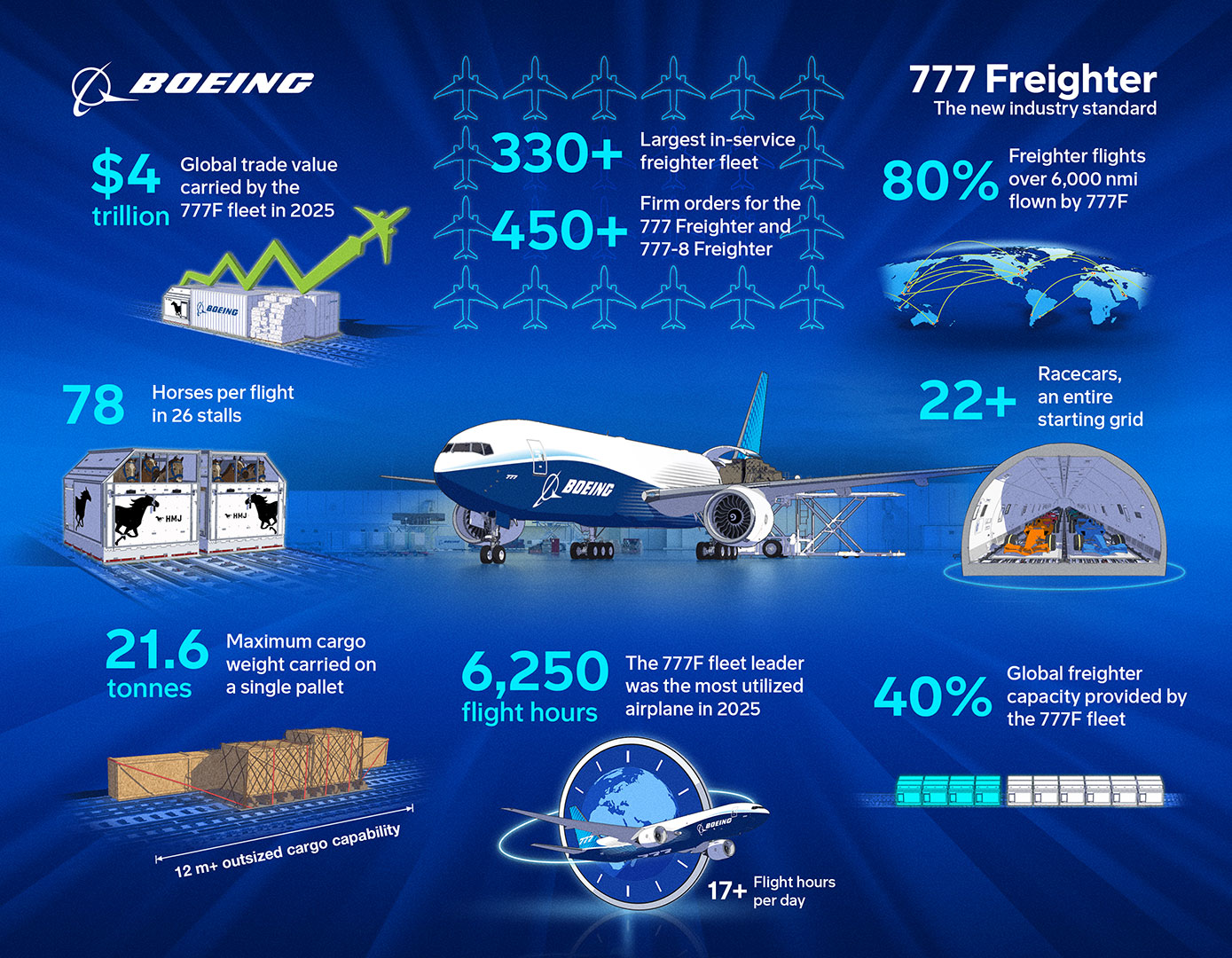
  • Due to its high utilization on long-haul routes, the industry-leading 777F fleet provides around 40% of global freighter capacity.
  • Last year, the value of global trade carried by the 777F fleet was estimated to be around $4 trillion, according to Boeing.
Infographic titled “777 Freighter: The new industry standard” showing a Boeing 777 Freighter surrounded by cargo, horses, racecars, aircraft icons and a global route map. It highlights that the 777F fleet carried $4 trillion in global trade in 2025, has the largest in-service freighter fleet with more than 330 aircraft. It highlights that Boeing has received more than 450 firm orders for the 777 Freighter and 777-8 Freighter. Additional facts include: 80% of freighter flights over 6,000 nautical miles are flown by 777Fs; 78 horses can be transported in 26 stalls; more than 22 racecars can be carried; a single pallet can hold up to 21.6 tonnes; the fleet leader flew 6,250 hours in 2025, or more than 17 hours per day; and the 777F fleet provides 40% of global freighter capacity. 777 Freighter: The new industry standard. (Artist rendering)

Team pride: Since its first delivery in 2009, the 777F has carried everything from phones, pandas and fresh produce to life-saving medicines, helicopters and airplane engines – fueling global commerce and trade as well as humanitarian and aid missions requiring timely transportation.

Ben, a 777/777X Fuselage Assembly Center lead, joined Boeing in 2018 after working as an automotive technician. A third-generation Boeing employee, he carries on a family legacy that includes work on earlier freighter programs. Ben, a 777/777X Fuselage Assembly Center lead, joined Boeing in 2018 after working as an automotive technician. A third-generation Boeing employee, he carries on a family legacy that includes work on earlier freighter programs. (Photo by Marian Lockhart)
“We get an early look at each 777 Freighter as we build its fuselage sections before final assembly,” said Ben Fredrickson, a lead in the 777/777X Fuselage Assembly Center. “After working on hundreds of 777s and seeing their performance in service, I’m not surprised the 777F plays such a leading role in air cargo. I’m proud to help build the fleet that is vital to global logistics.”  

What’s next: As deliveries of the industry-standard 777F continue, Boeing teams are advancing engineering and manufacturing work on Boeing’s newest widebody freighter and the eighth 777 model, the 777-8 Freighter.

  • As a member of the 777X family, the 777-8F includes an innovative new carbon-fiber composite wing and new engines that are purpose-built for the 777X. The design that will enable the 777-8F to carry 118 tonnes with 30% lower fuel use than prior airplanes – and fly farther than the competition at any payload, according to the company.
  • The team has designed the 777-8F to keep common features with the 777F that support efficient operations such as high utilization and reliability.
  • The 777-8F has 89 firm orders from world-class operators, including ANA, Cargolux, China Airlines, China Southern Cargo, Ethiopian Airlines, Lufthansa, MSC Air Cargo, Korean Air Cargo, Qatar Airways and Silk Way West Airlines.

By Charlie Kauffman and Matt Pentz