Crew Flight Test (CFT)

Mission milestones

Starliner crew patch

Mission progress

Starliner Arrives Safely Back on Earth

Boeing’s Starliner is seen after landing at White Sands Space Harbor at the U.S. Army’s White Sands Missile Range, New Mexico, at 12:01 Eastern time Saturday.

Boeing’s Starliner landed safely at 12:01 a.m. Eastern time on Saturday, Sept. 7 (10:01 p.m. Mountain time, on Friday, Sept. 6).  After an extended stay at the International Space Station, Starliner’s reusable crew module touched down at its designated landing site, White Sands Space Harbor at the U.S. Army’s White Sands Missile Range in New Mexico.

 "I want to recognize the work the Starliner teams did to ensure a successful and safe undocking, deorbit, re-entry and landing," said Mark Nappi, vice president and program manager of Boeing's Commercial Crew Program. "We will review the data and determine the next steps for the program."

The Starliner crew module will be transported back to NASA's Kennedy Space Center in Florida, where Boeing teams will analyze mission data.

Starliner heads back to Earth

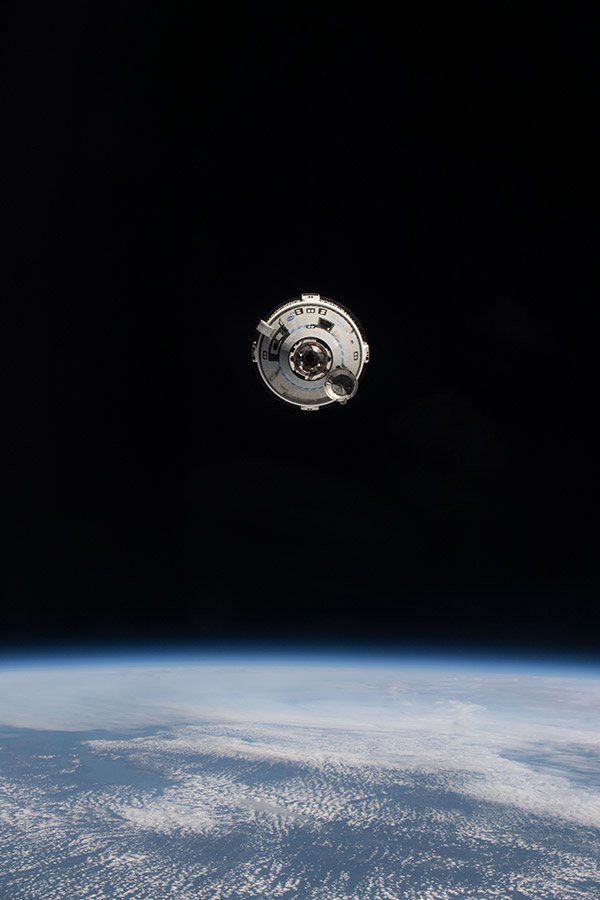
Boeing’s Starliner spacecraft undocked from the International Space Station on Friday, Sept. 6, with separation confirmed at 6:04 p.m. Eastern time. 

The reusable crew module is expected to land at12:03 a.m. Eastern time (10:03 p.m. Mountain time) Saturday at White Sands Space Harbor at the U.S. Army’s White Sands Missile Range in New Mexico. 

Coverage on Boeing’s Starliner CFT mission website is underway as Starliner prepares for reentry into the Earth’s atmosphere and landing at White Sands. The broadcast can also be viewed on NASA TV. 

Starliner Return to Earth Preps Underway

The Starliner team is proceeding through checklists to be ready for return when a date is chosen. They spent Tuesday practicing for undocking during an integrated simulation with the International Space Station. Teams occupied their consoles in the Mission Control Center in Houston and in Boeing’s Mission Control Center (BMCC) at Kennedy Space Center. Commander Butch Wilmore and Pilot Suni Williams participated in the “sim” from space, aboard Starliner. Starliner-1 crew members Commander Scott Tingle and Pilot Mike Fincke took part in the simulated undocking from the BMCC, while Canadian Space Agency astronaut Josh Kutryk was on-console in Houston.

On Sunday, the Starliner and NASA teams worked together in Boeing’s Avionics and Software Integration Lab (ASIL) to develop, test, and deliver updated data parameters for potential returns throughout August. That included a Propulsion Quantity Mission Data Load to update the fuel quantity on board Calypso. The crew also entered their spacecraft Monday to refill its water systems and to pressure check their spacesuits. A standard operation before crew departure includes an exterior inspection of Starliner, as well. The crew completed that task by using the Canadarm outside the space station.

Starliner Docked Hot Fire Testing Complete

Starliner team conducts hot fire test on 27 thrusters. Credit: NASA

The Starliner team completed a docked hot fire test of the spacecraft’s Reaction Control System (RCS) thrusters Saturday afternoon, and monitored its helium system, providing additional data points for the Crew Flight Test’s return to Earth.

With Starliner flight director Chloe Mehring at the helm and Boeing engineers on console monitoring the spacecraft’s systems, flight controllers commanded the sequential firing of 27 RCS thrusters.

“The integrated teams between Starliner and ISS worked extremely well together this week to finalize and safely execute the docked hotfire sequence,” said Mehring, who will lead the Starliner flight control team in the upcoming undocking from the International Space Station.

“Both teams were very happy with the results.”

The one-pulse firings were designed to confirm the performance of each thruster. Aft-facing thrusters were fired for 1.2 seconds and all others for .40 seconds. Between each firing, the team reviewed real-time data and all thrusters performed at peak thrust rating values, ranging from 97-102%. The helium system also remained stable. Additionally, an RCS oxidizer isolation valve that was not fully seated previously, was cycled several times during today’s testing and is now operating normally.

This is the second time the spacecraft has been hot fired successfully while docked, an integrated operation the station and Starliner teams will also conduct during future long-duration missions.

Flight test astronauts Butch Wilmore and Suni Williams were inside Starliner Calypso giving the team on the ground real-time feedback during the test. In preparation for the return home, Wilmore and Williams will participate in two undock to landing simulations next week.

A Flight Test Readiness Review is tentatively planned for late next week, and the data gathered today will be reviewed and included in return flight rationale. While a landing date has not yet been set, opportunities are available throughout August.

Starliner thruster ground testing complete, data reviews underway

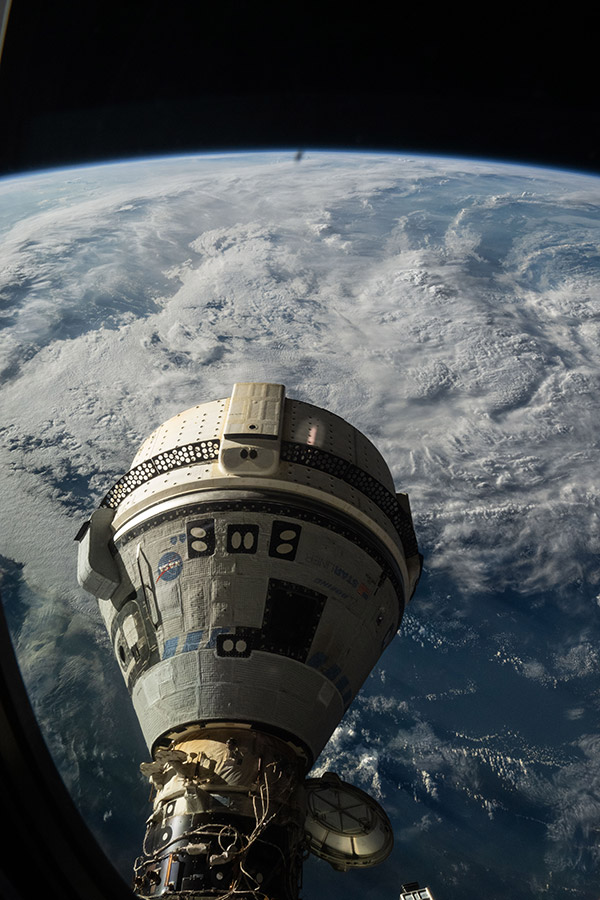
Starliner docked to the International Space Station. Credit: NASA

Ground testing of a Starliner Reaction Control System (RCS) thruster at White Sands Test Facility in New Mexico is complete, and teams are now turning their attention to data reviews. The test objective was to observe thruster degradation so teams could get a better understanding of why some thrusters were deselected in-flight and what, if any impacts, returning those thrusters to service could have on the remainder of the Crew Flight Test (CFT).

The new thruster was put through one of the most stressing launch-to-docking firing sequences with over 1,000 pulses to simulate CFT conditions, including manual flying and rendezvous with the International Space Station. It then went through five undock-to-deorbit burn profiles with 500 pulses. While the team recorded terabytes of data from those profiles firings, they wanted to see what additional learnings they could glean from more aggressive firings.

“We decided to run additional profiles with longer and more frequent pulses to see if we could more closely simulate the higher thermal conditions the thrusters experienced in-flight,” said Dan Niedermaier, the lead Boeing engineer for the thruster testing. The team was able to replicate the thrust degradation on the ground.

Boeing and NASA engineers will proceed with thruster disassembly and inspections, and move forward with finalizing flight rationale in support of readiness reviews for Starliner’s nominal return to Earth with commander Butch Wilmore and pilot Suni Williams in the coming weeks. NASA’s Commercial Crew Program Manager Steve Stich and Boeing Starliner Program Manager and Vice President Mark Nappi will provide an update on progress during a media telecon next week on www.nasa.gov/live.

Approximately 200 miles away from the ground testing, in Albuquerque, New Mexico, Boeing’s Laser & Electro-Optical Systems team shared a video of the moment Starliner approached the space station for docking on June 6. Using advanced daytime satellite tracking technology, the team combined a modified infrared telescope with a control computer and a specialized mount to compensate for the Earth’s rotation to capture the docking.

Meanwhile, Starliner remains in docked quiescent mode, which means Wilmore and Williams are supporting the Expedition 71 crew – or as Williams likes to call it, the “Expedition 71 plus” crew – with space station research and maintenance. Both astronauts participated in vein scans using the Ultrasound 2 device on Monday, July 15. Doctors on the ground monitored in real-time as the pair took turns imaging each other’s neck, shoulder, and leg veins. Afterward, Wilmore scanned the veins of NASA Flight Engineer Matthew Dominick to help researchers understand how microgravity affects the human body. Wilmore and Dominick also spent a portion of the day taking inventory of the food stored aboard the space station.

Williams worked on a pair of differing studies as she first explored using the microgravity environment to manufacture higher quality optical fibers than on Earth. She also investigated using fluid physics such as surface tension to overcome the lack of gravity when watering and nourishing plants grown in space.

CFT Commander Rates Starliner Handling of Manual Flying Tests

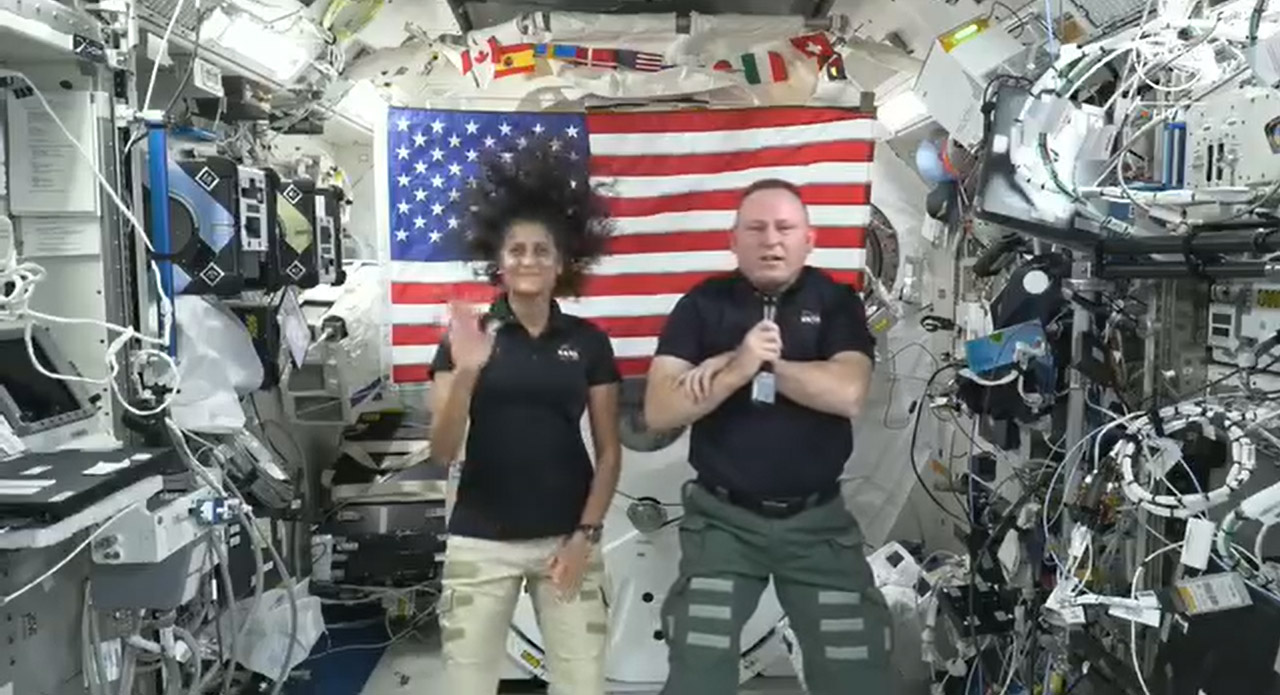
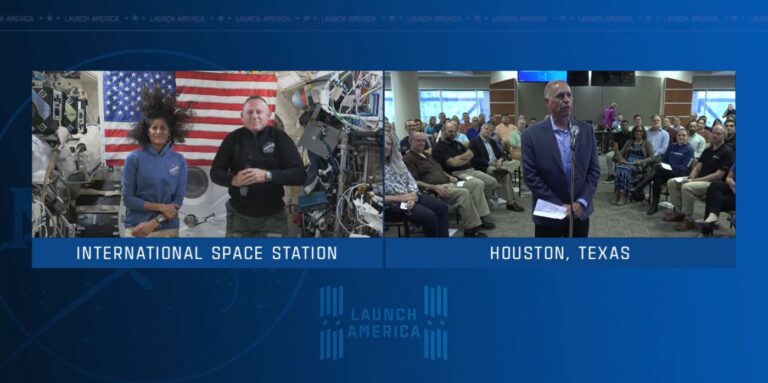
CFT Commander Butch Wilmore and Pilot Suni Williams speak with media from the International Space Station

On the Starliner crew’s 35th day in space, Crew Flight Test Commander Butch Wilmore brought the focus back to day one. “Launch was spectacular! I mean, truly amazing,” Wilmore said.

During the first press conference between Wilmore, pilot Suni Williams, and the media, he praised Starliner for its precision. “The spacecraft performed unbelievably well,” Wilmore said. “We have these things called the Cooper-Harper Pilot Rating Scale – one to ten. One being the best, ten being the worst.”

The Cooper-Harper Pilot Rating Scale, or CHPRS, is an evaluation tool for test pilots and engineers. On the scale, a one defines aircraft or spacecraft characteristics as “excellent” and “highly desirable” and means pilot compensation is not a factor for the desired performance.

“I’ve never given a one in all my flight test years for handling qualities, but I was tempted,” Wilmore said. “That’s how precise this spacecraft controlled in all aspects of the various tests we did.”

Although the spacecraft is usually autonomous, the crew used the hand controller to point and aim the spacecraft during about two hours of free-flight demonstrations on the day of launch. Then, on the day of docking, the crew took over manual control for about an hour on the V-bar, which is the axis when Starliner rendezvous with the International Space Station. Wilmore said even though five thrusters had been taken offline at the time, Starliner’s handling was still impressive.

“Coming into docking, those final ten meters, we have a tolerance when we actually connect with the space station (autonomously) of five degrees in attitude and about four inches in position,” Wilmore said. “Starliner came right down the middle, even with the degraded thrusters, which was truly impressive.”

The crew told reporters they’ve been doing science and maintenance on the ISS since they arrived. They fixed the station’s urine processor with a new pump brought up on Starliner. Williams said she performed gene sequencing and Wilmore conducted experiments with a 3-D printed moon microscope.

“We’ve been thoroughly busy up here,” said Williams. She said they have been integrated right into the crew – in which they’re now dubbing “Expedition 71-plus.”

Following the crew’s comments about Starliner’s launch and docking, members of the media asked about their return home. “I have a real good feeling in my heart that this spacecraft will bring us home no problem,” said Williams.

She said it is great to be back on the orbiting laboratory and feels like home to them. “I’m not complaining, Butch isn’t complaining, that we’re here for a couple of extra weeks.”

All work stopped for the Starliner ground teams Wednesday at 11:00 a.m. ET so they could listen to the crew speak from space. “We are very close and friends with those who are making these decisions and we trust them,” said Wilmore. “We trust their integrity.”

A replay of the crew news conference is available here.

Following the crew news conference, NASA’s Commercial Crew Program Manager Steve Stich and Boeing Commercial Crew Program Manager and Vice President Mark Nappi spoke extensively about the mission and testing plans ahead of the Crew Flight Test return. Listen to a replay of the leadership briefing.

Starliner testing continues in space and on the ground to support future long-duration missions

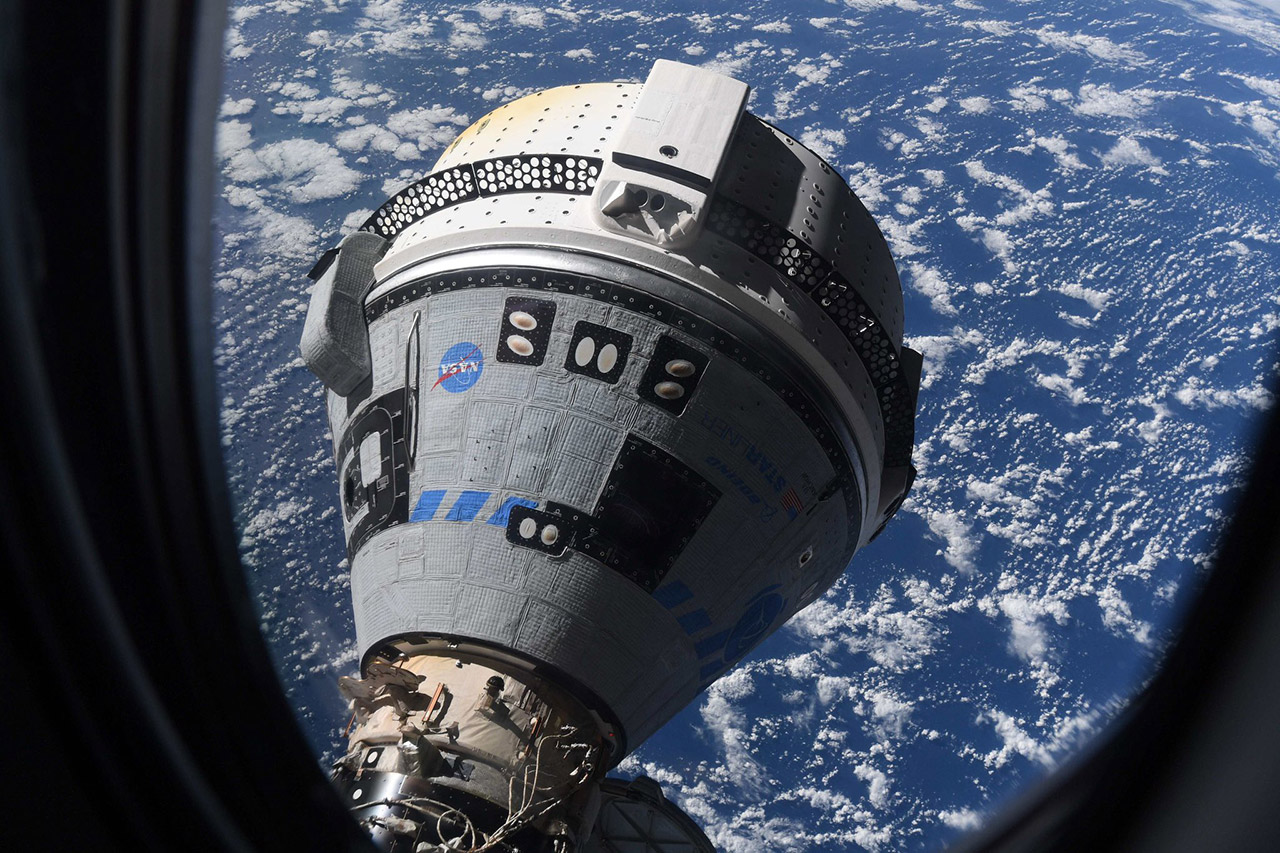
Starliner is seen on the International Space Station over Houston, home to Starliner mission control and astronaut training. (NASA photo)

NASA astronauts Butch Wilmore and Suni Williams climbed into Starliner at the International Space Station and worked with Boeing flight controllers and engineers on Tuesday, July 2, during power up of the spacecraft.

The teams on-console in NASA’s Mission Control Center in Houston and Boeing’s Mission Control Center at Kennedy Space Center checked out various systems of the spacecraft with the crew, including repressurizing the propellant manifolds. They also conducted mission data loads, or MDLs, which are files for the spacecraft’s computer to understand current inertial and relative navigation states, Earth rotation, and thermal conditioning on thrusters used during Starliner’s return, and more.

“We updated some products on board to support the continued docked duration through the month of July and through the higher positive beta periods we are approaching,” said Chloe Mehring, the Starliner flight director who coordinated the power-up actions with Wilmore and Williams. “Starliner is healthy and no anomalies were written against the spacecraft.”

Additional Operational Checkout Capabilities, or OCCs, that were added during Tuesday’s testing included tablet and procedure updates. Camera and tablet batteries were also charged while the spacecraft was fully powered up.

Canadian Space Agency astronaut Josh Kutryk, the CAPCOM or capsule communicator, who will fly on Starliner-1 following CFT, was also on console working with the crew. Kutryk updated crew toward end of power up that transfer of the MDLs were successful and all software updates are in a good configuration.

“Good news. Great work. Copy all,” Wilmore replied over the ISS Space-to-Ground loop.

That work took place as teams at NASA’s White Sands Test Facility in New Mexico prepared for Starliner’s Reaction Control System, or RCS, thruster testing. An acceptance test, which is standard for all new thrusters as a quality check and to gather baseline performance data, is starting today, July 3. This thruster was planned for a future Starliner mission.

Beginning next week, teams will run the thruster through similar conditions that Starliner experienced after launch on the way to the space station. The tests will include replicating the phase of the Crew Flight Test from launch to docking. Then tests will be performed to replicate what thrusters will experience from undocking to landing.

“We really want to understand the thruster and how we use it in flight,” said Dan Niedermaier, the lead Boeing engineer for the thruster testing. “We will learn a lot from these thruster firings that will be valuable for the remainder of the Crew Flight Test and future missions.”

Wilmore and Williams have remained busy assisting the space station crew with organizing stowage on orbiting laboratory. Earlier this week, Wilmore disassembled an empty NanoRacks CubeSat Deployer in the Japanese Experiment Module in preparation of upcoming NanoRacks missions. He also prepped and viewed samples for Moon Microscope, a demonstration that allows flight surgeons on Earth to diagnose illnesses and could provide diagnostic capabilities for crews on future missions to the Moon and Mars. Williams conducted some routine orbital plumbing, then audited U.S. stowage items housed inside the Zarya module. Go here to see more work the two performed Tuesday and today.

The Crew Flight Test astronauts will also provide an update on their mission and stay at the ISS during a news conference at 11 a.m. ET on Wednesday, July 10. Media interested in participating should RSVP by 5 p.m. Tuesday, July 9, and can learn how here.

Starliner works “exceptionally well” as Safe Haven in real-life scenario

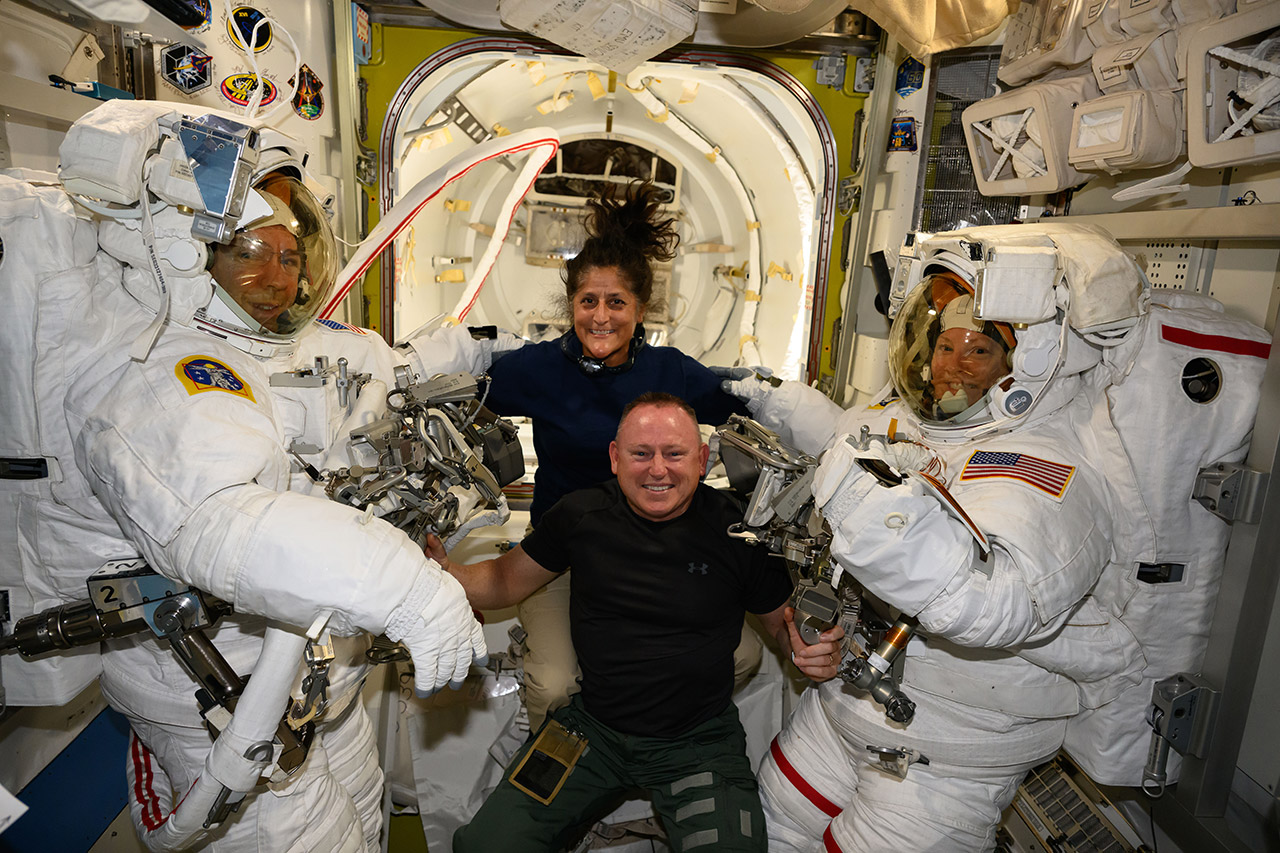
(June 24, 2024) NASA’s Boeing Crew Flight Test astronauts Suni Williams and Butch Wilmore (at center) pose with Expedition 71 Flight Engineers (far left) Mike Barratt and Tracy C. Dyson (far right), both NASA astronauts, in their spacesuits aboard the International Space Station’s Quest airlock.

Wednesday started as any other morning on-orbit for Starliner’s maiden crew, astronauts Butch Wilmore and Suni Williams. Their exercise routine was followed by organizing cargo inside the Permanent Multipurpose Module. But the nominal day quickly changed when a satellite broke apart at an altitude near the International Space Station.

Shortly after 9 p.m. EDT,  NASA instructed all astronauts to seek shelter in their respective spacecraft. Wilmore and Williams activated their Safe Haven procedures, sheltered inside Starliner, and began preparations for a possible undocking from station if it became necessary. They closed the hatch before the closest debris approach, which passed without issue.

“Starliner’s Safe Haven worked exceptionally well and as envisioned for this case,” said Ed Van Cise, the Starliner flight director who coordinated the sheltering actions with Wilmore and Williams.

Mission Control monitored the path of debris and after about an hour the crew was cleared to exit their spacecraft and resume station operations – which in this case was sleep. Starliner was out of docked quiescent mode for about three hours.

Wilmore and Williams performed two prior Safe Haven exercises inside Starliner, as part of the CFT test objectives. However, the additional metrics gathered Wednesday evening will benefit Starliner’s certification process and sharpen the experience for future crews. Starliner remains available for return in case of an emergency on the space station that would require the crew to leave orbit immediately and come back to Earth.

The opportunity to learn more about how Starliner performs in space is also giving Wilmore and Williams the additional time they had hoped for in zero gravity.

Earlier in the week, Wilmore cheered on the University of Tennessee’s baseball team, who played for and won the national championship, from the space station cupola. Wilmore is a Tennessee native and achieved a Master of Science in Aviation Systems from UT.

The ISS crew also helped prepare astronauts Tracy Dyson and Mike Barratt for a spacewalk. Their time outside station ended early due to a water leak in the service and cooling umbilical unit on Dyson’s spacesuit. The crew members were not in any danger as result of the leak.

Tuesday, all nine astronauts worked on advanced microgravity research, checked spacesuits, and performed maintenance on the orbiting laboratory. Wilmore and Williams spent the evening inside the Harmony module maintaining plumbing gear. They replaced the pressure control and pump assembly motor that supports the space station’s main restroom.

Next week, the Starliner crew will work with flight controllers to power up the spacecraft and load software files, charge batteries on a camera and their tablets, and perform other housekeeping activities. In addition to their valuable contributions to the space station, Wilmore and Williams are also helping ground teams collect critical data for longer-duration Starliner missions.

NASA, Boeing Adjust Timeline for Starliner Return

NASA and Boeing leadership are adjusting the return to Earth of the Starliner Crew Flight Test spacecraft with agency astronauts Butch Wilmore and Suni Williams from the International Space Station. The move off Wednesday, June 26, deconflicts Starliner’s undocking and landing from a series of planned International Space Station spacewalks while allowing mission teams time to review propulsion system data. Listen to a full replay of the June 18 media briefing where NASA and Boeing leadership discussed the ongoing efforts.

“We are taking our time and following our standard mission management team process,” said Steve Stich, manager of NASA’s Commercial Crew Program. “We are letting the data drive our decision making relative to managing the small helium system leaks and thruster performance we observed during rendezvous and docking. Additionally, given the duration of the mission, it is appropriate for us to complete an agency-level review, similar to what was done ahead of the NASA’s SpaceX Demo-2 return after two months on orbit, to document the agency’s formal acceptance on proceeding as planned.”

A media telecon with mission leadership will follow the readiness review’s conclusion, and the agency will share those details as they are solidified. Boeing’s Starliner spacecraft remains cleared for return in case of an emergency on the space station that required the crew to leave orbit and come back to Earth.

Mission managers are evaluating future return opportunities following the station’s two planned spacewalks on Monday, June 24, and Tuesday, July 2.

“Starliner is performing well in orbit while docked to the space station,” said Stich. “We are strategically using the extra time to clear a path for some critical station activities while completing readiness for Butch and Suni’s return on Starliner and gaining valuable insight into the system upgrades we will want to make for post-certification missions.”

Wilmore and Williams remain integrated with the Expedition 71 crew, assisting with station operations as needed and completing add-on in-flight objectives for NASA certification of Starliner.

“The crew’s feedback has been overwhelmingly positive, and they know that every bit of learning we do on the Crew Flight Test will improve and sharpen our experience for future crews,” said Mark Nappi, vice president and program manager, Boeing’s Starliner Program.

The crew is not pressed for time to leave the station since there are plenty of supplies in orbit, and the station’s schedule is relatively open through mid-August.

Recent Starliner Docked Activities

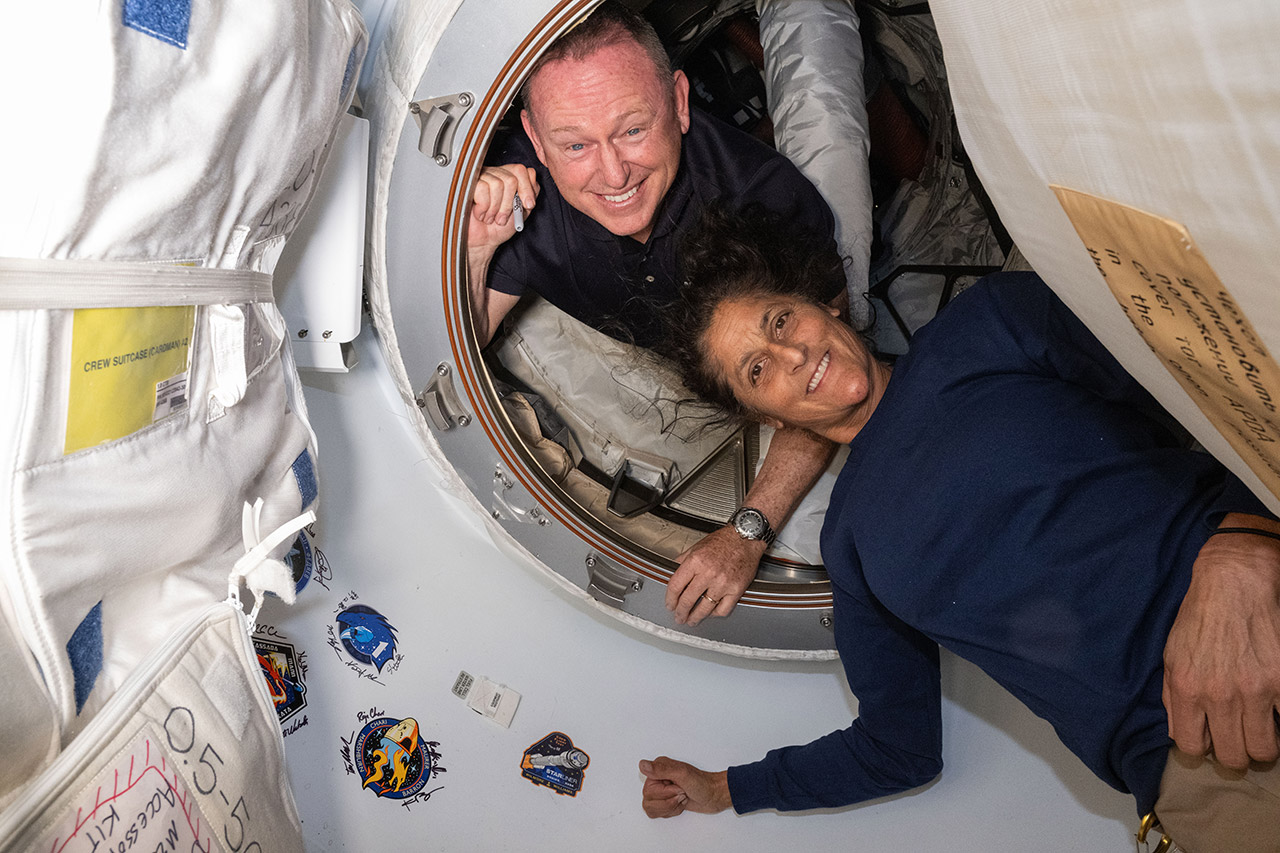
June 13, 2024) — NASA’s Boeing Crew Flight Test astronauts (from top) Butch Wilmore and Suni Williams pose for a portrait inside the vestibule between the forward port on the International Space Station’s Harmony module and Boeing’s Starliner spacecraft.

Crew Flight Test (CFT) astronauts Butch Wilmore and Suni Williams are testing more capabilities of the Starliner spacecraft and contributing to International Space Station operations. The entire CFT team is taking advantage of the additional days docked to learn as much as possible about Starliner to inform the ongoing certification process.

“Starliner is performing very well and we are getting exactly what we wanted out of this flight test by learning things you can only learn in flight,” said Mark Nappi, Starliner program manager, Boeing Commercial Crew. “The crew has been incredibly supportive of this learning on orbit, working with the ground teams, to improve and sharpen the experience for future crews.”

On Saturday, June 15, a hot fire test was performed on Starliner’s reaction control system (RCS) thrusters in the service module propulsion system. Wilmore and Williams sat in the cockpit during the tests so teams could hear their feedback on the sounds and feel of the thrusters firing. At the conclusion of the hot fire testing, the helium manifolds were isolated and the leak rates in each manifold decreased.

Other Starliner tasks included cabin sound checks, Communications Head Protection Assembly (CHPA) adjustments, and filming of on-orbit hatch operations for future crews to study. While the spacecraft was powered up, data was transferred from on-board recorders to support engineering assessments and software was uploaded with upcoming landing parameters.

Sunday, June 16, Boeing and NASA participated in a mission dress rehearsal at White Sands Space Harbor in New Mexico ahead of Starliner’s return. The combined Landing and Recovery Team (LRT) simulated convoy operations and recovery of the crew and Starliner.

Wilmore and Williams helped the Expedition 71 crew with ISS tasks, such as research and maintaining electronic, life support, and orbital plumbing systems.

  • Williams transferred wastewater between station modules, replaced a video camera in the Columbus laboratory module, moved to the Kibo lab and watered the Advanced Plant Habitat to prepare for upcoming science operations, and packed trash in a cargo return vehicle.
  • Wilmore swapped out thermal gear that protects electronics hardware on station and also worked in the Harmony module’s maintenance work area setting up hardware and researching liquid flows to improve the health care and food industries. The Gaucho Lung study he supported is exploring ways to optimize drug delivery for respiratory conditions, treat infants with respiratory distress syndrome, and prevent contamination of tubes with intermittent flows of liquids.

On Thursday, June 20, the crew took inventory of cargo stowed in Starliner for weight and center of gravity data analysis. Wilmore also made an adjustment to his commander seat in Starliner to account for an elongated spine from being on orbit, another key capability tested for future long-duration flights.

NASA, Boeing Update Starliner Crew Flight Test Return from Station

Teams from NASA and Boeing now are targeting no earlier than 10:10 p.m. EDT Tuesday, June 25, for the undocking of the Starliner spacecraft from the International Space Station. For the primary undocking opportunity, NASA astronauts Butch Wilmore and Suni Williams, the first crew to fly aboard Starliner, would land about 4:51 a.m. on Wednesday, June 26, at White Sands Space Harbor in New Mexico.

Mission teams supporting NASA’s Boeing Crew Flight Test continue to review Starliner’s data from the completed test objectives.

During a media teleconference on Tuesday, Steve Stich, manager of NASA’s Commercial Crew Program, discussed the flight test and upcoming return plans. Stich was joined by Dana Weigel, manager of NASA’s International Space Station Program; Mike Lammers, flight director at NASA’s Johnson Space Center in Houston; and Mark Nappi, vice president and manager of Boeing’s Commercial Crew Program. Listen to a full replay of the teleconference.

Following undocking and the deorbit burn, Starliner will descend under parachutes to land in the desert grounds of White Sands. Airbags attached to the bottom of Starliner will soften the spacecraft’s touchdown. The landing will mark the first time an American capsule has touched down on land with astronauts aboard. A team of NASA and Boeing specialists will retrieve the crew soon after landing.

Wilmore and Williams docked the Starliner spacecraft to the space station’s forward port on June 6 and have been testing spacecraft systems and performing tasks aboard the orbiting laboratory.

NASA, Boeing Target June 22 for Flight Crew Test Return

NASA and Boeing now are targeting no earlier than Saturday, June 22, to return the agency’s Boeing Crew Flight Test mission from the International Space Station. The extra time allows the team to finalize departure planning and operations while the spacecraft remains cleared for crew emergency return scenarios within the flight rules.

NASA and Boeing leadership will discuss the details of the new return target, flight status, and weather considerations for landing during a pre-departure media teleconference at 12 p.m. EDT Tuesday, June 18. NASA will provide additional media teleconference details soon.

“We are continuing to understand the capabilities of Starliner to prepare for the long-term goal of having it perform a six-month docked mission at the space station,” said Steve Stich, manager of NASA’s Commercial Crew Program. “The crew will perform additional hatch operations to better understand its handling, repeat some ‘safe haven’ testing and assess piloting using the forward window.”

NASA and Boeing teams also prepared plans for Starliner to fire seven of its eight aft-facing thrusters while docked to the station to evaluate thruster performance for the remainder of the mission. Known as a “hot fire test,” the process will see two bursts of the thrusters, totaling about a second, as part of a pathfinder process to evaluate how the spacecraft will perform during future operational missions after being docked to the space station for six months. The crew also will investigate cabin air temperature readings across the cabin to correlate to the life support system temperature measurements.

“We have an incredible opportunity to spend more time at station and perform more tests which provides invaluable data unique to our position,” said Mark Nappi, vice president and program manager, Commercial Crew Program, Boeing. “As the integrated NASA and Boeing teams have said each step of the way, we have plenty of margin and time on station to maximize the opportunity for all partners to learn – including our crew.”

NASA astronauts Butch Wilmore and Suni Williams, who are serving as Starliner’s crew for the mission, arrived at the International Space Station on June 6. They’ve completed numerous flight objectives required for NASA certification of Boeing’s transportation system for flights to the orbiting laboratory under the agency’s Commercial Crew Program.

Over the past three days, Wilmore and Williams have performed tasks as part of the space station team, including installing research equipment, maintaining the lab’s hardware, and helping station crewmembers Matt Dominick and Tracy Dyson prepare for a spacewalk. After NASA called off Thursday’s spacewalk, Williams worked to help the crew out of their spacesuits.

Engineering teams continue to increase their understanding of previous observations from Starliner propulsion systems on the spacecraft’s service module.

Pending spacecraft return readiness and acceptable weather conditions, Starliner will undock from the space station for a parachute and airbag-assisted landing in the southwestern United States. 

Starliner Flight Day 8 Activities

NASA astronauts Butch Wilmore and Suni Williams joined the Expedition 71 crew on the International Space Station one week ago and have been working closely with them each day on orbit.

On June 13, they helped astronauts Matt Dominick and Tracy Dyson suit-up and prepare for a planned spacewalk to remove a faulty electronics box from a communications antenna on station and to collect samples of microorganisms on the exterior of the orbiting laboratory.

When the spacewalk was later called off, Wilmore and Williams helped Dominick and Dyson get back out of their extravehicular activity spacesuits.

Later, the Starliner crew took an inventory of the food, water and hygiene products that have been used up to this point. They also worked with flight controllers to update a USB drive that is often refreshed with new information for return scenarios, like weather conditions, that can be downloaded to their tablets and used for an unlikely situation where crew would need to quickly leave the ISS.

Starliner Flight Day 7 Activities

Suni Williams supports the Genes in Space Molecular Operations and Sequencing, or GiSMOS, experiment on June 12. Photo credit: NASA

NASA astronauts Butch Wilmore and Suni Williams, who flew to the International Space Station on Boeing’s Starliner spacecraft, spent June 12 focusing on lab maintenance and researching advanced biotechnology.

Wilmore started his day checking cargo stowed in the Harmony module before replacing components in the station’s bathroom, known as the waste and hygiene compartment located in the Tranquility module.

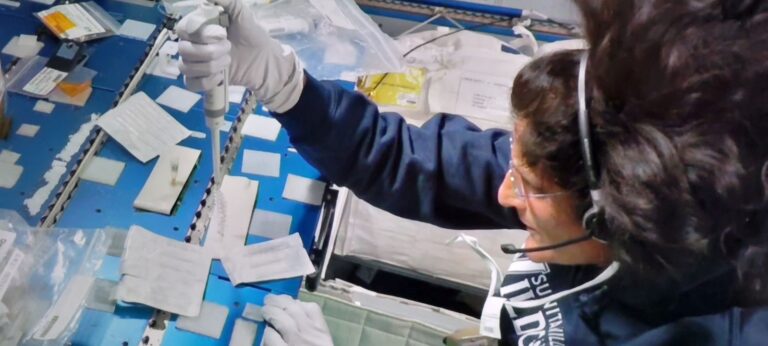
Williams extracted DNA from microbes collected from station water samples and sequenced their genes for identification in support of the Genes in Space Molecular Operations and Sequencing (GiSMOS) tech demo co-developed by Boeing and NASA. Results may inform ways to keep crews healthy and space habitats cleaner, which is vital for future long-duration and deep-space travel.

Having these two extra crew members on board the orbiting laboratory with experience in station work enabled the Expedition 71 crew to prepare for a June 13 spacewalk to remove a faulty electronics box from a communications antenna and collect samples of microorganisms on exterior surfaces.

Starliner Flight Day 6 Activities

Crew Flight Test (CFT) Commander Butch Wilmore and Pilot Suni Williams continued supporting International Space Station activities on June 11, having worked through all Starliner flight test objectives and operational capability checkouts with the exception of those associated with the next phase of flight.

“Our experienced test pilots have been overwhelmingly positive of their flight on Starliner, and we can’t wait to learn more from them and the flight data to continue improving the vehicle,” said Mark Nappi, vice president and program manager, Boeing’s Commercial Crew Program.

Wilmore and Williams also spent Tuesday working on biomedical activities and gene sequence training. Wilmore took an inventory of the Human Research Facility checking items such as blood tube kits, saliva sample packs, and gloves. Williams studied procedures to collect microbe samples, extract their DNA, and sequence their genes to learn how to identify bacteria and fungi living in station water systems.

Meanwhile, the integrated NASA-Boeing Starliner Mission Management Team (SMMT) is monitoring the overall health of the spacecraft and adhering to mission flight rules.

Wilmore and Williams continued to share their experiences with the public, including Tennessee Tech University in Cookeville, Tenn.

They also made a special call to colleagues who support their flight test back on Earth at Boeing, NASA, and United Launch Alliance. “It would’ve been great to take you all with us,” Wilmore told the team. “From launch, all the way up through the first day, this was one precise spacecraft. You would put in a point and it would go there and it would stay there. Much better than in the simulator. It was thrilling!”

NASA, Boeing Progress on Testing Starliner with Crew at Space Station

The Starliner spacecraft on NASA’s Boeing Crew Flight Test approaches the International Space Station while orbiting 263 miles above Quebec, Canada. NASA astronauts Butch Wilmore and Suni Williams aboard Starliner docked to the orbital outpost’s forward port on the Harmony module at 1:34 p.m. EDT on Thursday, June 6. (Photo credit: NASA)

Orbiting Earth as part of the nine-person crew of the International Space Station, NASA astronauts Butch Wilmore and Suni Williams continue testing Boeing’s Starliner spacecraft as part of its first flight with astronauts. The testing is part of the data collection on the Starliner system for certification by NASA for regular crewed mission to the orbital complex.

As part of NASA’s Boeing Crew Flight Test, Wilmore and Williams, along with teams on the ground, are stepping through numerous flight objectives following arrival of Starliner to the space station on June 6, including:

  • Powering the spacecraft down into a minimal power mode, which it will enter during operational missions while the crew works aboard station, and then powering it up again;
  • Conducting “safe haven” checks to show the spacecraft can support a crew with its own air and consumables during in an emergency on the station;
  • Performing a habitability study, along with astronauts Tracy Dyson and Matthew Dominick,to evaluate seating positions and other factors, such as air circulation for a four-person crew;
  • Evaluating spacesuit and seat-fits, as well as checkouts of the service module’s batteries.

Meanwhile, ground teams continue to assess and monitor Starliner’s performance and planning for return of the mission no earlier than Tuesday, June 18, pending weather and spacecraft readiness. Starliner is cleared for crew emergency return scenarios from space station, if needed, in accordance with the flight rules.

While Starliner remains docked to station, ground teams are continuing to evaluate propulsion system in-flight observations.

“Butch and Suni are doing great aboard station as ground teams continue digging into the details of Starliner’s on-orbit, rendezvous, and docked performance,” said Steve Stich, manager, NASA’s Commercial Crew Program. “We expected to do a lot of valuable learning on this test flight, and I am extremely proud of how the NASA and Boeing teams are working together to ensure we can safely execute the return portion of the mission.”

One of Starliner’s aft-facing reaction control system (RCS) thrusters, capable of about 85 pounds of thrust, remains de-selected as teams continue to evaluate its performance. Ground teams plan to fire all 28 RCS thrusters after undocking to collect additional data signatures on the service module thrusters before the hardware is expended. As part of normal operations, the service module separates from crew module on return, so NASA and Boeing will gather as much data as possible to aid in system assessments.

Teams currently are assessing what impacts, if any, five small leaks in the service module helium manifolds would have on the remainder of the mission. Engineers evaluated the helium supply based on current leak rates and determined that Starliner has plenty of margin to support the return trip from station. Only seven hours of free-flight time is needed to perform a normal end of mission, and Starliner currently has enough helium left in its tanks to support 70 hours of free flight activity following undocking. While Starliner is docked, all the manifolds are closed per normal mission operations preventing helium loss from the tanks.

Engineers also are evaluating an RCS oxidizer isolation valve in the service module that is not properly closed. Ground teams performed a successful propulsion system valve checkout on Sunday. All other oxidizer and fuel valves within the service module were cycled normally. The suspect oxidizer isolation valve was not cycled in the recent checkout. It will remain commanded closed for the remainder of the mission while ground teams continue to evaluate its data signatures. The crew module propulsion valves, which are part of an independent system that steers the capsule in the last phase of flight before landing, also were successfully cycled, and all those valves are performing as designed.

Mission managers are continuing to work through the return plan, which includes assessments of flight rationale, fault tolerance, and potential operational mitigations for the remainder of the flight. NASA and Boeing will hold a pre-departure media teleconference to provide additional updates before Starliner undocks from station.

With launch and docking already completed, the last remaining dynamic phase of the mission will come at the end of the flight test when Starliner will undock from the orbiting laboratory and then adjust its orbit to move away from the space station. The spacecraft, with Wilmore and Williams aboard, will perform a deorbit burn before entering the atmosphere and landing in the southwestern United States under parachutes and landing airbags to complete the flight.

Starliner Flight Day 5 Activities

Starliner has entered a quiescent state and will remain in a minimal power mode until it’s time to fully power back up and undock from the International Space Station to bring NASA astronauts Butch Wilmore and Suni Williams home. Meanwhile, teams on the ground have been reviewing vehicle system performance, as well as flight test objectives and operational capability checkouts achieved.

On June 10, the crew got to work supporting space station operations. After doing their daily exercises and health checks, Wilmore worked on a computer connected to the Microgravity Science Glovebox and Williams installed hardware in the Solid Fuel Ignition and Extinction chamber, in support of a space fire investigation.

Wilmore and Williams also began sharing their journey with the public from space during three in-flight events streamed live on NASA TV. Replays of those events are available via the links below.

Starliner Flight Day 4 Activities

NASA astronauts Butch Wilmore and Suni Williams continue testing and evaluating the Starliner spacecraft while docked to the International Space Station, a stay that will be extended by a few days.

Ahead of turning their attention to space station support, the crew worked in partnership with Boeing engineers and flight control teams on the ground to efficiently tick through more flight test objectives and operational capability checkouts of the spacecraft.

On June 9, Wilmore and Williams performed docked space-to-space audio checks, installed a window cover designed for long-duration missions, and performed a dry run of undock vehicle power up and propulsion system checkout procedures. Starliner’s Service Module batteries were also checked out and are fully charged for the next leg of the Crew Flight Test journey – returning to Earth in the southwest United States.

The crew was informed by CAPCOM Neal Nagata that mission managers are now targeting Starliner’s landing for no earlier than June 18. This paves the way for the crew to support additional station activities, such as the upcoming spacewalk on June 13, while engineers complete Starliner systems checkouts.

On June 10, the crew will participate in a number of public outreach events that will be carried live on NASA TV.

Starliner Flight Day 3 Activities

NASA astronauts Butch Wilmore and Suni Williams continue to settle into the pace of the International Space Station (ISS) after flying Boeing’s Starliner spacecraft, named Calypso, to the orbital complex.

June 8 began with Boeing engineers and flight control teams powering the spacecraft down and back up ahead of a scheduled “safe haven” demonstration. The ability to shelter in the spacecraft or depart the station quickly is a requirement of any visiting crew vehicle. In the “safe haven” configuration, Starliner’s own systems would be used to provide air and other essentials to astronauts during a contingency. Expedition crews occasionally move into their spacecraft if space debris is predicted to pass by or if solar radiation is higher than usual.

“We practiced a safe haven event where we would use this as a lifeboat. If something, say a conjunction or something was about to intercede with the space station, some space debris, then we would all go scurry to our spacecraft and hunker down and hopefully everything passes. We went through that process today, closing the hatches, everything, and it was quite a successful event,” said Wilmore while giving a tour of Calypso during a live downlink event.

In a test of what it would be like to live and work inside Starliner with additional crew members, Wilmore and Williams were joined by Matthew Dominick and Tracy Caldwell Dyson for a number of hours. Together, they assessed air circulation, sleeping arrangements, privacy space, windows, and spacesuit donning, doffing and storage.

Data was also collected by Starliner as the space station received a re-boost from Northrop Grumman’s NG-20 Cygnus spacecraft, an operational activity that will occur regularly on future long-duration missions.

Wilmore and Williams then conducted a bit of weekend housekeeping, cleaning up the spacecraft that they occupied for about 30 hours from pre-launch to docking.

Finally, Starliner was again powered down to enter quiescent mode – another critical capability for future long-duration missions. It will be powered back on June 9 for an undock systems checkout before going back into and remaining quiescent until the pre-undock power up.

All this follows a busy June 7, when Wilmore and Williams worked with ISS crew members to unpack cargo, including a late add – a pump for the station’s Urine Processing Assembly, which is now back in full operation.

For test pilots like Wilmore and Williams, who both graduated from the U.S. Navy’s test pilot school before joining NASA’s astronaut corps, data collection and precise evaluation is the normal routine for learning about a new vehicle whether it be a high-performance aircraft or sophisticated spacecraft.

Starliner Flight Day 2 Activities

On June 7, one day after docking, Crew Flight Test (CFT) Commander Butch Wilmore and Pilot Suni Williams unloaded cargo, charged tablets and reviewed emergency procedures to prepare for the “safe haven” operational capability checkout.

Wilmore and Williams also met with Boeing teammates on the ground to talk about their experiences so far, including crew-interactive type items like spacesuits, seats, cargo bag placement, maneuverability in the interior, food, sleeping arrangements, hatch operations and lighting.

On June 8, at 9:00 a.m. ET, Wilmore and Williams will welcome the world aboard the spacecraft for the first time in space with a tour of Calypso live on NASA TV.

Starliner Completes 1st Crewed Docking

ISS Expedition 71 crew members welcome Starliner’s first crew, Butch Wilmore (center left) and Suni Williams (center right) on board the International Space Station. (NASA TV image)

A combination of sensors, automatic steering and the careful gaze of two astronauts worked together to make history Thursday, June 6, by guiding Boeing’s CST-100 Starliner to its first docking to the International Space Station (ISS) while carrying astronauts. Crew Flight Test (CFT) Commander Butch Wilmore and pilot Suni Williams became the first of what is expected to be dozens of astronauts who will fly aboard Starliner on crew-rotation missions to the orbital laboratory complex.

The docking capped a precisely choreographed flight plan that saw the Boeing-owned and -operated spacecraft lift off Wednesday precisely at 10:52 a.m. Eastern time from Space Launch Complex 41 in Florida. Starliner began a planned series of thruster firings to first lift Starliner’s orbit and then refine its track to the space station.

Wilmore and Williams performed some manual steering and navigation checks on Starliner throughout the flight to station to confirm the systems operated properly. They also demonstrated the spacecraft’s manual control system, which allows an astronaut to take over all of Starliner’s operations, if needed. Equipped with cutting-edge sensors and complex flight computers, Starliner carried out the maneuvers autonomously while its crew evaluated every step and stood ready to jump into the process if needed.

Starliner progressively caught up to the station then moved ahead of it, lining itself up perfectly with the forward port of the ISS.

“It’s nice to be attached to the big city in the sky,” Wilmore said as the Starliner made contact with the space station. “It’s a great place to be. We are looking forward to … getting all the things done in Starliner we need to get done and also on station.”

Starliner is designed to fit a maximum crew of seven, though future NASA missions will carry a crew of four to five.

This flight test is being carried out with two people aboard to prove all the systems operate as expected. Confirming a raft of sensors and systems perform correctly is, in fact, the prime task for Wilmore and Williams during the eight to 10 days they are at the ISS. They will also unpack a number of cargo containers in orbit and move them into the station before boarding Starliner again for the return flight to a landing on land in the American southwest.

“We’ve had an ideal start for this flight test that our team has been working toward for some time,” said Boeing’s Mark Nappi, program manager for Starliner. “We are going to be careful with this spacecraft, making sure we are listening to what its systems are telling us. So far, Starliner is telling us everything we want to hear, but we are not taking anything for granted.”

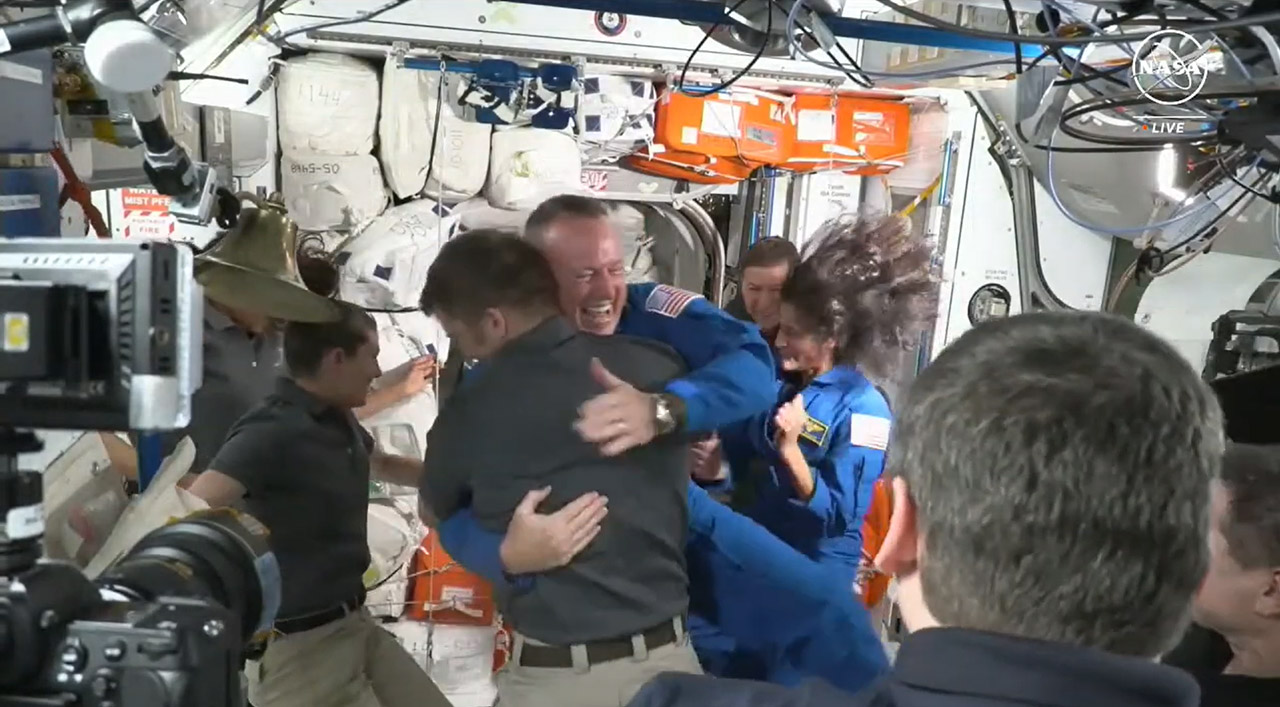
After concluding a number of procedures to connect the Starliner’s systems fully with the ISS, Wilmore and Williams opened the Starliner hatch and joined the seven ISS crew members inside the sprawling, million-pound complex.

“Butch and Suni, we are glad to see you,” said Oleg Kononenko, the current ISS commander, as Wilmore and Williams floated through the hatch into the main part of the station. “We want to congratulate the whole team … for launch, for docking. Very happy.”

“We are just as happy as can be to be up in space, one in Starliner, in on Atlas 5, and then here on the International Space Station,” Williams said. “It just doesn’t get much better.”

Starliner Arrives at the Space Station

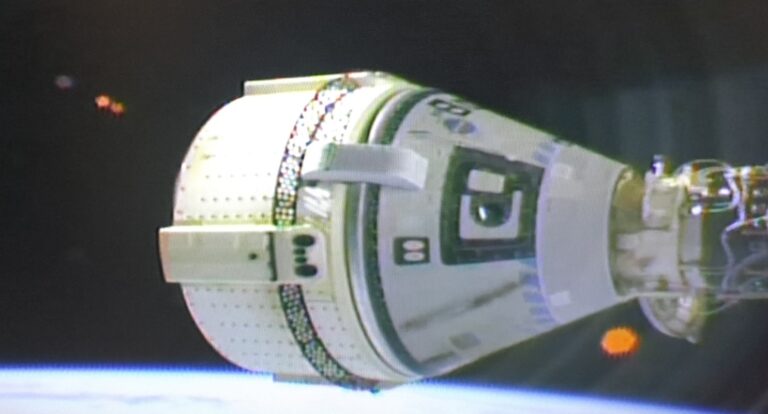
Boeing’s Starliner arrives at the International Space Station for the first time with crew on board, docking at 1:34 p.m. Eastern time Thursday. (NASA TV image)

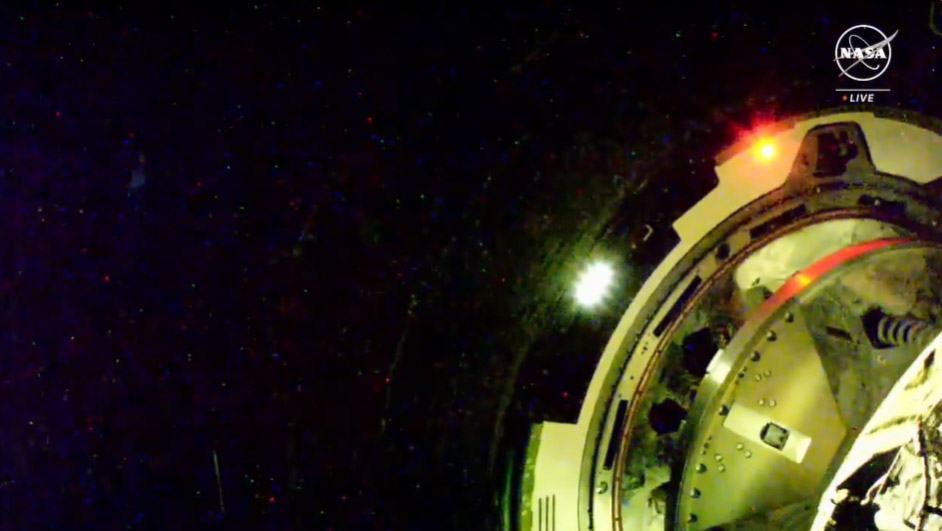
After a historic launch and arrival on orbit, the CST-100 Starliner docked with the International Space Station (ISS) at 1:34 p.m. Eastern time on Thursday, safely delivering NASA astronauts Butch Wilmore and Suni Williams to the space station’s door.

Watch live now and throughout the mission on Starliner’s CFT mission website or on NASA TV — stay tuned as ISS crew members prepare to open the hatch and welcome Suni and Butch on board.

CFT Crew Prepares for Rendezvous and Docking

The Crew Flight Test crew is getting ready for the rendezvous and docking. Today, mission managers gave the “go” for the Starliner spacecraft to proceed with International Space Station (ISS) integrated operations at 12:15 p.m. ET after a review of the vehicle’s status and continued monitoring of the helium system.

Butch Wilmore and Suni Williams are now preparing Starliner for near-field rendezvous and docking operations. As Starliner nears the ISS and its VESTA cameras identify the orbital lab, the astronauts don their spacesuits and begin what’s known as near-field operations.

Starliner’s VESTA system will be the first to see the ISS, first as a distant point of light. The spacecraft will then use a combination of its visual sensors, GPS and inertial navigation systems to continue chasing the station. Rendezvous begins with Starliner nearing the station from below, then a series of inbound flyaround maneuvers place the capsule in front of the ISS for its docking approach.

Commander Wilmore will exercise another set of manual piloting demonstrations, which will be similar to those conducted earlier in flight. After that, the mission management team will give a “go” for Starliner to enter the ISS’s Keep Out Sphere, and an automated final docking attempt will begin.

CFT crew in seats, Starliner hatch closed

Boeing crews close the hatch to the Starliner capsule carrying NASA astronauts Butch Wilmore and Suni Williams. Photo credit: NASA Television

Starliner progressing towards final countdown ahead of first crew flight

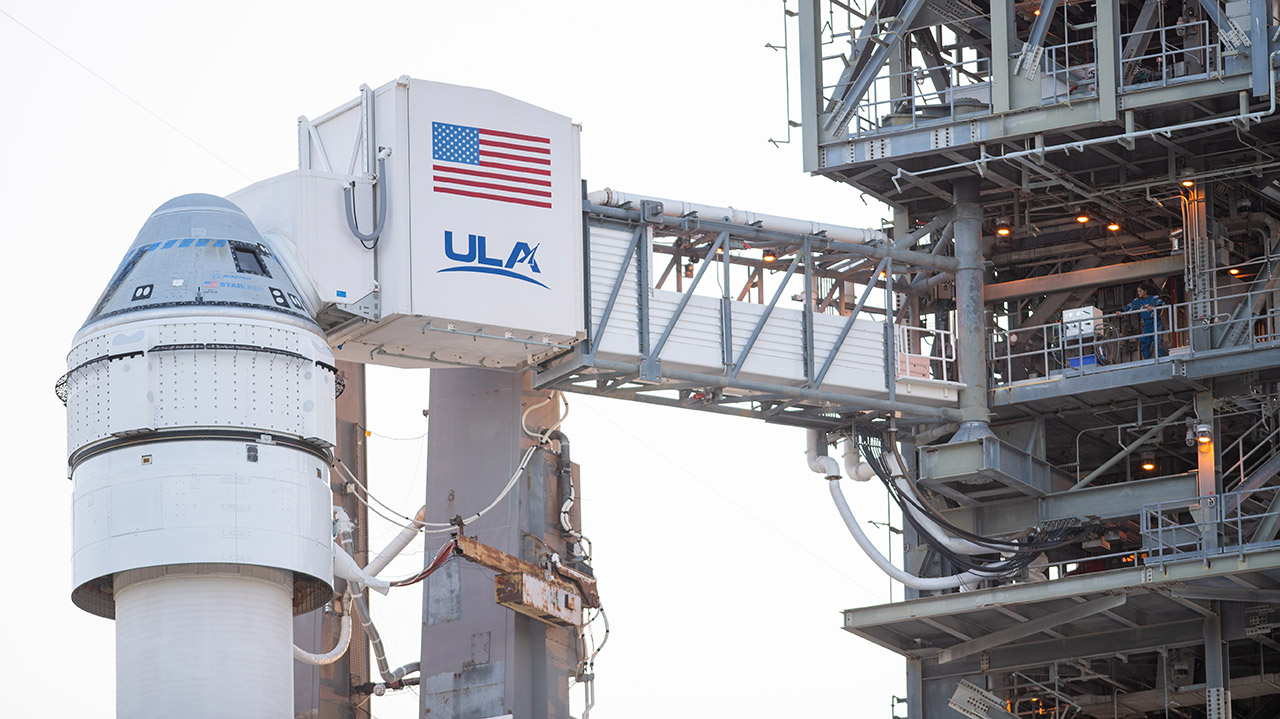
A United Launch Alliance Atlas V rocket with Boeing’s CST-100 Starliner spacecraft aboard is seen on the launch pad at Space Launch Complex-41 after the arrival of NASA astronauts Butch Wilmore and Suni Williams, Wednesday, June 4, 2024, at Cape Canaveral Space Force Station in Florida. (Photo Credit: NASA/Joel Kowsky)

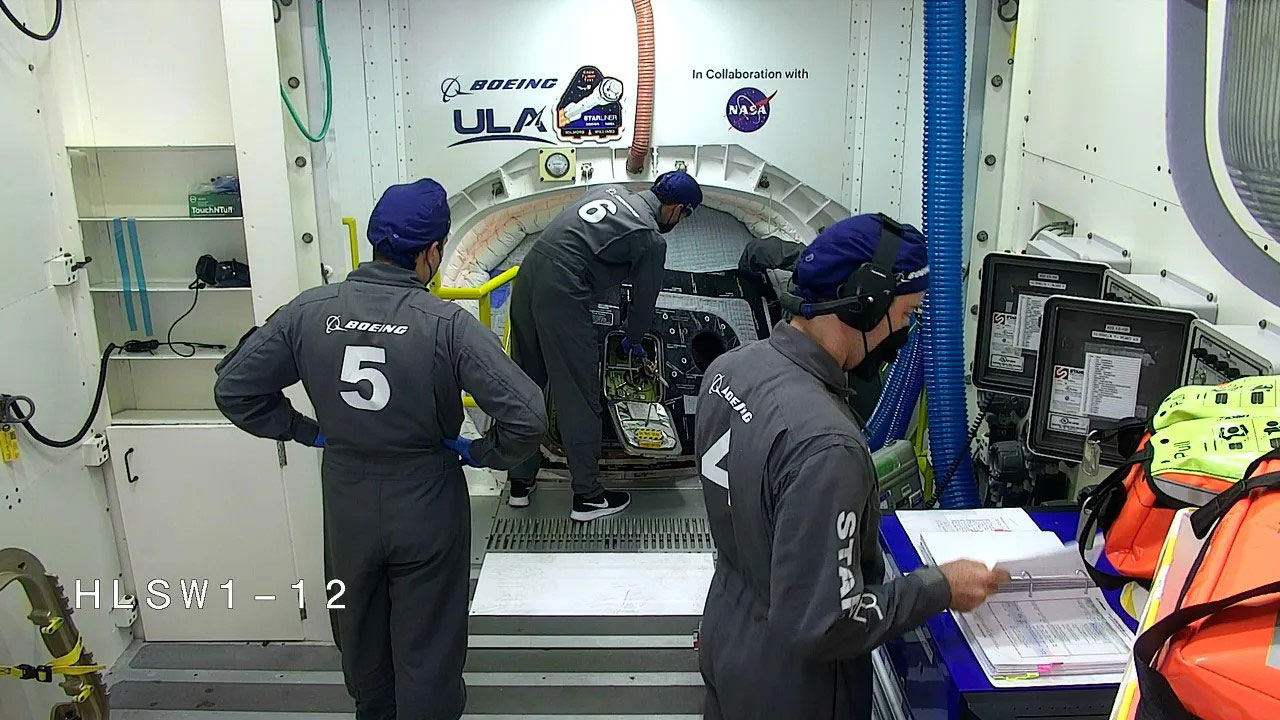
At 9:34 a.m. ET on Wednesday, June 5, Boeing engineers and technicians closed the hatch to the CST-100 Starliner after ensuring NASA astronauts Butch Wilmore and Suni Williams were safely secured in their seats ahead of launch.  Mission operators will conduct leak checks on the capsule to prove the hatch has a tight seal and is holding pressure.

The joint Boeing-United Launch Alliance pad team will depart the launch pad and to join emergency response teams stationed a safe distance away until after liftoff. Wilmore and Williams are continuing their prelaunch procedures in coordination with launch control teams in Houston and Florida.

The next major milestone ahead of launch will be polling to resume the T-4 minute countdown after the extended, planned hold to allow for crew ingress and final closeouts. Liftoff is scheduled for 10:52 a.m. ET.

Starliner Manual Piloting Demonstrations Successful

On the way to the International Space Station, Butch Wilmore and Suni Williams tested out a unique capability of Boeing’s Starliner spacecraft on orbit – manual piloting. Although the spacecraft is usually autonomous, the crew used the hand controller to point and aim the spacecraft during about two hours of free-flight demonstrations.

“We’ve also spun out the manual maneuvering and it is precise, much more so than even the simulator,” said Wilmore, CFT commander. “Stopping exactly on a number you want to stop on, the precision is pretty amazing.”

During a far-field demo, they pointed Starliner’s nose toward the Earth so that its communications antenna on the on the back of the Service Module was pointed at the TDRS satellites. They then moved the Starliner so its solar array pointed at the sun to show they could charge the internal batteries, if ever needed.

Next, they swung Starliner around and pointed the nose away from Earth to look at the stars. This was to show they can manually use the star trackers in the VESTA system to establish their attitude in space in case all three flight computers were to ever go out or be turned off at the same time.

Then, they manually sped Starliner up and then slowed it down, which slightly raised and then lowered their orbit. This was to show that the crew could manually break away from the space station orbit during rendezvous, if necessary.

Finally, the crew manually pointed Starliner in the orientation needed for entry into the Earth’s atmosphere, just in case they have to do that manually. During that maneuver, they again pointed the solar array at the sun to try a different method of confirming they can manually charge the batteries.

There is more manual piloting to come for this “pilot’s spacecraft” with Wilmore and Williams on docking day, June 6.

Starliner on orbit, astronauts headed to space station

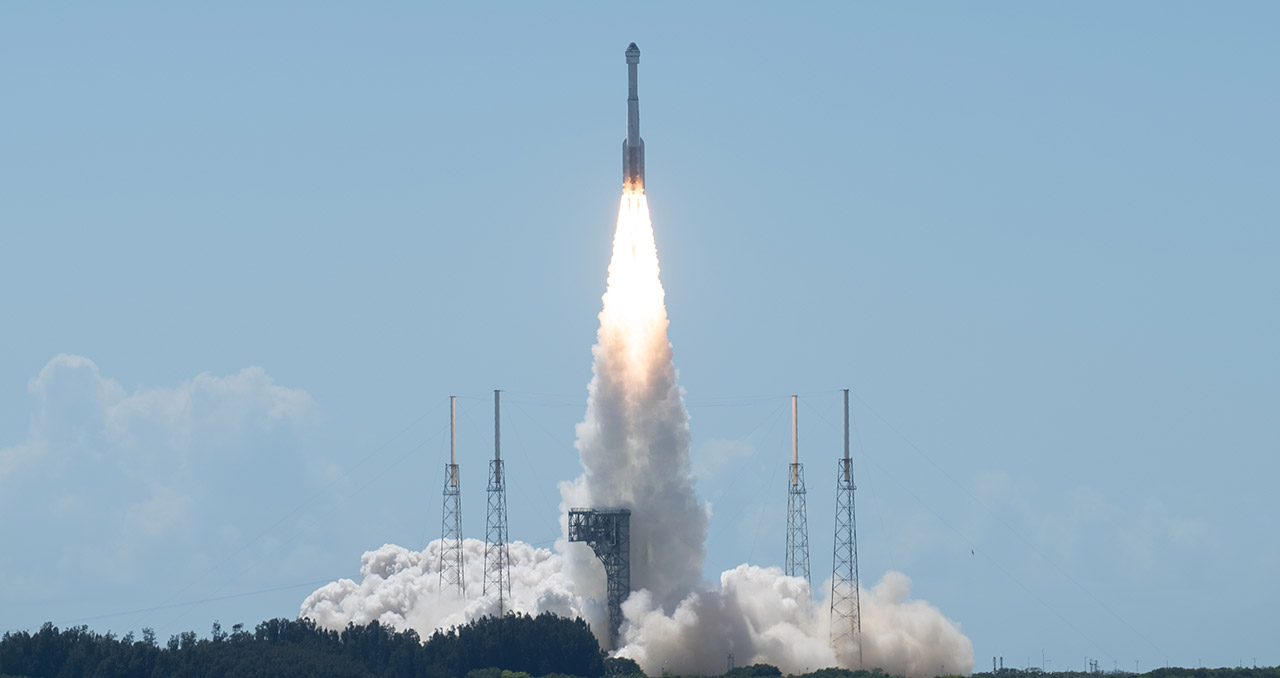
Boeing’s CST-100 Starliner launches atop a United Launch Alliance Atlas V rocket on the Crew Flight Test at 10:52 a.m. Eastern time on Wednesday, June 5, from Cape Canaveral Space Force Station in Florida. (Photo credit: Boeing/ Joey Jetton)

Carrying its first passengers — NASA astronauts Butch Wilmore and Suni Williams — the CST-100 Starliner is on its way to the International Space  Station. The spacecraft performed its planned orbital insertion burn about 31 minutes after launching from Florida’s Cape Canaveral Space Force Station aboard a United Launch Alliance Atlas V rocket.

“With Starliner’s launch, separation from the rocket and arrival on orbit, Boeing’s Crew Flight Test is right on track,” said Mark Nappi, vice president and program manager of Boeing’s Commercial Crew Program. “Everyone is focused on giving Suni and Butch a safe, comfortable ride and performing a successful test mission from start to finish.”

The spacecraft is expected to dock with the space station a little more than 24 hours after reaching orbit. Wilmore and Williams will be on station with Expedition Crew 71 and stay for about eight days. In addition to transporting the astronauts, the Boeing-built Starliner has on board about 760 pounds (345 kilograms) of cargo, including 307 pounds (139 kilograms) for NASA, such as food and items requested by the crew while on the space station.

Starliner Remains Powered Up for Launch

The Starliner spacecraft and Atlas V rocket stand ready for the next launch opportunity on June 5. (Photo credit: Boeing/Anthony Hight)

Boeing subsystem experts and engineers have been working in shifts to provide around-the-clock monitoring of the Starliner spacecraft from their positions on console in Boeing’s Mission Control Center (BMCC) at NASA’s Kennedy Space Center in Florida since initial powerup and activation operations began at 3:30 a.m. ET on Friday, May 31. All systems are flight ready ahead of the next Crew Flight Test (CFT) launch attempt on Wednesday, June 5, at 10:52 a.m. ET.

Commanding of the vehicle will come from the BMCC team until handover to Starliner mission controllers in Houston at about L-3 hours, 55 minutes on launch day. BMCC teammates will continue working in shifts to provide engineering support to flight control teams until quiescent mode while Starliner is docked to the International Space Station.

Tune into the joint NASA/Boeing Starliner broadcast at boeing.com/starliner#watch beginning at 6:45 a.m. ET, running continuously through hatch open and crew remarks at the International Space Station.

NASA, Boeing Set for June 5 Crew Flight Test Launch Attempt

Teams at NASA and Boeing confirmed Monday the company’s Starliner spacecraft, ULA (United Launch Alliance) Atlas V rocket, and ground support equipment are healthy and ready for the next launch attempt. The first Starliner flight with NASA astronauts Butch Wilmore and Suni Williams, known as NASA’s Boeing Crew Flight Test, is targeted to liftoff at 10:52 a.m. EDT Wednesday, June 5, to the International Space Station for about a one-week stay aboard the microgravity laboratory.

Work at the launch pad at Space Launch Complex-41 at Cape Canaveral Space Force Station in Florida was completed June 2 to change out and test a failed power distribution source that halted a launch attempt on June 1. The Starliner mission management team reviewed multiple aspects of the replacement and troubleshooting steps and polled “go” to proceed during a detailed session as they continued to prep the teams and hardware for the June 5 opportunity.

“I really appreciate all the work by the NASA, Boeing, and ULA teams over the last week,” said Steve Stich, manager of NASA’s Commercial Crew Program. “In particular, the ULA team worked really hard to quickly learn more about these issues, keep our NASA and Boeing teams informed, and protect for this next attempt. We will continue to take it one step at a time.”

The weather forecast continues to call for favorable conditions, with U.S. Space Force meteorologists from the 45th Weather Squadron predicting a 90% chance of acceptable conditions at launch time. The ascent corridor and onshore winds weather also is forecast to be acceptable in the unlikely case of an emergency abort during the launch.

Wilmore and Williams continue preparing for launch with proficiency training. The two remain quarantined at Kennedy Space Center in Florida ahead of liftoff.