

European innovation
Key sites

Madrid, Spain
The headquarters of Boeing’s European research focuses on national and SESAR funded air operations projects and leads Boeing’s Digital Engineering International Hub.

Munich, Germany
Leading research into production systems, autonomy, digital engineering, advanced structures, generative design and probabilistic certification methods

Sheffield, UK
Specialized in composite manufacturing, automated production processes, and supply chain integration through the Advanced Manufacturing Research Centre ecosystem.

Prestwick, UK
Home to the Aerospace Innovation Center, the site supports pilot lines, supplier industrialization, sustainability, and skills development for Scotland and the UK.
By the numbers
80+
Projects
170+
Researchers
5
Sites
60+
Partners
Future sustainable airspace
Operational efficiency is one of the four pillars of Boeing’s sustainability strategy. Our teams are developing decision-support software prototypes that will enable superior operations planning, execution, analysis and recovery, leading to unparalleled fuel burn savings and resilience to disruptions.
The team helps airlines to better plan, execute and analyze their operations to reduce costs, and mitigate potential disruptions, and above all to build long term strategies in sustainability.
We’re transforming how we design, build and operate to improve aerospace efficiency and performance.
A SESAR founding member
At Boeing, we are proud to be a founding member of the European union Single European Sky ATM Research (SESAR) 3 Joint Undertaking - an institutionalized European public-private partnership where we join forces with the EU, EUROCONTROL and over 50 organizations covering the entire aviation value chain to apply our knowhow, experience and innovative thinking to deliver the Digital European Sky. We contribute to eight SESAR 3 JU Projects.
Projects highlights
The demand on the aerospace sector is growing - from commercial aviation to cargo transport and even innovative advanced air mobility being on the rise. With new aerospace users and new technologies deployed in the same airspace occupied by conventional forms of air travel, new solutions for airspace management and safety are needed.
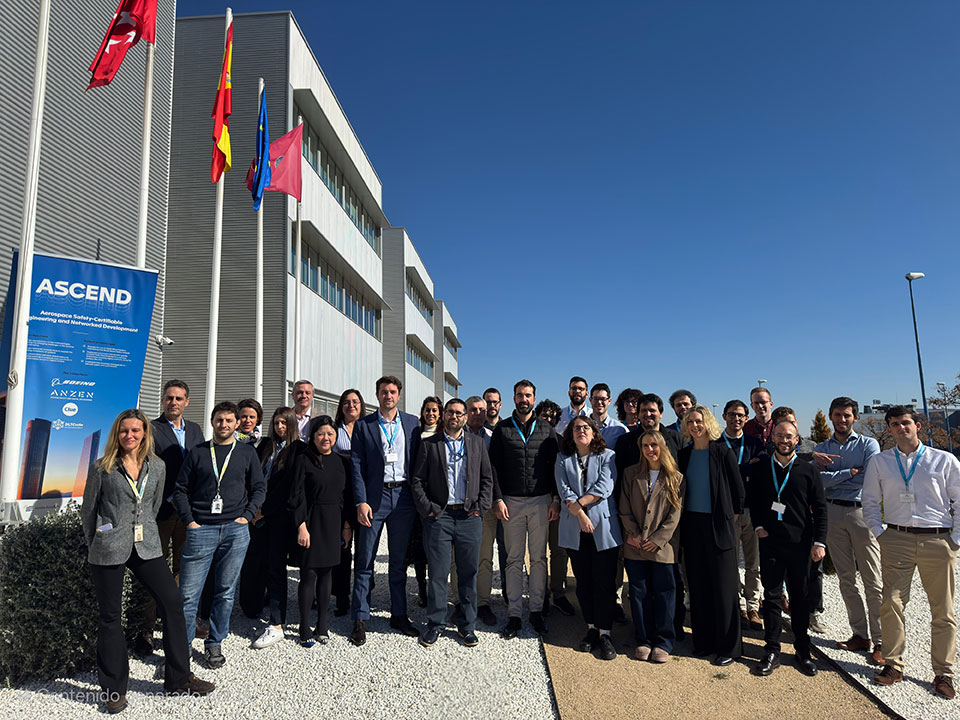
ASCEND, a project led by Boeing Aerospace Spain with Anzen Engineering, Clue Technologies, and DLTCode, applies MBSE/MBSA and digital engineering to create scalable methodologies and standards that accelerate technology adoption. The project, part of the iMBMT program, is co‑funded by the Community of Madrid and the ERDF for more than 50% and totals nearly €5 million. Learn more via the links below:
The VARIANT project is a strategic industrial research initiative to enable the safe, efficient, and scalable integration of emerging electric and autonomous aircraft into existing and future airspace. Led by Boeing Aerospace Spain, the consortium includes ANZEN Engineering, AI METHODS, and QCentroid, with subcontractors Dimetor, Universidad Carlos III de Madrid, ENAIRE, Universidad Politécnica de Madrid and CRIDA A.I.E. VARIANT focuses on Innovative Air Mobility, including eVTOLs operating at low altitudes in urban and suburban environments, and will validate operational concepts, ground systems, and technologies through simulation, laboratory testing, and high-fidelity simulation trials.
SONRISA is developing digital quality assurance for laser powder bed fusion in aerospace, focusing on process monitoring, data analytics and certification-ready standards. Led by Liebherr-Aerospace Lindenberg GmbH, the consortium includes Boeing Deutschland and industry and research partners. Boeing Deutschland is contributing to quality assurance concepts for 3D-printed, weight-optimized aerospace components.
LuFo VII-2 DeCAF, or Decarbonized Aircraft Cabin and Fleet, is a collaborative research project running from 2026 to 2029. Suppliers, aircraft manufacturers, airlines and research organizations are studying how cabin design and technology can support more sustainable aviation. Boeing Deutschland, through Boeing Commercial Airplanes, is researching ways to reduce cabin equipment energy use and component weight, while improving sustainability across cabin manufacturing, operation and maintenance. A fully integrated demonstrator will support validation of the project’s results.