
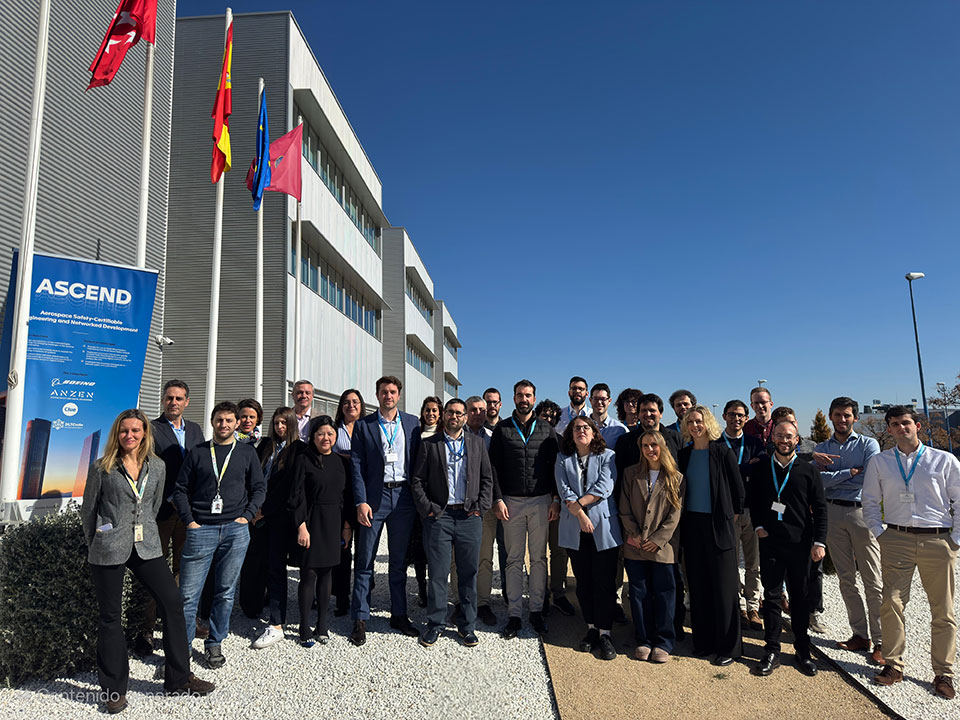
MADRID, Spain, July 21, 2026 – In the first half of the ASCEND project, the Boeing team has advanced a suite of digital engineering and model-based safety technologies in collaboration with consortium partners Anzen Engineering, Clue Technologies and DLTCode. The collaboration highlights the important role of Spanish companies in advancing globally relevant aerospace digital engineering capabilities.
The Aerospace Safety Certifiable Engineering and Networked Development (ASCEND) project applies model based systems engineering (MBSE), model-based safety analysis (MBSA), product security engineering and digital engineering approaches to improve prevention, safety and efficiency across aircraft development lifecycles.
“This first phase of ASCEND has demonstrated the power of model-driven engineering to accelerate safety and streamline certification-relevant workflows,” said Eduardo Carrillo de Albornoz, managing director of Boeing Global Technology-Europe. “Working with our consortium partners we’ve been able to prototype practical tools and contribute to standards activities that will benefit the broader aerospace community.”
Key highlights
- Accelerating safety through model-driven standards (via a metamodel) that enable automated safety and security analysis
- Prototyping tools to streamline safety analysis like Functional Hazard Assessments (FHA) or Failure Mode & Effects Analysis (FMEA) for complex aircraft systems
- Shaping industry best practices with direct contributions to working groups such as OMG, INCOSE, and SAE International
“ASCEND represents a unique opportunity to demonstrate how model-based engineering can transform safety and certification processes in the aerospace industry. At Anzen Engineering, we are proud to contribute our expertise in functional safety and model-based analysis to develop solutions that not only address the industry's current challenges, but also lay the foundations for a safer, more efficient, and more digitalized aviation sector,” said Pablo de la Cruz, CEO of Anzen Engineering.
Funding and project value
The Community of Madrid co-finances more than 50% of the ASCEND 2024 consortium through its program to support public-private cooperation in R&D&i, along with support from the FEDER (European Regional Development Fund) operational program. The project is valued at nearly five million euros.
“The progress achieved in this first phase of ASCEND demonstrates the potential of applied digital engineering and how collaboration between industry and technology can accelerate the adoption of new methodologies in the aerospace sector. At DTCode, we contribute to the project our experience in developing advanced technology solutions to transform complex models into practical tools that enhance safety across all areas of the aeronautical sector,” said Santiago Barrio, Chief Operating Officer (COO) of DLTCode.
“The use of MBSE methodologies in ASCEND enables the integrated definition and validation of safety and security requirements within a structured logical model, replacing traditional documentation with executable processes. This methodological transition will provide the aerospace sector with a more agile and collaborative engineering framework, drastically reducing integration times and the resources associated with the development of complex technologies. Projects like ASCEND embody Clue's dedication to remaining at the forefront of technological research, integrating advanced capabilities that redefine the development of next-generation avionics,” says Juan Ángel Tomás, innovation director at Clue Technologies.
About ASCEND
The ASCEND project brings together industry and technology partners to accelerate adoption of certifiable, model-based practices and digital tools that reduce risk, improve traceability and enhance safety in aerospace system development.