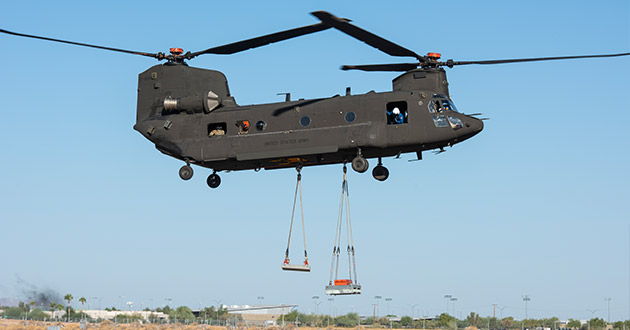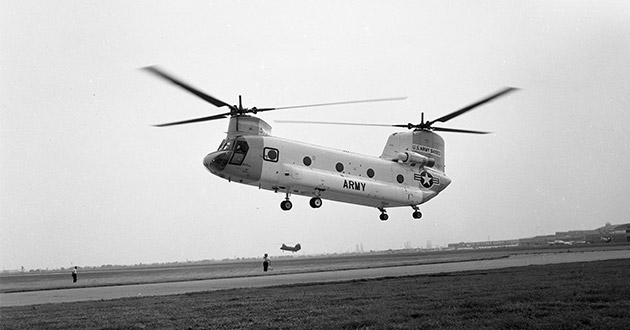
This month marks 60 years since the Chinook prototype took to the skies, setting the stage for the rotorcraft’s eventual dominance in heavy-lift heroics.
Whether flown in harsh combat conditions, transporting loads of cargo and troops, or conducting humanitarian missions, the Chinook has made a career of doing the unthinkable. So it’s fitting that the helicopter’s extraordinary 60 years appear to be merely a warmup act.
“There’s no doubt in my mind that Chinook will be at least a 100-year-old aircraft,” said Patrick Serfass, Boeing Global Sales and Marketing representative for Vertical Lift. “It will be operating and performing for the United States and its allies well beyond 2060.”
That would not have been possible without the incremental improvements – large and small – Team Chinook has worked into the aircraft over its six decades. Today, H-47s are known for their strength and durability, but that wasn’t the case earlier in the Chinook’s lifetime.
Retired pilot Herman Richardson, who flew Chinooks for the U.S. Army and later worked at Boeing, recalls when Chinooks had only a fraction of their current power. Looking back at his service during the Vietnam War era, Richardson said, “We couldn’t fly them the way we do now.”
Over his career, Richardson had a front-row seat for the Chinook’s evolution. He flew all versions of the Chinook as it progressed from models A through G, and he witnessed the rotorcraft’s power become its greatest attribute. “It was a joy ever since,” he said. “There’s not a better aircraft to fly than Chinook.”
Richardson, as well as a number of other individuals closely associated with Chinook, visited Boeing’s H-47 production facility in Philadelphia on the 60th anniversary of the aircraft’s first flight. While there, they shared memories and insights with Boeing and industry teammates who develop, build and support today’s Chinooks.
One of those guests, Fred Piasecki, chief technology officer of Philadelphia-based Piasecki Aircraft Corp., explained why Chinook continues to be a best-in-class platform.
“The longevity of this product is due to a dedication to engineering and manufacturing excellence,” said Piasecki, whose father, Frank, pioneered the tandem-rotor technology that is Chinook’s hallmark.
“The aircraft was an immature vehicle when it first went to flight,” Piasecki continued. “Field feedback was a cornerstone of early improvements. It was the dedication of the people that made it a success.”