While the Artemis II crew was just announced, Boeing teams are already preparing for when the crew will head much further into space than the moon
The moon is the first stop for NASA’s Space Launch System (SLS) rocket as the Artemis missions take off. Beyond that, SLS has its sights set on Mars — Earth’s most intriguing planetary neighbor.
While people have dreamed of exploring Mars for decades, the average distance between Earth and Mars is over 200 times greater than the distance between Earth and the moon.
So, a trip to Mars requires a more capable, in-space vehicle.
More capable than what?
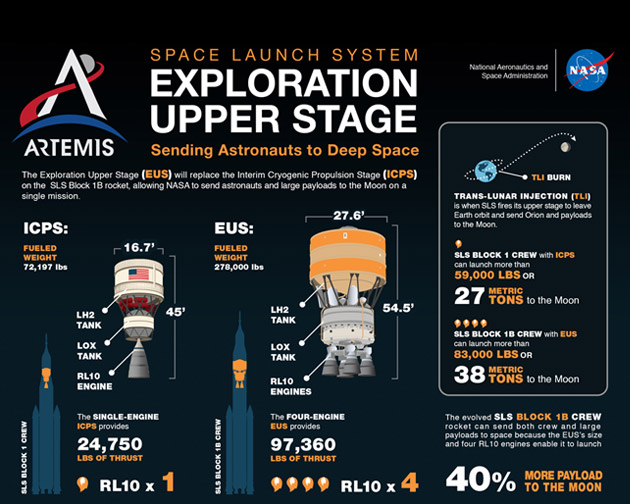
For the Artemis I, II and III missions, the upper stage on the SLS rocket is known as the Interim Cryogenic Propulsion Stage (ICPS). While sufficient to get Orion to the moon, the sustained exploration of lunar space requires more payload than a crew capsule. Meaningful exploration requires more capability and power.
Enter the Exploration Upper Stage (EUS):
EUS will provide the in-space propulsion needed to bring a crewed spacecraft and large payloads to the moon to enable the Moon to Mars objectives, beginning with the Artemis IV mission.