Before digital design, Boeing’s artists drew the future

Thousands of archived works bring to life a creative chapter in the company’s aerospace history.

October 27, 2026 in History

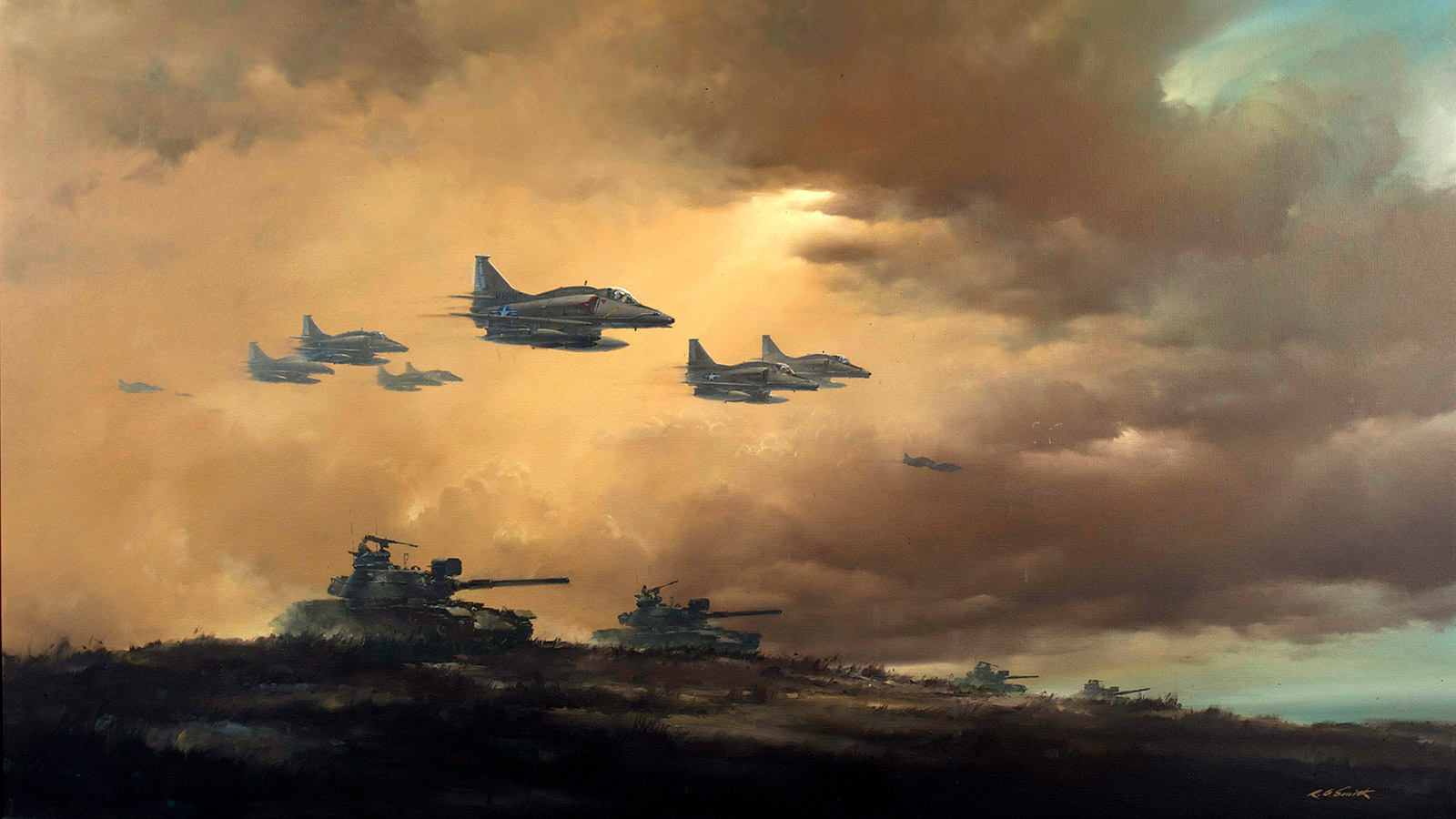
A painting showing military A-4 Skyhawk jets flying above tanks on the ground under a dramatic, cloudy sky at sunset. Robert Grant “R.G.” Smith helped design several military aircraft at Douglas Aircraft Co. and became an accomplished artist. This piece depicts Marine Corps A-4 Skyhawks in the sky over tanks. Smith had a distinctive approach to painting aircraft, capturing the scenes and context in which they flew. All photos courtesy of The Boeing Archives.

Among the many fascinating things found in the Boeing Archives, one collection holds the record as the most beautiful. Before computer design and computer-generated images, company artists were tasked with communicating visions for products through artwork. The Boeing Archives holds thousands of paintings and drawings created to explain engineering concepts and support marketing or advertising.

Many of the pieces of art in the collection were recently scanned as part of a larger digitization effort. Below is a sample of the variety of art created by talented artists over Boeing’s history.
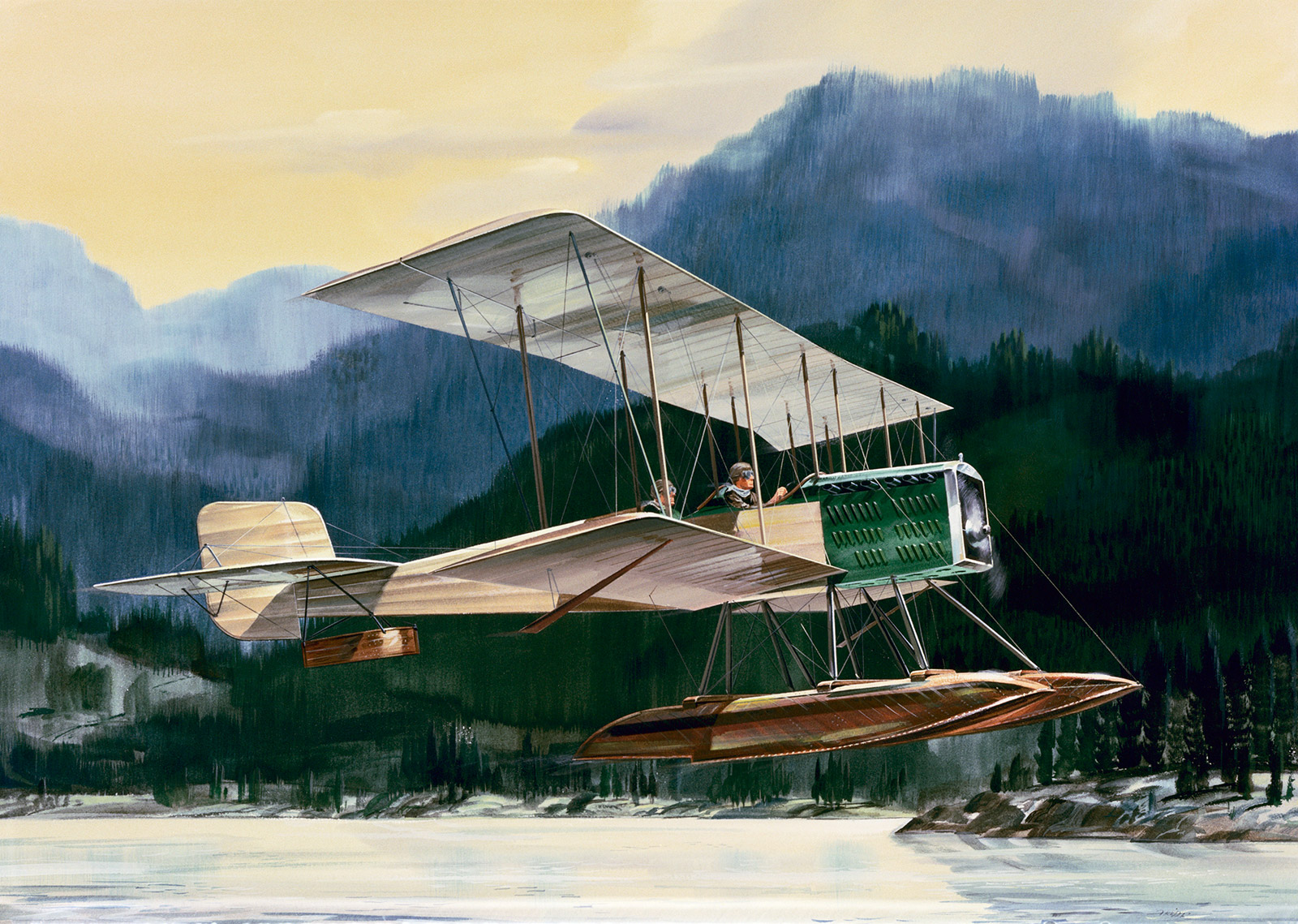
A painting of an early floatplane, the B&W, flying low over a river or lake, with mountains and forested hills in the background.

The B & W was the first Boeing product, named after the initials of its designers, William Boeing and U.S. Navy Lt. Conrad Westervelt. This painting of the B&W is part of the Boeing Historical Watercolor Series, commissioned to commemorate Boeing’s 50th anniversary in 1966.

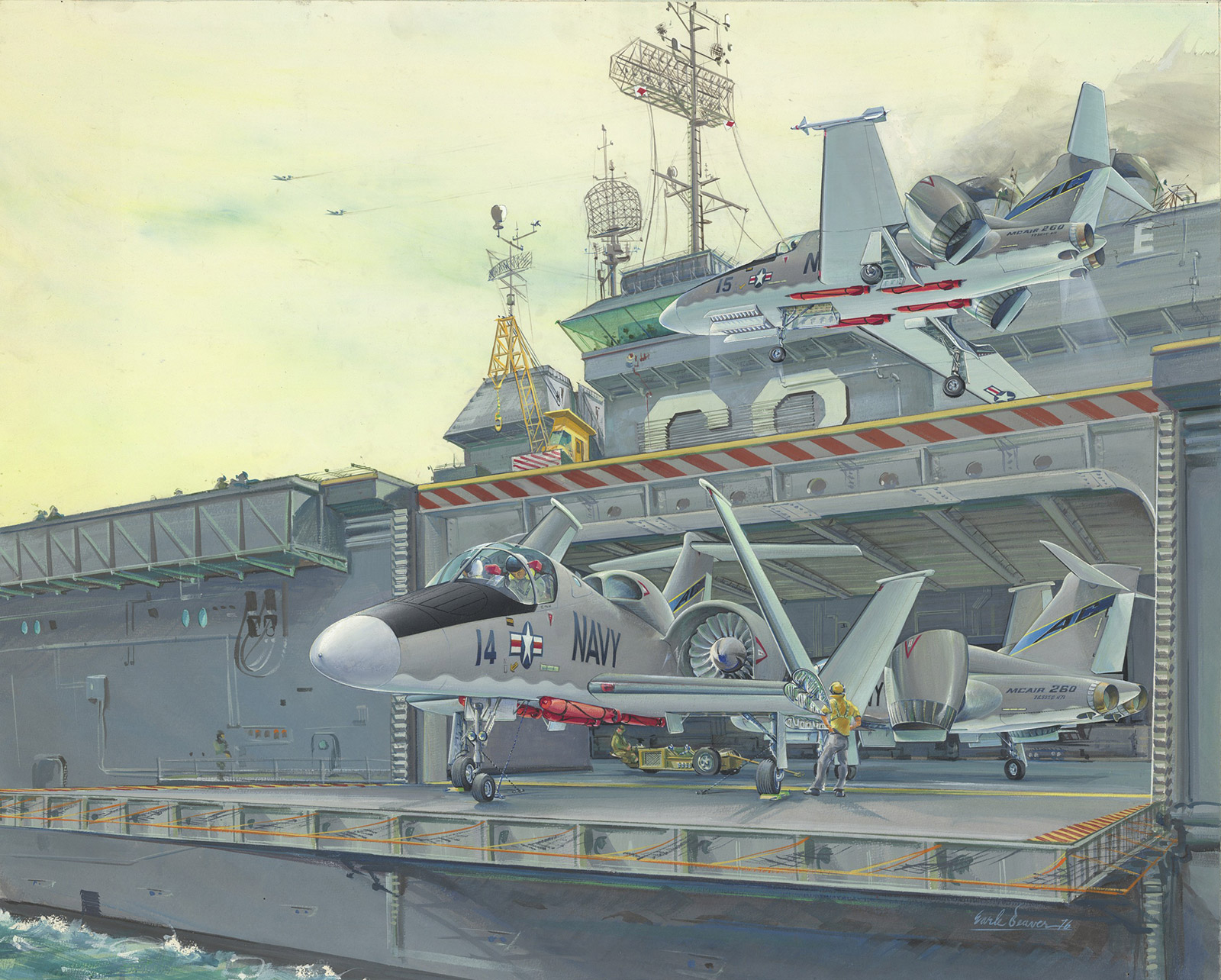
A painting of military vertical lift aircraft, the McDonnell Model 260, on the deck of an aircraft carrier, with crew members working around the planes and the ship’s superstructure in the background.

This concept art by Earle Beaver depicts the McDonnell Model 260, a vertical takeoff and landing (VTOL) aircraft, on a U.S. Navy aircraft carrier. The Model 260 featured a unique lift-cruise-fan propulsion system and was designed for multiple naval missions including anti-submarine warfare and vertical carrier onboard delivery.

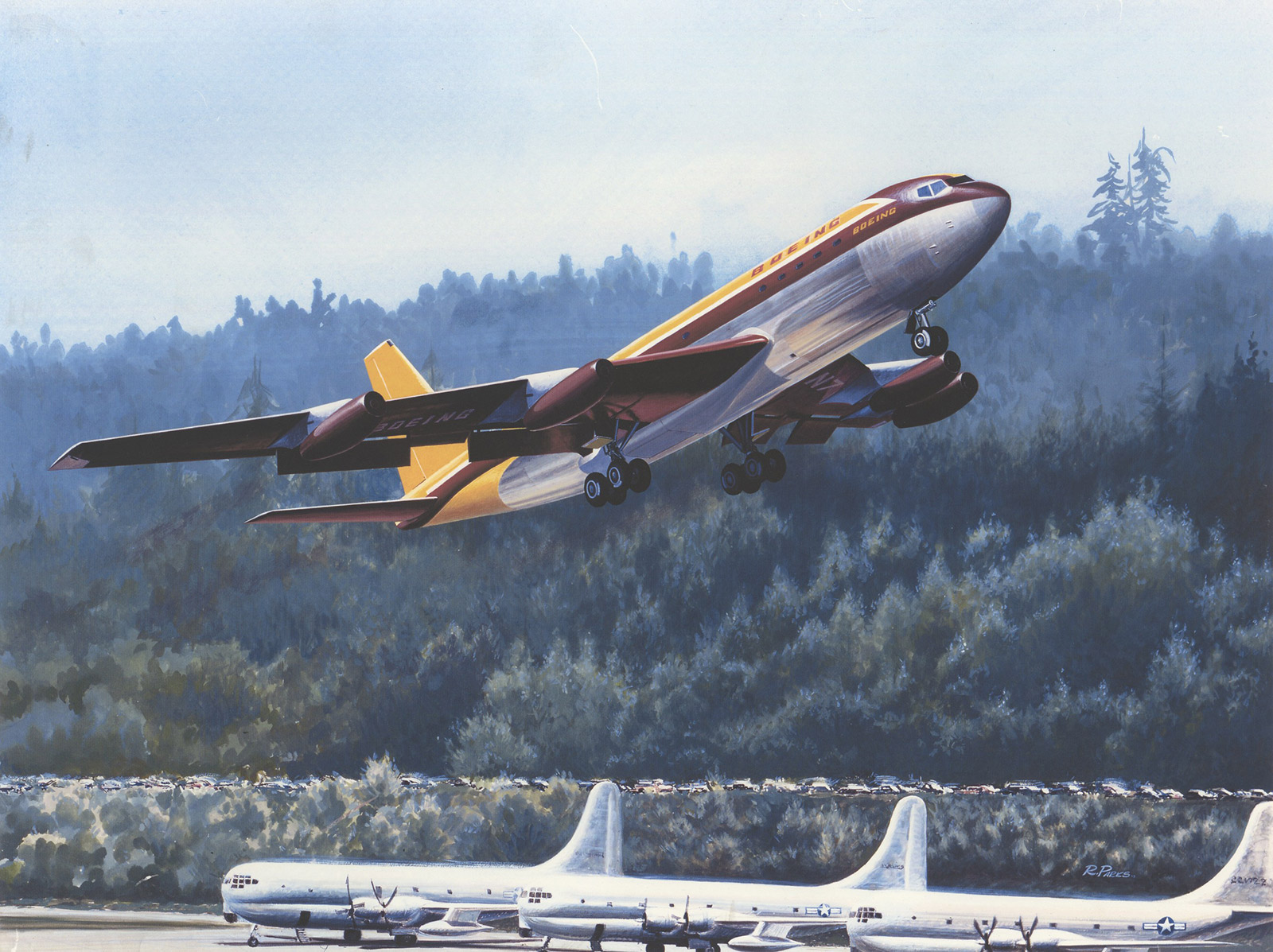
A painting of a commercial jet (Boeing Model 367-80 prototype) taking off over a forested landscape, with several tankers (C-97s) on the ground below.

The Model 367-80 (“Dash 80”) depicted taking off over C-97 Stratofreighters. The Dash 80 served as prototype for the KC-135 Stratotanker and 707 jetliner. Artist Bob Parks started at Boeing in 1950 as a mechanic, and soon became a production illustrator.

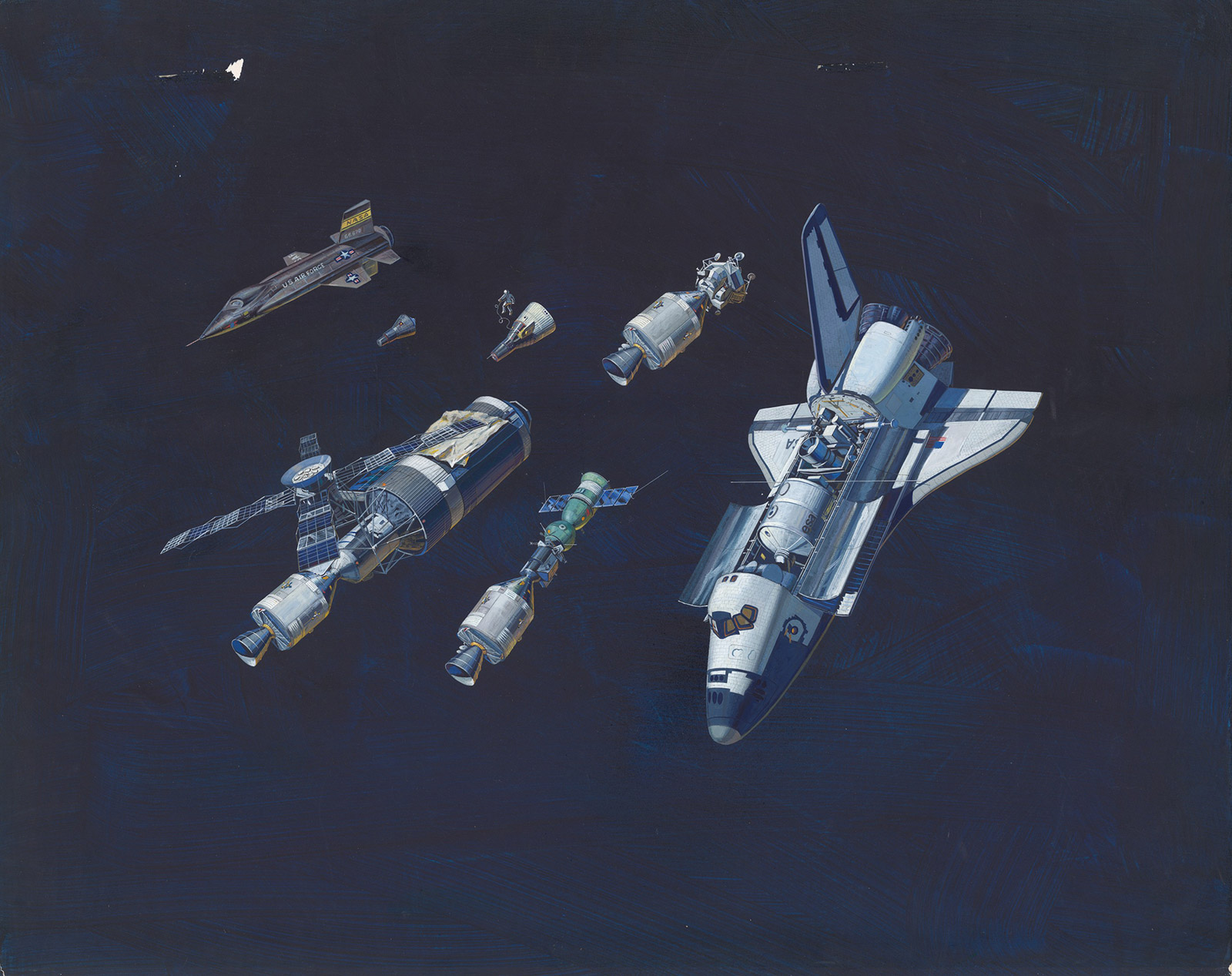
A painting compares the relative sizes of several U.S. spacecraft floating against a dark background, including early capsules, Apollo-era vehicles, Skylab, and an early Space Shuttle concept. The composition emphasizes the scale and evolution of spaceflight hardware through a clean, technical presentation.

This painting shows the relative sizes of U.S. spacecraft. Top row, from left: North American Aviation X-15, McDonnell Aircraft Corp. Mercury Capsule, McDonnell Gemini Capsule with a spacewalker, North American Apollo Command and Service Module with Lunar Module. Bottom row, from left: Skylab, Apollo Soyuz Test Project, early depiction of the Space Shuttle.

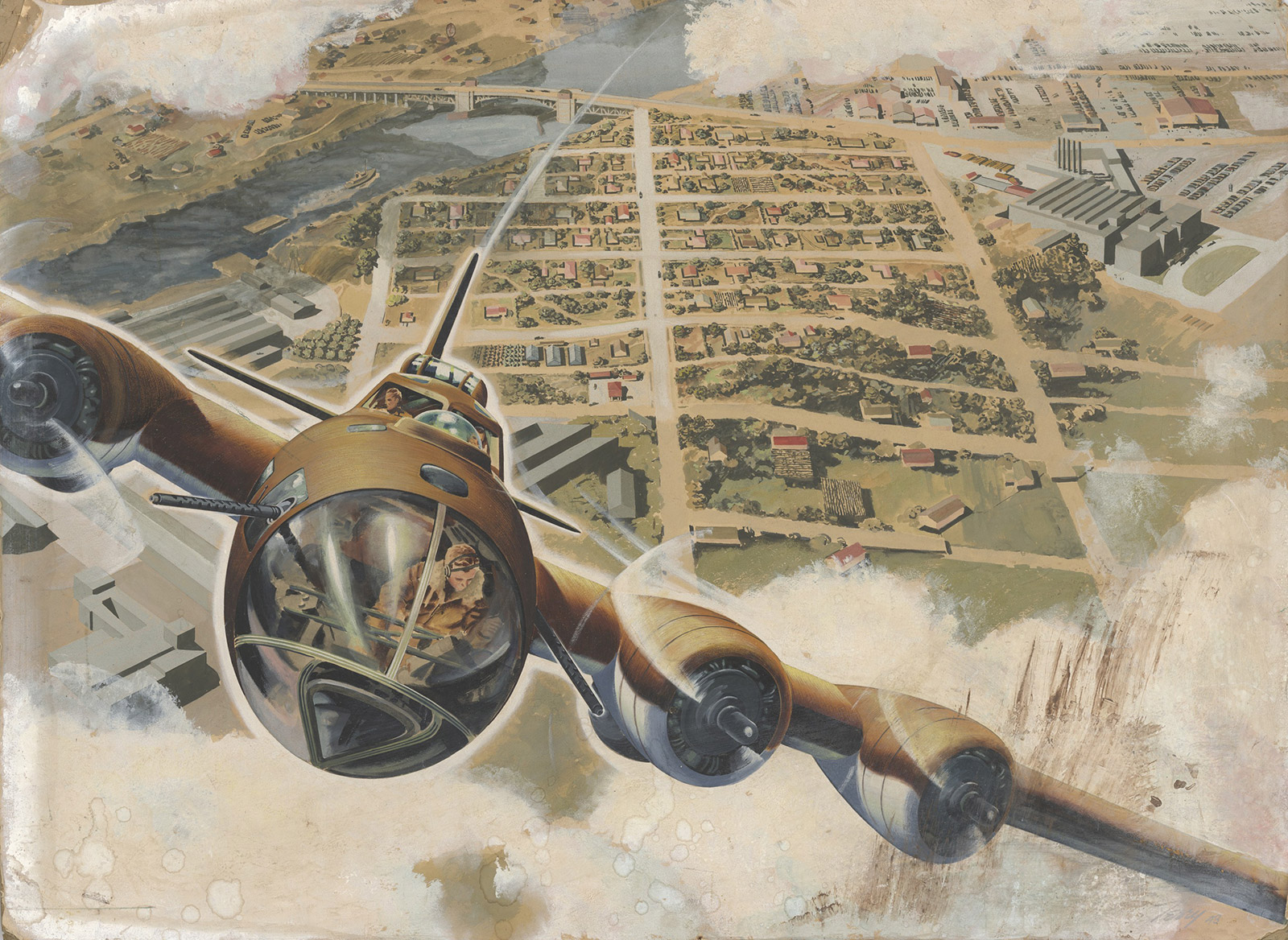
A painting of a B-17 Flying Fortress aircraft flying over a planned city, with the pilot visible in the cockpit and neighborhoods spread out below.

A B-17 flies over Boeing's Plant II factory where it was built, which was camouflaged during World War II to look like a typical Seattle neighborhood. This painting was commissioned prior to the actual rooftop transformation and depicted how the camouflaged factory would appear from the air.

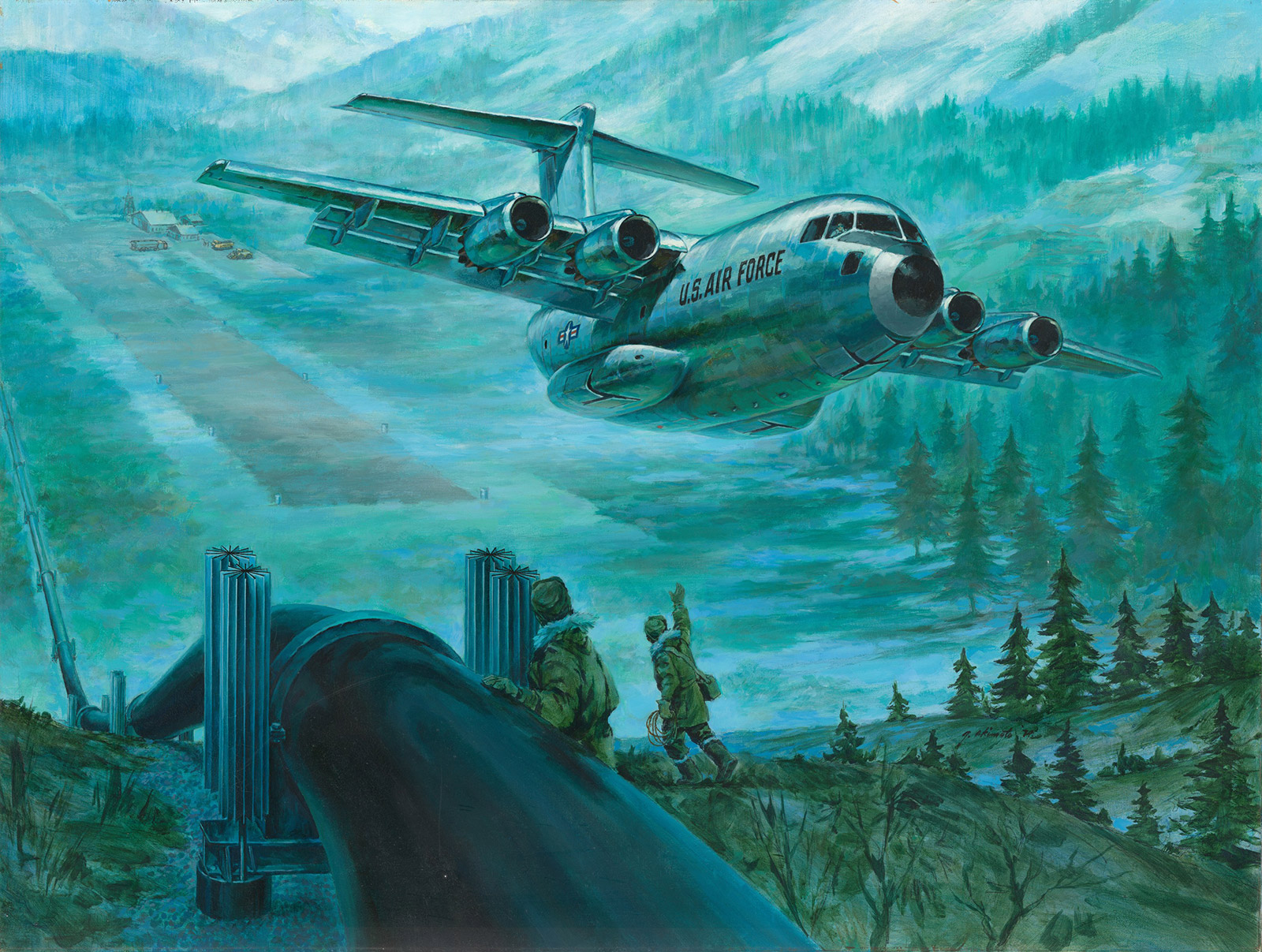
A painting shows a YC-15 aircraft flying low over a misty mountain valley with a runway or road stretching into the distance. In the foreground, two figures stand near a large pipe or structure, adding a sense of scale and drama to the scene.

A YC-15 flies over a pipeline, depicted by artist George Akimoto. Akimoto’s works are easily identified by vibrant colors. The YC-15 was a prototype for the U.S. Air Force that later informed development of the C-17 Globemaster III.

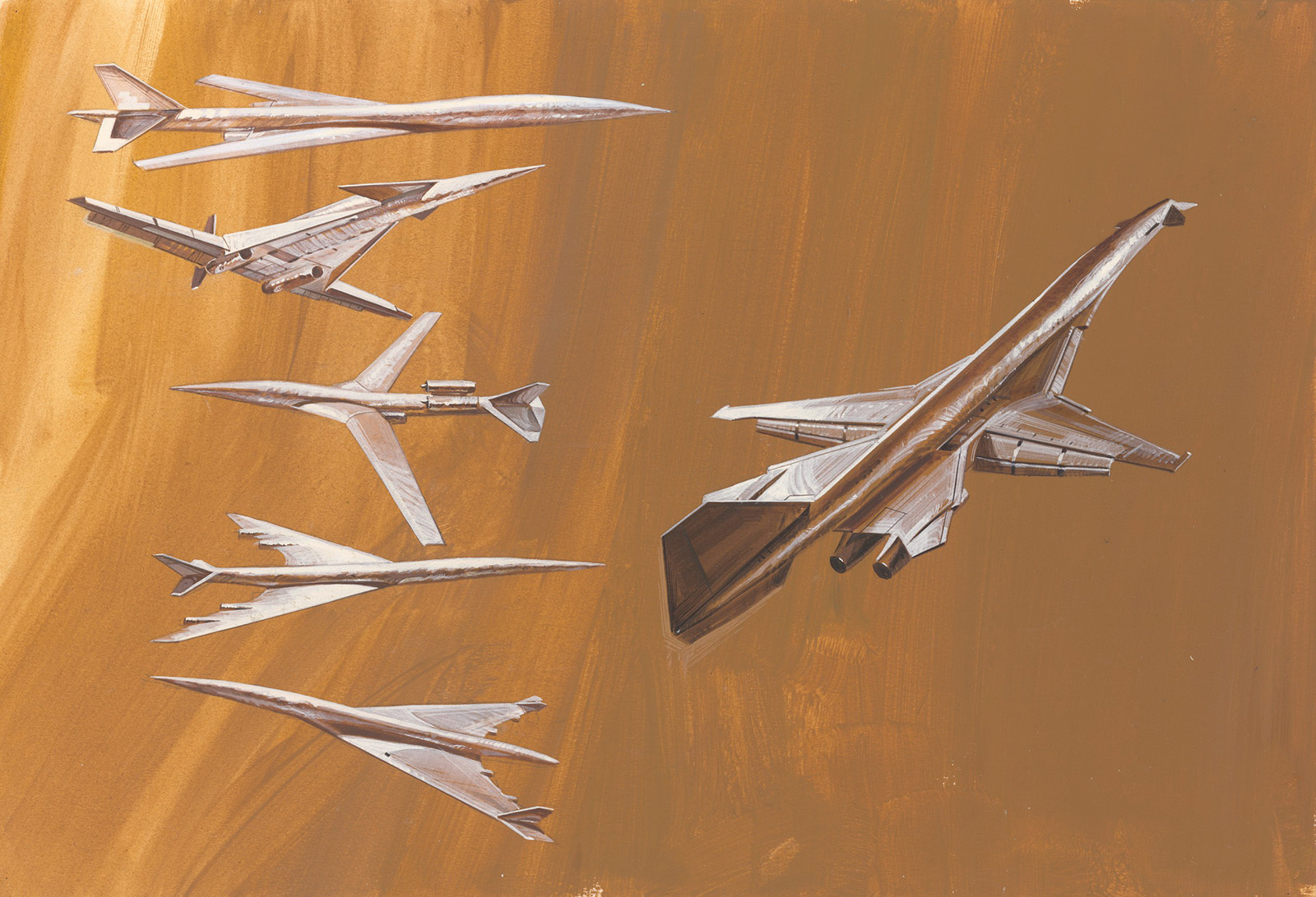
A painting depicts several concept versions of a supersonic transport aircraft arranged across a warm orange background, including one larger aircraft on the right and smaller variations to the left.

Boeing studied multiple versions of the Supersonic Transport (SST) during the 1960s. This painting depicts several concepts including fixed- and swing-wing configurations.

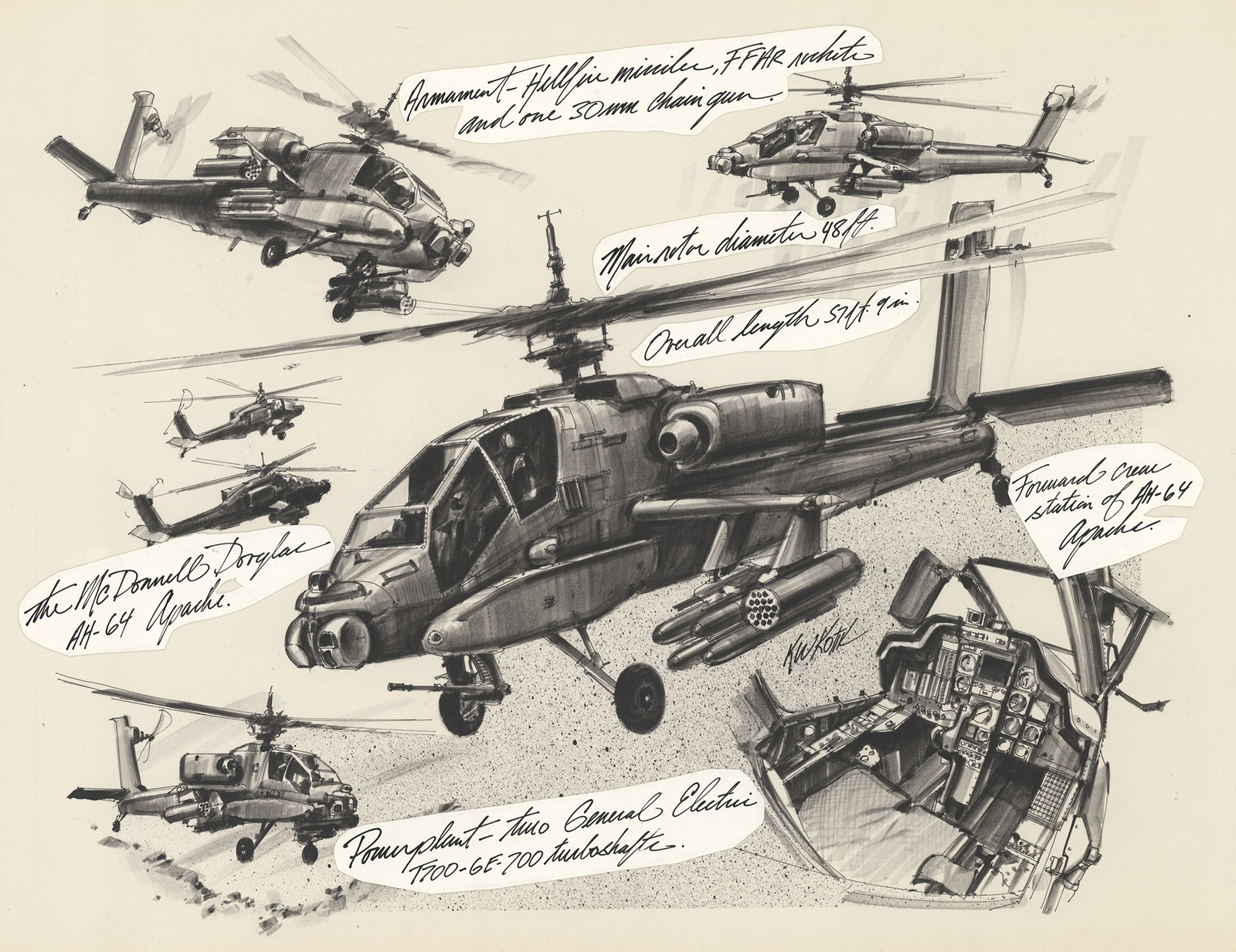
A monochrome drawing shows multiple views of the AH-64 Apache helicopter, with a central detailed rendering surrounded by smaller sketches from different angles and technical callouts.  The technical callouts read: -"Armament - Hellfire missiles, FFAR rockets and one 30 mm chain gun." -"Main rotor diameter 48 ft." -"Overall length 57 ft. 9 in." -"The McDonnell Douglas AH-64 Apache." -"Forward crew station of AH-64 Apache." -"Powerplant - two General Electric T700-GE-700 turboshafts."

Artist Kenneth W. Kotik created pen and ink montages of many McDonnell Douglas and Hughes products, including this piece featuring the AH-64 Apache. Paper labels overlaid on the montage describe attributes of the helicopter.

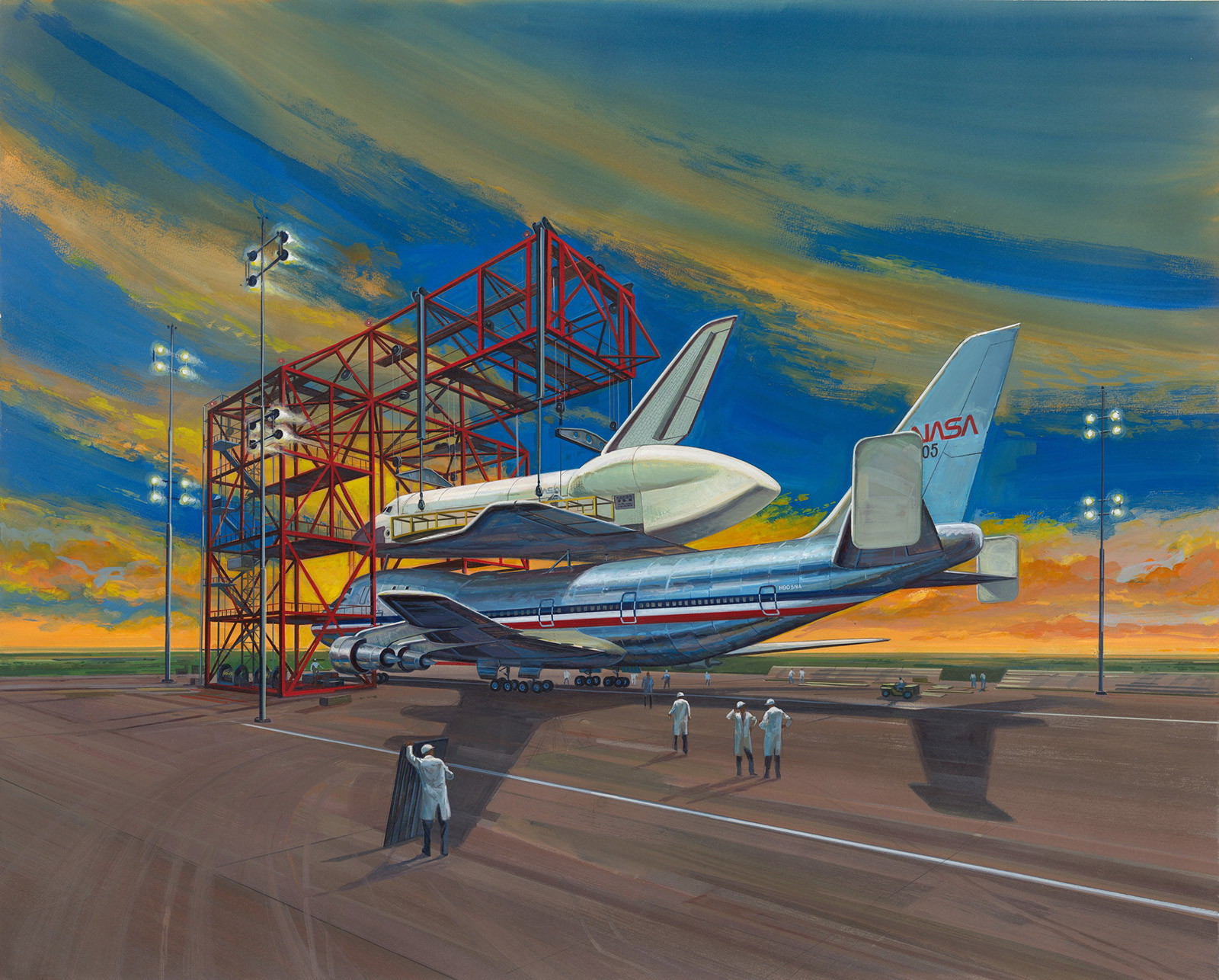
A painting depicts a Space Shuttle Orbiter mounted atop a NASA 747 Shuttle Carrier Aircraft on a runway at sunset, with dramatic clouds and support structures in the background. Small figures and ground equipment add scale to the scene, highlighting the size and complexity of the transport arrangement.

The Shuttle Carrier Aircraft was a modified 747 used to ferry the NASA Space Shuttle Orbiter and carry it to altitude for the initial Approach and Landing Tests. This concept painting depicts a 747 under the Mate-Demate Device, which hoists the orbiter into position.

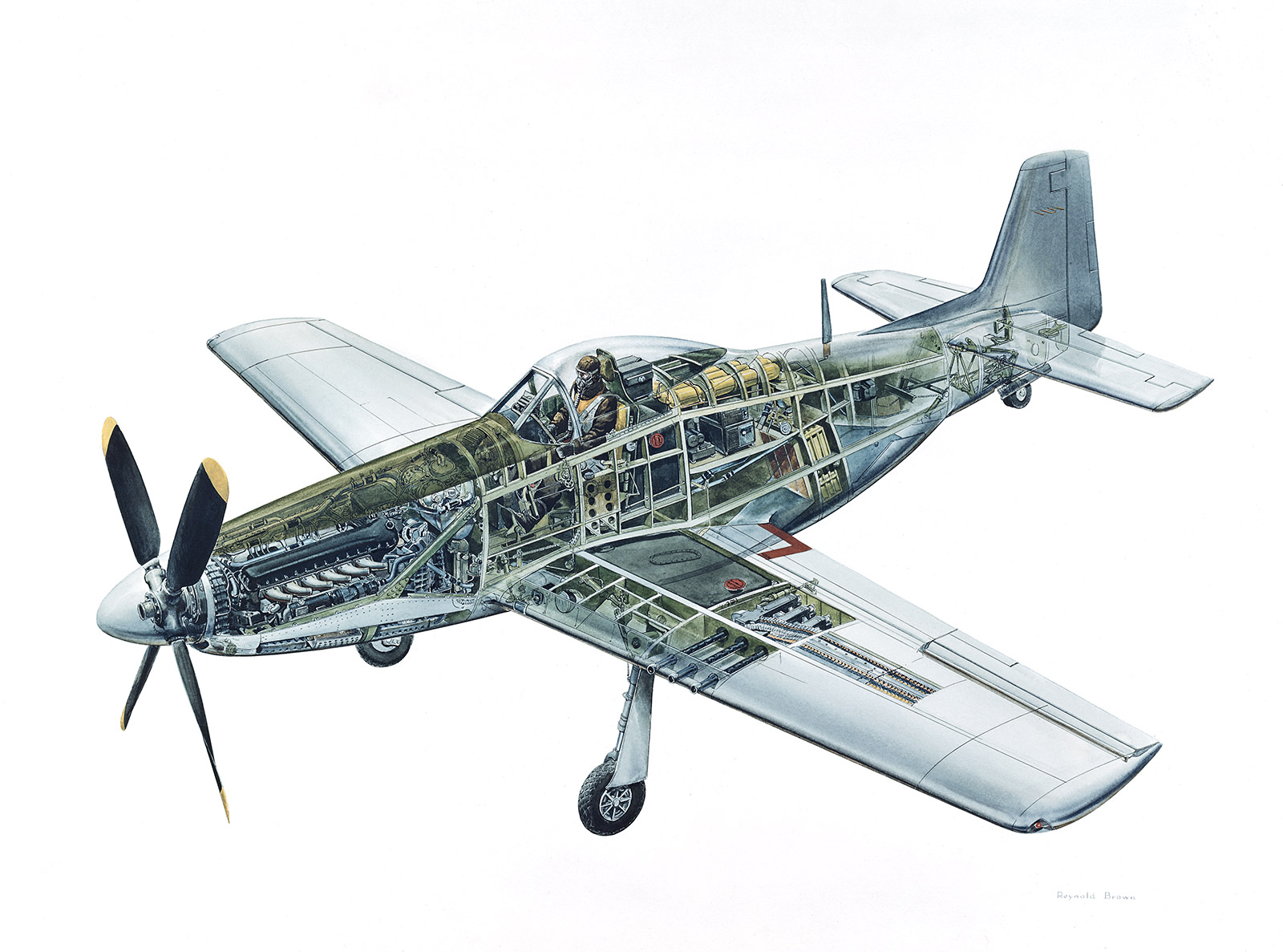
A detailed cutaway painting shows a P-51 Mustang with its internal structure exposed, revealing the engine, cockpit, and fuselage systems beneath the exterior skin. The aircraft is shown in a clean, technical style against a plain background, emphasizing its engineering details.

Prior to CAD and computer graphics, artists like Reynold Brown created detailed production illustrations and sketches like this one of the P-51 Mustang. Over 15,500 were built in support of the war effort by heritage company North American Aviation.

By Allison Balderrama