NASA spotlights future-focused EUS design

Boeing teams will build the Exploration Upper Stage with the enhancements needed to reach deep space.

March 22, 2024 in Space Launch System, Space

While work continues on the core stages for Artemis II and III missions, production of the Exploration Upper Stage (EUS) needed for the Artemis IV mission is also underway at NASA’s Michoud Assembly Facility in New Orleans.

Technical upgrades: As Boeing and NASA teams work together to advance the test articles and flight hardware for EUS, NASA recently marked additional enhancements developed for EUS. These upgrades will enable the evolved iteration of NASA’s Space Launch System (SLS) rocket, known as the Block 1B configuration, to carry larger payloads, co-manifested with the crew capsule, farther and faster into deep space than any other missions.

  • Four times the engines: EUS will have four RL10 engines — so nearly four times more thrust — compared with its predecessor, the Interim Cryogenic Propulsion Stage (ICPS), which has only one RL10 engine.
  • Uplink capability: While it can complete mission tasks autonomously, the upper stage can also be commanded by the ground crews or the human capsule via the uplink capability.
  • Boosted battery: EUS will also have an enhanced battery capacity to power missions up to eight hours in length.
  • More cargo space: The Block 1B configuration of the SLS rocket will feature an evolved universal stage adapter, which will allow EUS to carry more than 10,000 cubic feet of cargo, concurrent with the crew capsule.
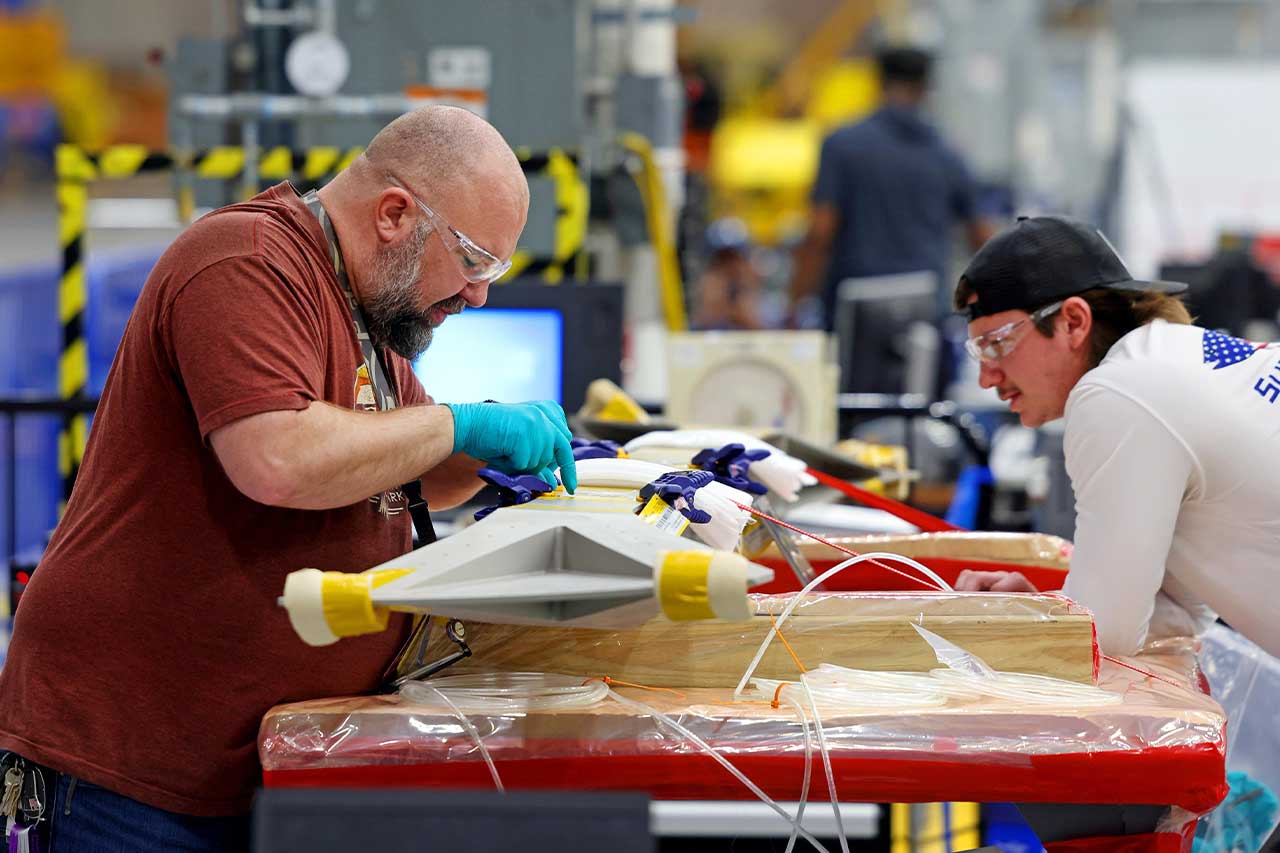
Nasa photo

Artemis mission impacts: More engine power, battery capacity and cargo space — along with the uplink capability — position EUS as the change agent for the Artemis missions’ unique science and exploration objectives.

  • Expanded launch windows: The additional engines and fuel capacity of EUS unlock two launch opportunities per day — compared with more limited launch windows of the current configuration of the SLS rocket with ICPS.
  • Moon and planetary exploring: With the additional payload capacity enabled by EUS, the SLS rocket will be equipped to transport larger components of the future lunar infrastructure — like parts of NASA’s Gateway, the first space station around the moon — as well as telescopes and other supplies needed for science experiments and missions to other deep space planets.

“The upgrades built into EUS solidify the SLS rocket as America’s next-generation, deep-space, super-heavy-lift rocket,” said Jerald Webber, Boeing’s director for the SLS Block 1B program. “We are building EUS with the future in mind — prioritizing crew safety, mission assurance and scientific exploration above all else while designing the vehicle to perform deep space missions we at one time only dreamed of accomplishing.”

NASA’s Space Launch System (SLS) rocket — the nation’s next-generation, super-heavy-lift rocket — will enable NASA’s Artemis campaign and will carry people and cargo to the moon, Mars and beyond. Boeing was selected by NASA to design, develop, test and produce the core stages, upper stages and avionics suite for the SLS fleet of rockets. The first SLS rocket — featuring the Boeing-built core stage — successfully launched at 1:47 a.m. Eastern time Nov. 16, 2022, as part of the Artemis I mission. Production is currently underway for the Boeing-built core stages; upper stages, including the Exploration Upper Stage, which enables a 40% increase in payload capacity for the SLS rocket’s Block 1B configuration, propelling deep space exploration to new heights; and avionics for future Artemis missions. Learn more about SLS.